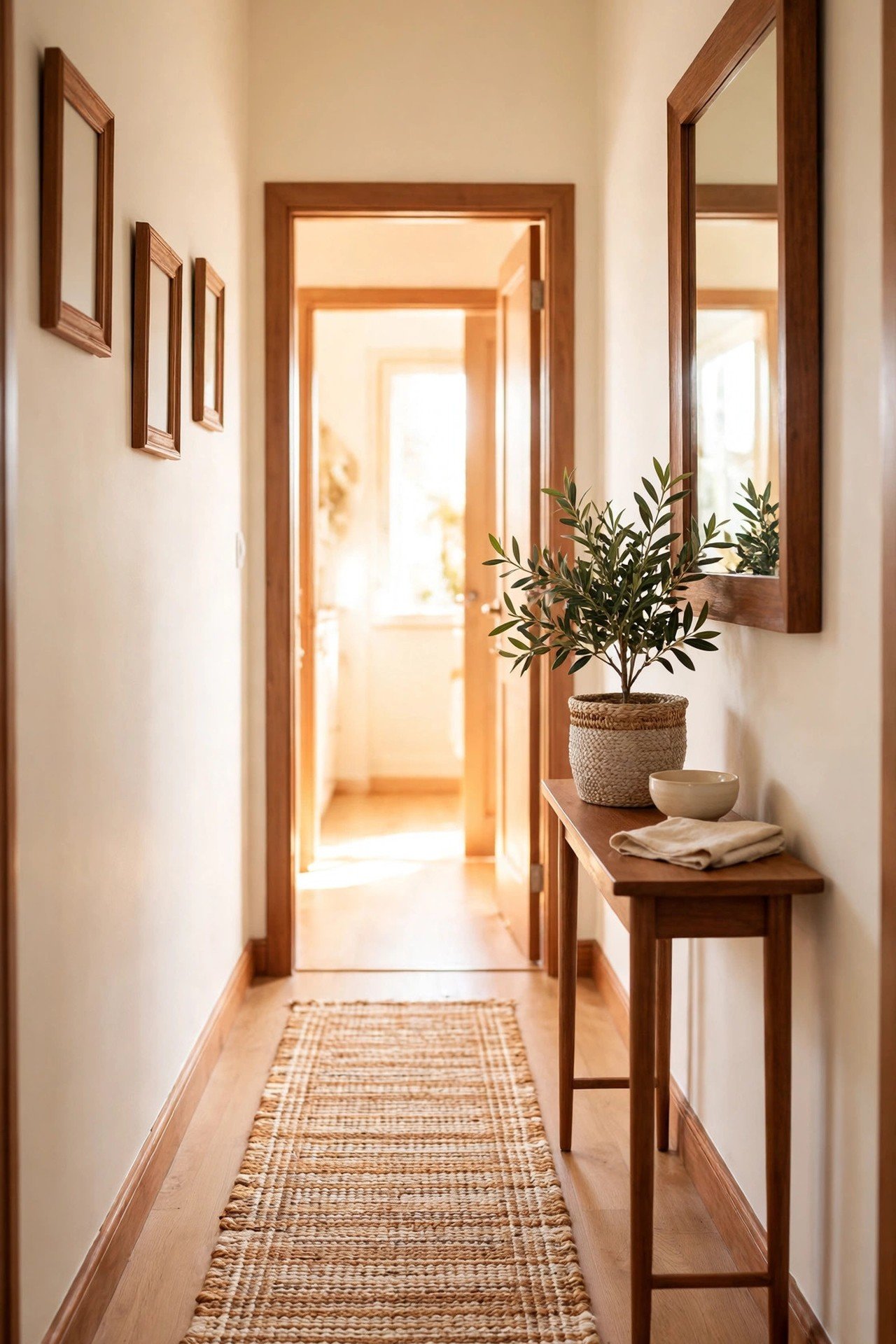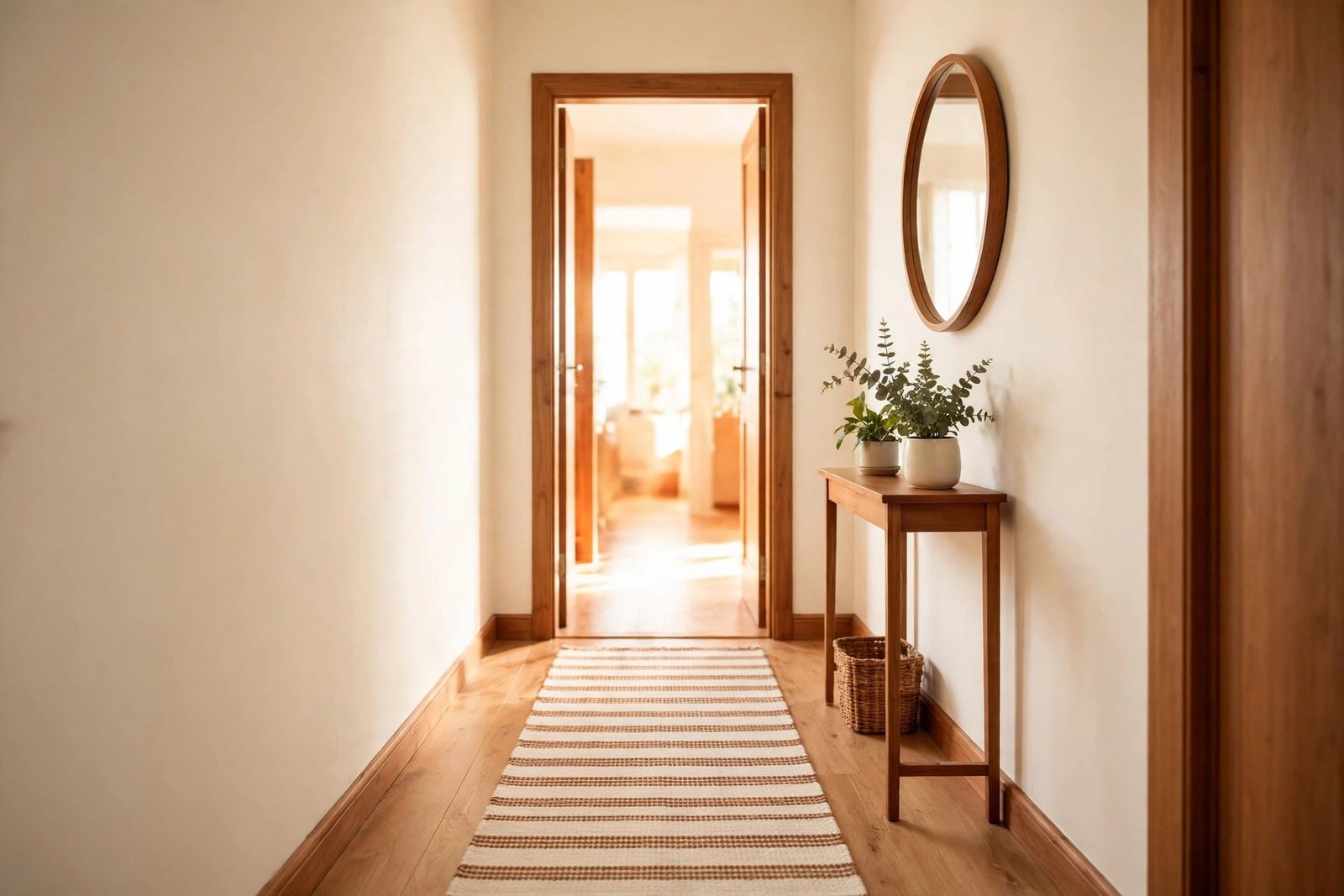
A narrow hallway is the hardest-working space in a home and the least loved. It has no window, no room for furniture, and just enough width to feel like the inside of a pipe — yet every day starts and ends by walking through it, and it is the first thing every visitor sees. The good news is that a hallway does not need width. It needs light, long lines, and one good view at the end of it. Get those three, and the narrowness stops being the story.
This guide covers the four levers: lighting a windowless passage, the end wall (the most important wall in the home, centimetre for centimetre), runner direction, and the colour of walls and doors. Decor only — no building work. If your hallway doubles as your entrance, pair these ideas with an entryway makeover on a budget, which handles the shoes, coats, and keys side of the same space.
Quick Answer
To make a narrow hallway look wider and brighter, light it like a room, not a corridor: two or three warm ceiling lights spaced along its length, or wall lights at eye level, instead of one bulb in the middle. Paint the side walls a pale warm colour and give the end wall the main event — a big picture, a mirror, or a slightly deeper colour — so the eye travels to a destination instead of measuring the walls. Run a pale runner lengthways down the middle to lengthen the floor. Paint doors the same colour as the walls so they stop chopping the passage into slices. Keep all decor flat against the walls: one row of pictures at eye level, shallow hooks, nothing that narrows the walking line.
Light a Passage With No Window
Most narrow hallways have exactly one ceiling light, placed in the middle, and it produces exactly one effect: a bright pool in the centre and gloom at both ends, with shadows pooled behind anyone walking through. The passage is not badly lit because it lacks windows; it is badly lit because it is lit like a cupboard.
Spread the light along the length
The single most effective change is more light points, evenly spaced. Two or three modest ceiling lights along a long hallway — or a simple track or a row of small flush fittings — light the whole passage evenly, and even light reads as width because the eye can see both walls everywhere. If new fittings are not an option, one existing fitting can still work harder: use the brightest warm bulb it allows and an opal shade that spreads light sideways onto the walls rather than down onto the floor. Light on the walls is what a hallway needs; light on the floor just shows the carpet.
Wall lights and borrowed light
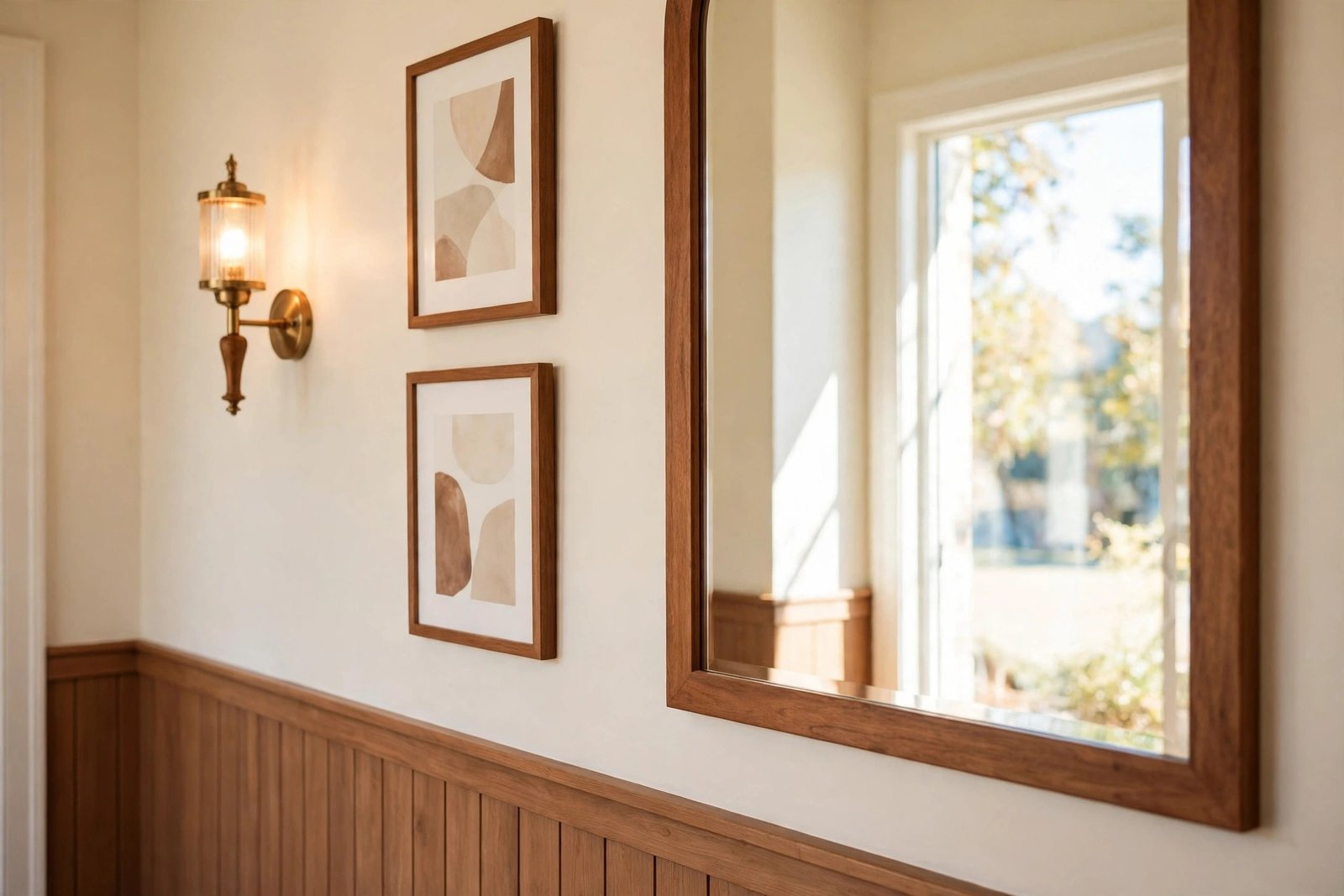
Wall lights at eye level do something ceiling lights cannot: they put brightness where faces are, which makes a passage feel like a place instead of a tunnel. Plug-in or battery wall lights exist for exactly this job and need no wiring, though in most homes a hallway already has the sockets to make plug-in versions easy. Then borrow light wherever you can. A glazed door at the end of the hall lets a room’s daylight spill into the passage. Failing that, a mirror on the end wall reflects whatever light exists and returns it down the passage. In a dark hall, decor that moves light matters as much as decor that makes it — the same principle used to fix any small room that is dark and boxy.
The End Wall: Give the Eye a Destination
Stand in your hallway and look along it. Whatever is on the far wall is the picture the whole passage frames — and in most homes it is a blank wall, a radiator, or the side of a wardrobe. A blank end makes a hallway feel like a dead end, and the eye, with nowhere to land, measures the side walls instead. That measurement is the narrowness.
Give the end wall one strong, simple treatment. The best options: one large picture at eye level, wide rather than tall, in a light frame; a big mirror, which adds a reflected view and doubles the sense of distance; or a slightly deeper colour than the side walls, which can work at the end of a hall because it reads as a deliberate destination rather than a wall closing in. What matters is scale and singleness: one big piece, not six small ones — a crowd of little frames makes a small wall look smaller.
If the end wall holds a door, make the door the treatment: paint it a warm accent colour, hang a wreath or one simple picture on it, and put the best light nearest to it. People decorate rooms and forget that in a hallway, the door at the end is the artwork.
Floor and Runner: Direction Is Everything
Floors in a hallway have one job: pull the eye along. A pale runner running lengthways, centred, with a border of floor visible on both sides, is the classic tool because it works like a road — long lines leading forward. Stripes, if you like them, should run along the length too, never across: crossways stripes are rungs on a ladder, and they measure the hall’s width stripe by stripe.
Keep the runner long — ideally most of the hallway’s length — and flat-weave, so doors swing over it. Continuous flooring that runs into the rooms off the hall, rather than stopping at each doorway, also makes the passage feel like part of the home. And if the floor is dark and staying, the pale runner and walls must work twice as hard — make them genuinely pale, not mid-toned.
Walls and Doors: Stop Slicing the Passage
Every door in a hallway is a vertical interruption, and four doors in four colours chop a passage into slices. The old decorator’s trick is simple: paint the doors the same colour as the walls, frames included, so they nearly disappear and the walls read as two long unbroken lines. If all one colour feels too plain, keep the doors pale but one shade deeper — they read as soft shadows rather than slices.
On the side walls, pale and warm beats bright white, which under bulbs can turn grey and cold. Warm white, pale cream, or the softest greige bounce warm light kindly. Keep the finish matte-to-satin: a slight sheen reflects more light, while full gloss shows every bump. Skirting boards painted the same colour as the wall remove one more horizontal chop line and make the wall read taller.
Decor That Adds Width Without Taking Space
A hallway cannot spare a centimetre, so its decor must be flat. One row of pictures along one wall, hung in a straight line at eye level with even gaps, leads the eye forward like stepping stones; the same pictures scattered at random heights make the wall — and the passage — feel jittery and narrower. Keep frames slim and light in colour, and put the family-photo wall here if you want one: a hallway is the one place a gallery row is genuinely walked past and enjoyed.
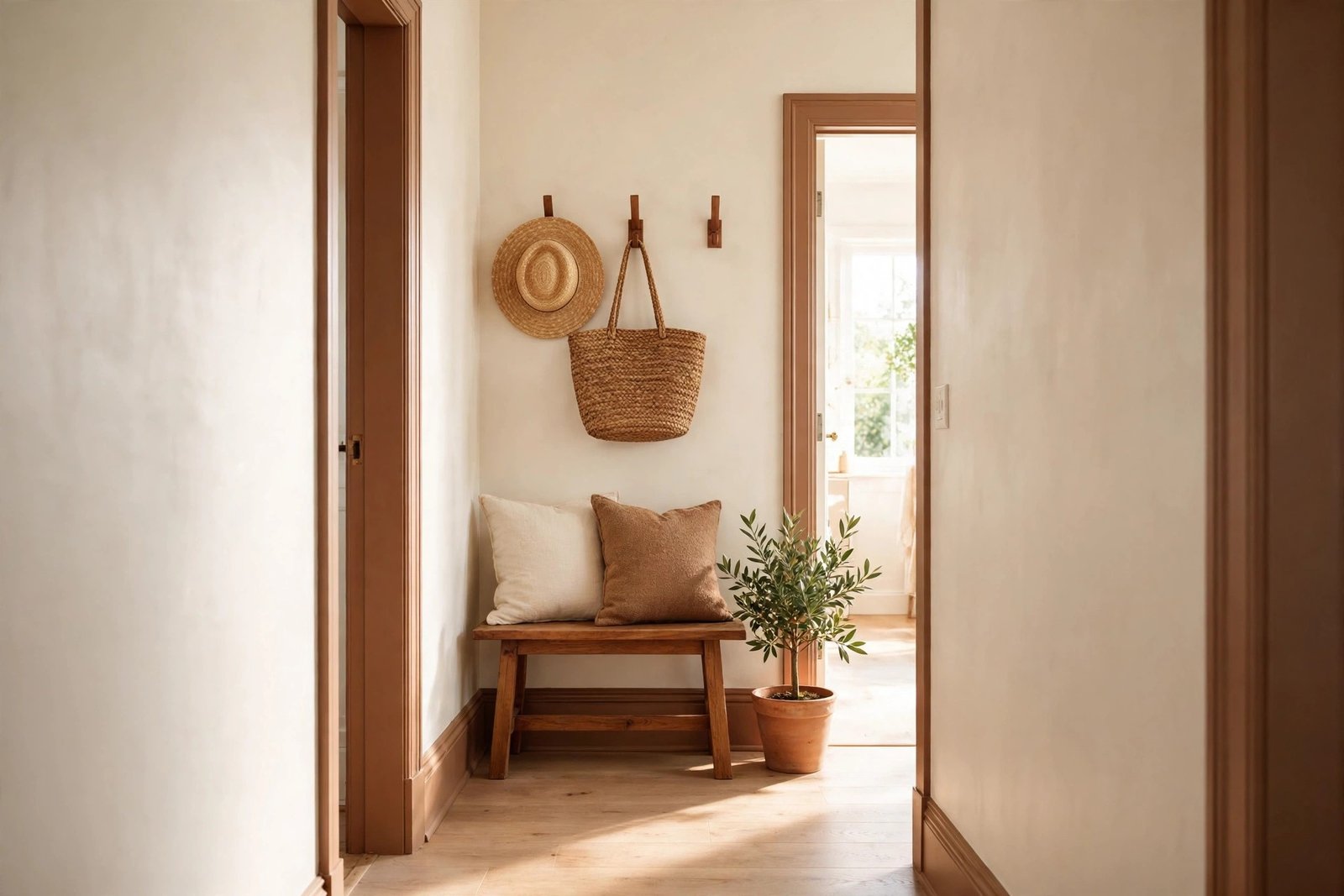
Everything else must earn its millimetres. Hooks should be shallow and, where possible, behind doors rather than along the walking line. A narrow picture ledge holds a display within a few centimetres of the wall. And the golden rule: nothing on the floor except the runner — one basket or shoe pile reduces the hall to the width that remains, and that remainder is what everyone feels.
A Sample Small Budget for a Narrow Hallway
- Light: $10–$25 — the brightest warm bulbs the fittings allow, one opal shade, or one plug-in wall light for the darkest stretch.
- Paint: $20–$35 — pale warm paint for walls and doors in one colour; use leftovers for the end wall accent if you want one.
- Runner: $15–$30 — pale, flat-weave, as long as the hall allows, washable.
- End wall: $0–$25 — one large picture or mirror, moved from another room before buying.
- Gallery row: $0–$10 — slim matching frames for pictures you already own.
All of these methods, with the rest of the small-space series, are gathered under small-space decor ideas that work.
Mistakes to Avoid
- One bulb in the middle. It lights a pool and abandons both ends. Spread light along the passage, or at least spread it sideways onto the walls.
- A crossways-striped or short runner. Short runners chop the floor into segments; crossways lines measure the width. Long and lengthways, always.
- Doors in several colours. Each contrast door is a slice across the passage. Doors painted to blend with the walls lengthen everything.
- A blank end wall. With no destination, the eye measures the side walls — which is the one measurement you do not want anyone making.
- Many small pictures at random heights. Visual jitter narrows a passage. One straight eye-level row leads the eye forward instead.
- Anything stored on the floor. Shoes, baskets, and boxes reduce the hallway to the width left over, and that leftover width is the one everyone experiences.
Frequently Asked Questions
What colour makes a narrow hallway look wider?
A pale warm colour — warm white, pale cream, or soft greige — on both side walls, with the doors and frames painted the same colour so the walls read as two unbroken lines. Keep the end wall either the same pale colour with one large picture or mirror, or one shade deeper as a deliberate focal point.
Should a hallway runner have stripes?
Only lengthways ones. Stripes running along the hall stretch it; stripes running across it act like measurement marks and emphasise the width. A plain pale runner works just as well — length and lightness matter more than pattern.
How can I light a hallway with only one ceiling fitting?
Fit the brightest warm bulb the fitting allows, in an opal shade that throws light sideways onto the walls. Then add light that needs no wiring: a plug-in wall light near the darkest end, a small lamp on any nearby surface that spills through a doorway, and a mirror positioned to return that light down the passage.
Is a mirror a good idea in a narrow hallway?
Yes, if it is large and in the right place: on the end wall, where it creates a reflected view and a sense of distance, or flat on a side wall beside a doorway where it can catch light. Avoid several small mirrors along the side walls — they fragment the passage and return a broken view of whoever walks past.