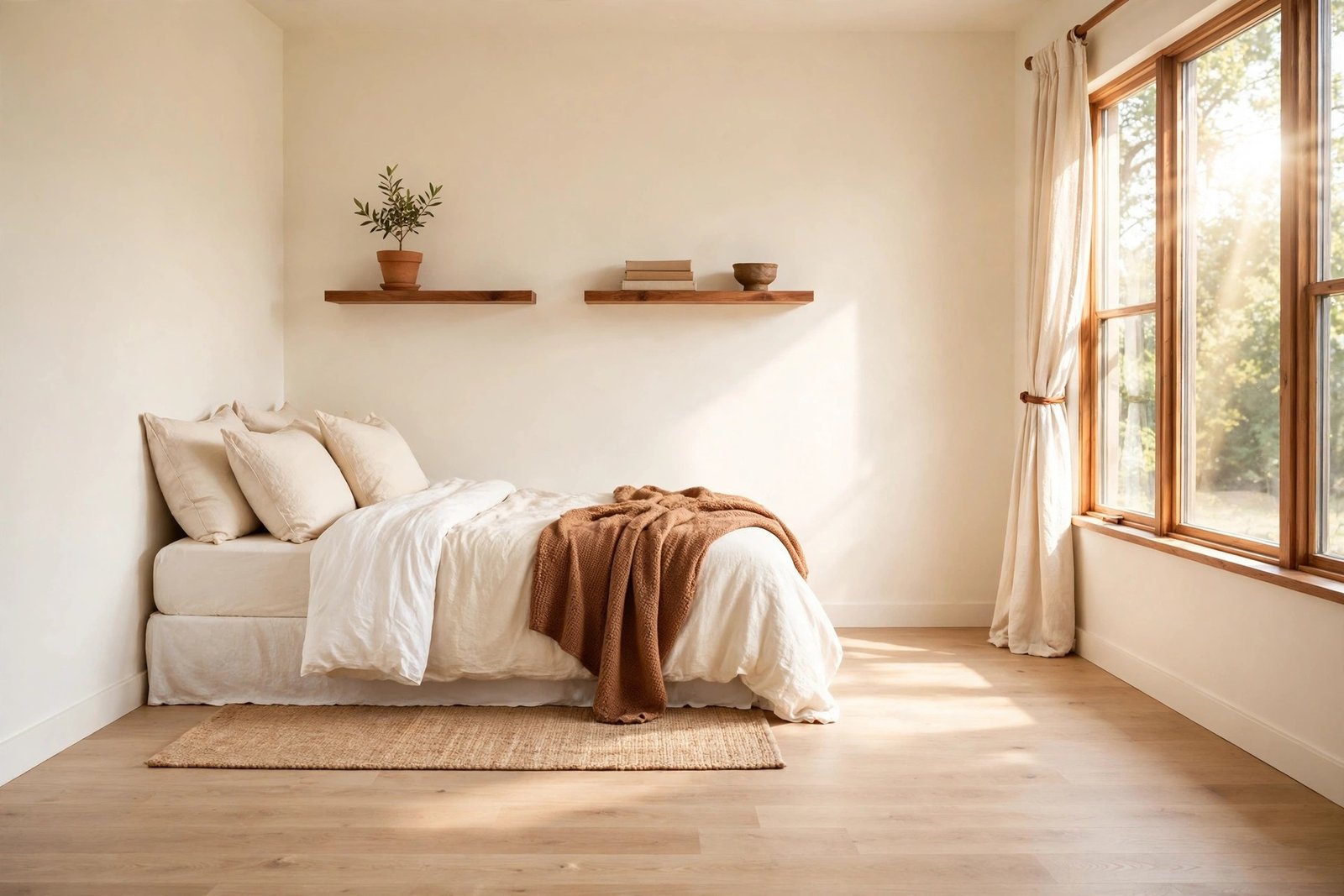
A tiny bedroom has a special kind of problem. The bed takes up most of the floor, the wardrobe takes the rest, and what is left is a narrow path you shuffle along sideways. The room can be clean and still feel like a storage box you sleep in. The good news: a small bedroom rarely needs more space. It needs decor that stops fighting the bed and starts using the walls, the light, and the few strips of floor that remain.
This guide works through the fixes in the order they matter: first the bed itself, because it is the giant in the room, then the walls, then the leftover floor, then colour and light. Most of it costs nothing; the rest is small money, spent in the same spirit as a bedroom makeover under $50 — small changes, done in the right order, that make the room feel new.
Quick Answer
To open up a tiny bedroom with no floor space, decorate around the bed instead of against it. Dress the bed in one pale, calm colour so it reads as one soft surface. Keep the headboard low or remove it. Move everything you can onto the walls: wall lamps instead of table lamps, a floating shelf instead of a bulky nightstand, one tall mirror instead of small pictures. Hang curtains high and close to the ceiling to stretch the walls upward. Use a narrow runner beside the bed, not a rug that disappears under it. Finally, light the room in layers — a ceiling light plus one warm lamp at pillow height — so the corners stop closing in.
The Bed Is the Giant: Work With It, Not Against It
In a tiny bedroom the bed is not one piece of furniture among many. It is most of the room. That means its colour, height, and styling decide how big the room feels, more than anything else you own.
Make the bed one calm surface
A bed dressed in four clashing colours and a busy pattern looks like a pile. The same bed in one pale colour family — white, cream, soft stone, pale sage — reads as one smooth, quiet surface, and quiet surfaces make rooms feel bigger. Keep the duvet cover plain, add one throw in a slightly deeper shade, and limit cushions to two — a mountain of decorative pillows makes the bed look like it is overflowing.
Lower the profile
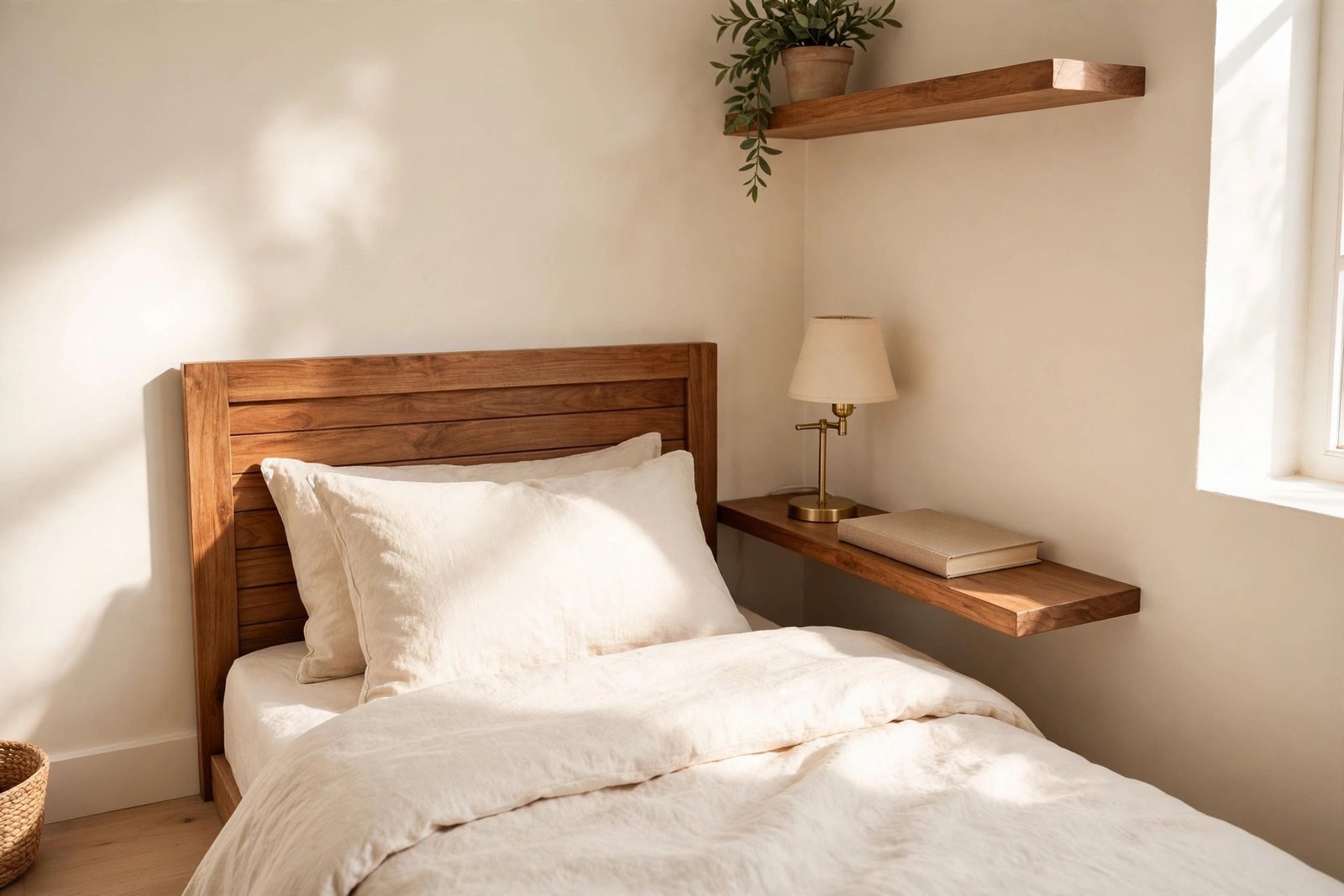
Height is pressure in a small room. A tall, heavy headboard eats visual space and shortens the wall behind it. If yours is bulky, remove it and hang one wide picture or a simple fabric panel at pillow height instead. If the bed frame is high, a plain, light-coloured bed skirt or a fitted throw that reaches the floor gives it a clean, low block shape instead of a tangle of legs and boxes underneath. What is under the bed should not be visible: visible storage makes the whole room look like storage.
Free the sides of the bed
Two chunky nightstands can take a quarter of the floor in a tiny room. Replace at least one with a floating shelf at mattress height — big enough for a book, a glass of water, and a phone, and nothing else. If a shelf is not possible, choose the narrowest nightstand you can find, ideally on legs so the floor shows beneath it. Visible floor, even a strip, tells the eye the room continues.
Move the Decor Up: Walls Do the Work Floors Cannot
When the floor is full, the walls are free. Every item that moves from a surface to a wall gives back breathing room.
Wall lamps instead of table lamps
Plug-in wall lamps on either side of the bed free the nightstand completely and pull the eye upward. They do not need an electrician; most fix with two screws and plug into a normal socket, with the cord dropped neatly behind the bed. Adhesive cord channels keep the cord tidy. Warm bulbs at pillow height make a tiny room feel like a place to rest, not a box to store a bed in.
One tall piece beats five small ones
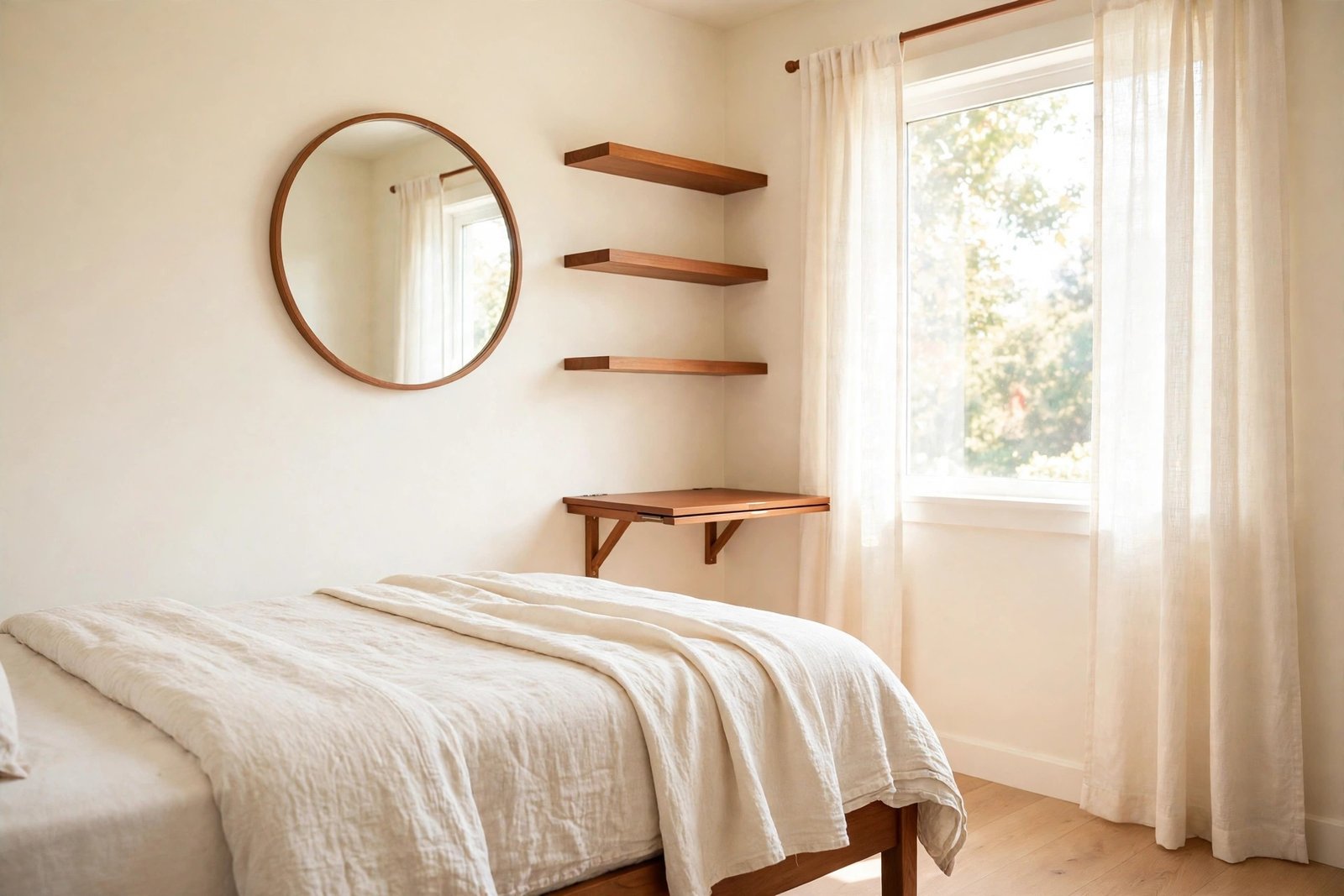
Small pictures scattered over a wall chop it into fragments, and fragments feel small. Choose one tall mirror or one large picture hung vertically. A tall mirror beside or opposite the window bounces light into the room and gives back a reflected view the eye reads as extra space. Hung higher than feels natural, it also stretches the wall — eyes judge a room by its longest lines.
Use the wall above the bed and the door wall
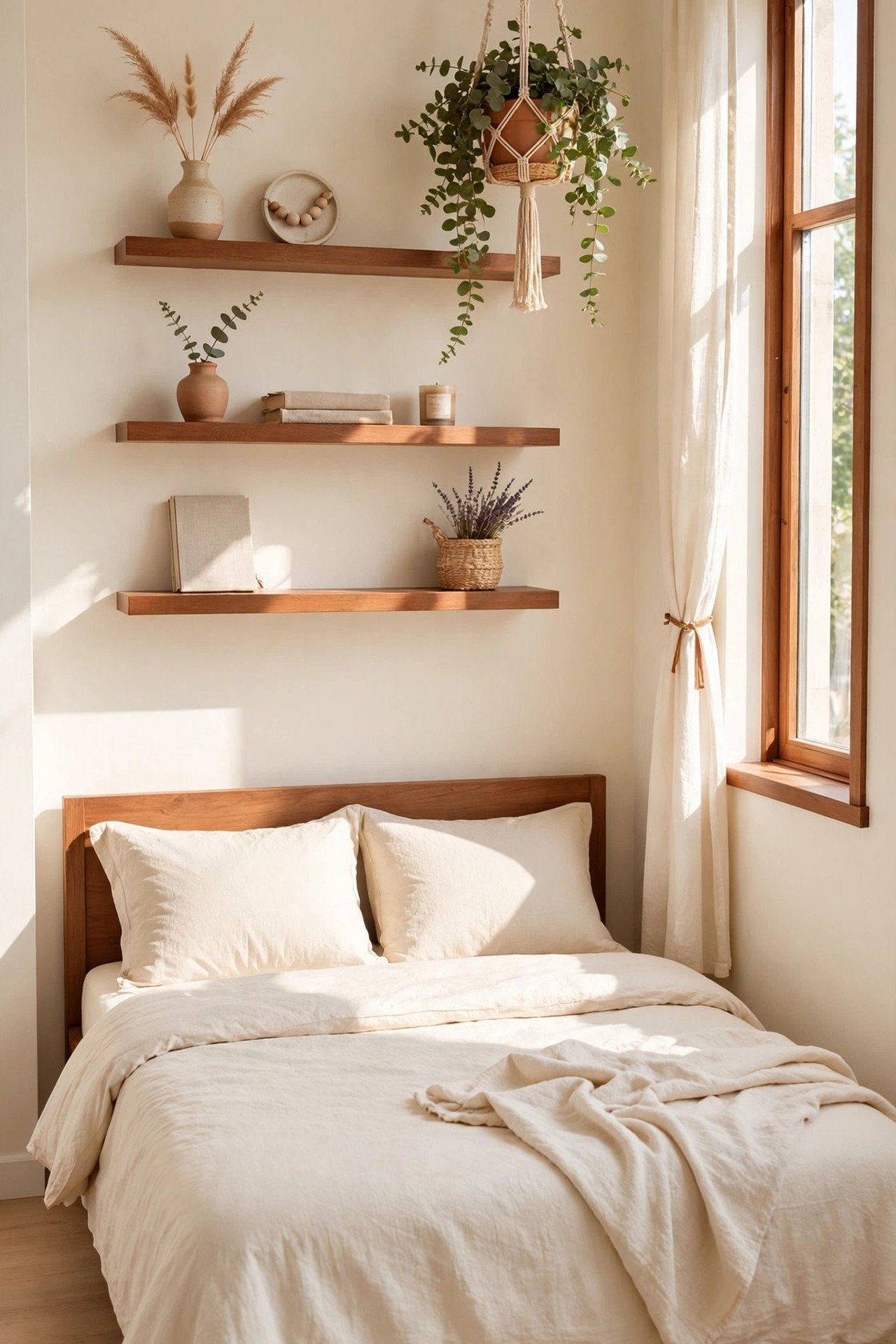
The wall above the headboard is the one wall every bedroom has spare. One wide, calm picture there, hung low enough to connect with the bed, turns the bed into a finished scene instead of furniture parked in a corner. The wall behind the door is forgotten space too: slim hooks there hold tomorrow’s clothes off the floor and off the bed.
The Forgotten Strips: Foot of the Bed and Walking Lines
Look at the floor that is left. Usually it is three strips: one side of the bed, the foot, and the path from the door. Decorating those strips well makes the whole room feel planned.
At the foot of the bed, a narrow bench gives the bed a finished end and a place to sit — but only if you can still walk past it comfortably. If the gap is under a stride, skip the bench and lay a washable runner across the foot instead, slightly wider than the bed on each side, framing it like a picture. Beside the bed, a long narrow runner softens the path you walk barefoot every morning.
Keep every walking line honest. If you have to turn sideways anywhere, something is in the way — usually a laundry basket or a chair doing nothing. The chair is the classic problem: it holds no one, collects clothes, and blocks a corner. Move it out and the corner can hold a tall plant or simply stay empty. Empty corners are not wasted space in a tiny room. They are the space.
Colour and Curtains: Stretch the Box Upward
Bedrooms this size benefit from the simplest colour plan there is: one pale colour on the walls, bedding in the same family, and one deeper accent in two or three small places only — a throw, a cushion, a picture frame. When walls, bed, and curtains sit in one family, the eye stops finding edges, and a room without visible edges feels larger. If the room is dark as well as small, the same light-colour logic is the starting point for any small room that feels dark and boxy.
Curtains do heavy lifting here. Hang them as high as the wall allows — the rod a few centimetres below the ceiling, not just above the window frame — and wide enough that the fabric stacks on the wall, not over the glass. This adds apparent height and lets in every bit of daylight. Choose a light, plain fabric; heavy dark curtains are a wall you did not need.
Light the Corners, Not Just the Centre
A single ceiling bulb in the middle of a tiny bedroom throws the bed into glare and leaves every corner in shadow, so the room reads as its smallest possible version. Layer the light instead: the ceiling light for dressing and tidying, and warm low light — the wall lamps, or one small lamp — for the evening. If the ceiling shade is a bare bulb or a yellowed dome, a simple opal shade for $10–$15 softens everything at once — the cheapest single upgrade a dark bedroom can get.
A Sample Small Budget for a Tiny Bedroom
- Bed reset: $0–$25 — plain pale duvet cover if the current one is busy or dark; one throw in a deeper shade.
- Wall swap: $15–$30 — one floating shelf or a pair of plug-in wall lamps, second-hand where possible.
- Mirror or one large picture: $0–$30 — move the best tall mirror from another room before buying anything.
- Runner: $10–$20 — washable, pale, sized to the bed, not to the catalogue photo.
- Shade and bulbs: $5–$15 — warm bulbs throughout, one soft ceiling shade.
Every small-space method used here is gathered in one place: small-space decor ideas that work.
Mistakes to Avoid
- A dark or busy duvet cover. The bed is most of the room; a loud bed makes a loud, smaller room. Plain and pale is not boring at this size — it is the whole strategy.
- Two big nightstands. They cost a quarter of your floor. A shelf or one narrow table does the same job.
- Many small pictures. Scattered small art fragments the walls. One tall or one wide piece keeps them calm.
- Curtains hung at the window frame. Low rods shrink the wall and cover the glass. High and wide costs nothing extra.
- Keeping the spare chair. The bedroom chair is a clothes pile with legs, and it blocks the corner that would let the room breathe.
- Visible storage under the bed. Boxes peeking out from under the frame turn the bed into a warehouse. Hide them fully or move them out.
Frequently Asked Questions
What is the single best change for a tiny bedroom?
Dress the bed in one pale, plain colour family, with styling reduced to one throw and two cushions. Because the bed fills most of the room, calming the bed calms everything. It costs the price of one duvet cover — and often nothing, if you swap in a plainer set you already own.
Can a tiny bedroom have a dark wall?
One dark wall behind the bed can work, because it recedes and makes pale bedding stand out. Dark walls on two or more sides, or a dark ceiling, will close a small room in. If you love a deep colour, keep it to the bed wall and keep every textile light.
Where should a mirror go in a very small bedroom?
Where it reflects light: beside the window, or opposite it so it catches daylight, leaning on the one free wall or fixed to a wardrobe door. Avoid placing it where it reflects the bed unmade from the doorway — the first view of the room should be its calmest one.
Is a bedside rug worth it when floor space is so tight?
Yes, if it is a runner rather than a rug. A narrow washable runner beside the bed adds softness and colour to the one strip of floor you actually touch, without pretending to cover floor that is under furniture. Choose pale, flat-weave, and washable.
1 thought on “Tiny Bedroom, No Floor Space Left: Decor Fixes That Open It Up”