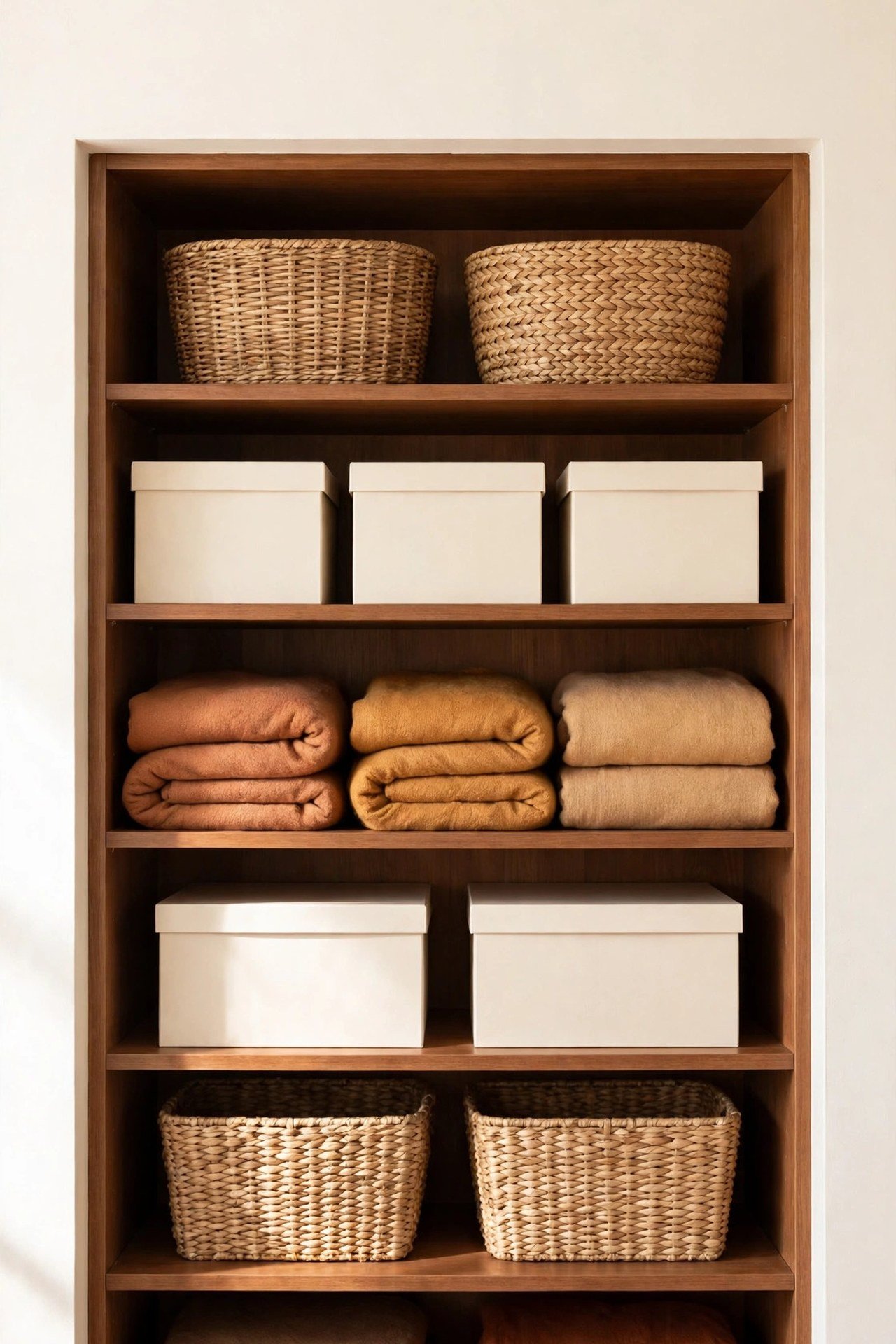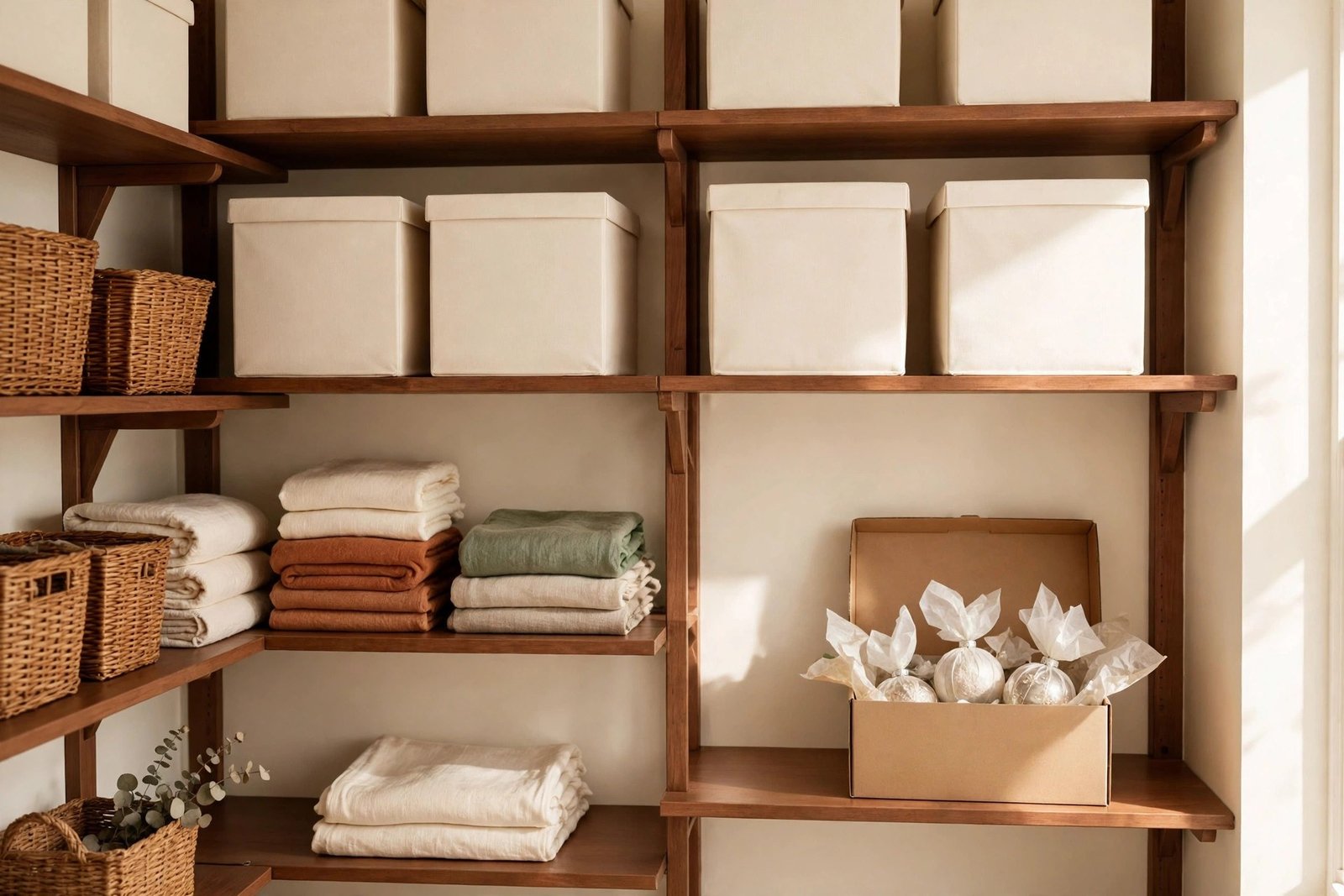
Every year, the same quiet disaster: you open the seasonal box and find a cracked ornament, a cushion cover that smells of cupboard, a garland tangled into a knot, and lights that worked perfectly when you packed them. Or the opposite problem — the decor survives, but it lives in four cupboards, two bags and a pile on the closet floor, and the closet no longer closes.
Both problems have the same cause: storage treated as an afterthought. This guide is the protection-and-space system — how to wrap, pack, label and place seasonal decor so it comes out next year exactly as it went in, and so all of it fits in a footprint a small home can actually spare. It goes deeper than rotation: the rotation system decides what swaps each season; this system protects those pieces for the other eleven months.
Quick Answer
Store seasonal decor in one box per season, packed by protection level: fragile pieces wrapped individually in tissue or cloth and nested so nothing touches; textiles washed, fully dry, folded with tissue and stored away from plastic bags; everything kept out of direct light, heat and damp. Label every box on two sides with its season and a short inventory card inside the lid. Choose the storage spot by climate first (cool, dry, stable) and size second — under-bed space, the top of a wardrobe, or one shelf — and cap the collection at what those boxes hold: if it does not fit, edit, do not expand.
First, the Rule That Solves the Space Problem
The simple decor rotation system runs on one box per season. This article protects that idea with one hard rule: the boxes are the budget. Decide the footprint first — say, one box per season on one shelf — and the collection is only allowed to fill it. When a new piece arrives, an old piece leaves. Collections do not grow by one ornament a year until they own the house; they stay edited, and the pieces that remain are the ones genuinely loved.
If your current collection is far bigger than the footprint, do the edit on packing day, not someday: handle every piece, keep what you would display this year, and let the rest go while you can see exactly how much space the decision frees.
Protection Level 1: Fragile Pieces
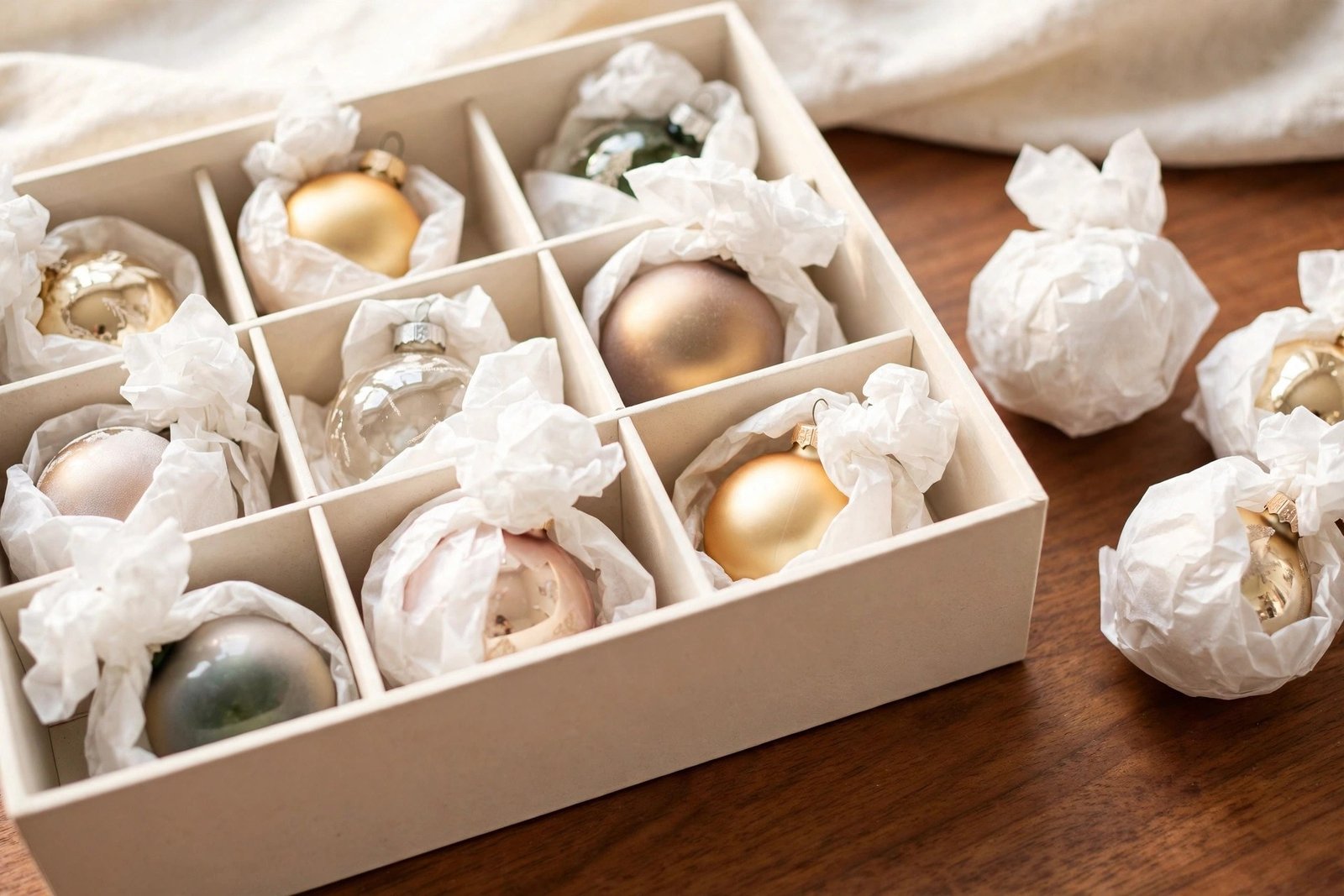
Glass, ceramic and thin metal pieces break from contact, not from time. The system:
- Wrap individually. Plain tissue paper, soft cloth or a square of old cotton per piece — never newspaper (the print transfers) and never bare plastic against painted or gilded surfaces.
- Nest and divide. Use the box’s own dividers, egg cartons for small ornaments, or rolled tissue between layers. Nothing hard should touch anything hard.
- Fill the gaps. A half-empty box is a breaking box: pieces shift and collide. Crumple tissue into empty corners so nothing can move when the box is carried.
- Heavy at the bottom, fragile on top. Within the box and within the stack of boxes.
- Lights get their own wrap. Wind strings around a piece of cardboard or a hanger, never balled up — next year’s tangle is made this year, at packing speed.
Protection Level 2: Textiles
Cushion covers, throws, runners and table linen are the backbone of seasonal decor, and they fail in storage three ways: smell, stains setting, and pests.
- Wash before storing, always. Invisible food and candle-soot marks set into permanent stains over months, and scent clings. Wash, and dry completely — “mostly dry” is how mildew starts.
- Fold with tissue between layers for anything with embroidery, beading or a print you care about; it prevents hard creases and surface-to-surface transfer.
- Breathable beats plastic. Cotton storage bags or the box itself with the lid slightly vented. Sealed plastic traps moisture and gives textiles that stale cupboard smell; if you must use plastic bins, make sure everything goes in bone dry.
- A simple pest deterrent: a small cloth bag of dried lavender or cedar pieces in the textile box. Clean fabric stored dry is the real protection; scent is the backup.
Protection Level 3: The Enemies — Light, Heat and Damp
Where the boxes live matters more than the boxes themselves:
- Light fades fabric and paper and yellows pale pieces. Boxes with lids, in a dark spot — never in a sunlit spare room corner “temporarily”.
- Heat melts candle-based decor, warps plastic and ages adhesives. Avoid the space right under a hot roof in summer and anything near a boiler or radiator.
- Damp is the worst of the three: it rusts metal, spots fabric, swells paper and ruins anything with a battery. A damp cellar or garage floor will damage more in one season than years of careful use. Raise boxes off floors on a shelf or pallet, and if the only available space runs damp, that is the one case where sealed plastic bins earn their place — with everything going in dry, plus a small desiccant packet per box.
- Stability beats convenience: a slightly awkward spot with steady, dry conditions protects better than an easy spot that swings between hot and damp.
The Label and Inventory System
Future-you, standing on a chair in a hurry, is the audience for this system. Keep it that simple:
- Label on two sides plus the lid: season name in large letters — “AUTUMN” — visible from whichever way the box faces.
- Inventory card inside the lid: a plain card listing what is inside, in groups (“textiles: 3 covers, 1 throw / fragile: 6 ornaments, wrapped / light: 1 string, card-wound”). Ten lines maximum. Writing it takes two minutes on packing day and saves twenty on unpacking day.
- Note the borrowed space: if a piece lives elsewhere (“wreath base — hall cupboard hook”), write it on the card. One line ends the annual hunt.
- Update the card when the edit happens. Cross out, add, done. The card is a working document, not an archive.
Where to Store It All in a Small Home
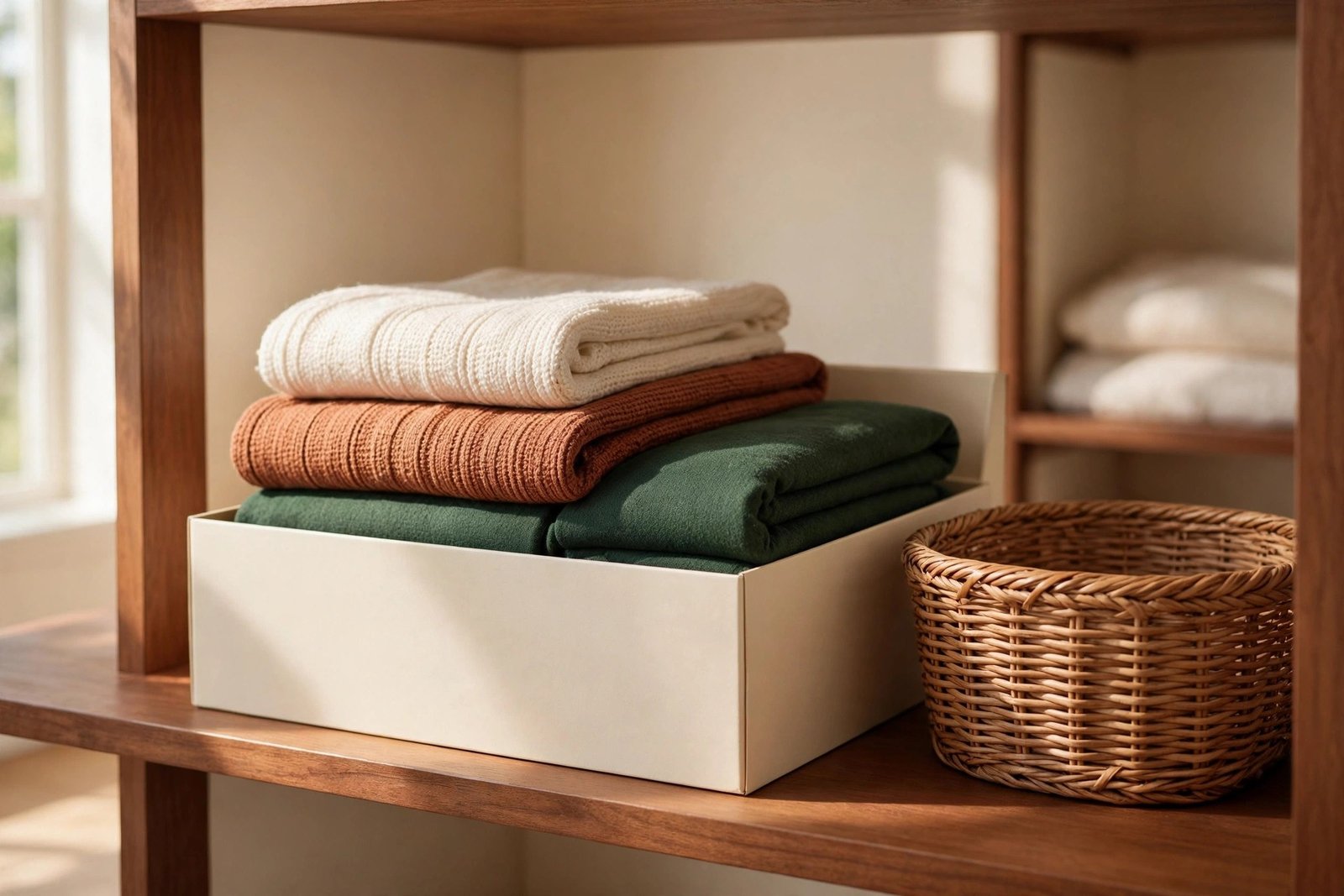
No spare closet is not a problem once the collection is box-sized — this is exactly the space logic behind decorating for celebrations in a small home without taking over every surface. Good spots, in climate order:
- Under the bed: low, wide boxes or bags; cool and dark — ideal for textiles and flat decor.
- The top shelf of a wardrobe: the dead space above hanging clothes fits two to four season boxes and stays dry.
- On top of a tall cupboard or bookcase: matching plain boxes look intentional, almost decorative, and stay out of daily life’s way. Keep fragile boxes lower — lifted down once a year is enough of a risk.
- A suitcase you rarely travel with: a perfect decor container that is itself already stored.
- Inside an ottoman, storage bench or the hollow of a rarely used drawer: small pieces and textiles disappear into furniture you already own.
What to avoid: the damp garage floor, the hot spot under the roof, and the “spare room pile” that becomes permanent. And keep one rule across all spots: all four season boxes in the same home base, so the annual changeover is one trip, not a treasure hunt.
Materials and Costs
- Sturdy boxes with lids, one per season — $3–$6 each ($12–$24 total), or free sturdy reused boxes
- Plain tissue paper, a large pack — $3–$5 (lasts years)
- Cotton storage bags for textiles — $5–$8 for a set
- Labels or a marker, inventory cards — $0–$2
- Desiccant packets, if your storage spot runs damp — $4–$6 for a pack
- Lavender or cedar for the textile box — $3–$5
The whole protection system costs $15–$35 once and replaces the annual “some of it broke again” spend entirely.
Mistakes to Avoid
- Packing dirty textiles. The stain you cannot see today is set and yellow by next season. Wash and fully dry, every time.
- Newspaper as wrapping. Print ink transfers onto pale and painted pieces permanently. Plain tissue or cloth only.
- Sealing damp-prone pieces in plastic in a damp room. Plastic traps whatever moisture is already there. Dry first, desiccant second, plastic only where the room demands it.
- Half-empty fragile boxes. Space inside the box is movement, and movement is breakage. Fill the gaps with tissue.
- Letting the collection outgrow the footprint. A fifth box “just for this year” is how the closet gets taken over again. New piece in, old piece out.
- Labelling one side only. Boxes turn around in storage. Two sides and the lid, or you will pull down three boxes to find one.
The full seasonal collection — rotation, celebrations, storage and swaps — lives in the seasonal and holiday decor guides.
Frequently Asked Questions
How do I store candles and anything with wax?
Cool is the whole rule: wrap each candle in tissue, stand them upright in a small box within the season box, and store them in the coolest of your spots — never near heat or under a warm roof, where they soften, lean and fuse together. Keep scented candles separate from textiles so the fragrance does not move in permanently.
What about battery-powered lights and decor?
Take the batteries out before storing — leaking batteries are the most common silent killer of stored decor. Store the batteries with the piece in a small labelled bag so they reunite next season, or keep a note on the inventory card (“lights need 4 fresh AA”). Test lights on packing day, not unpacking day, so replacements can be found calmly.
My only storage space is a damp basement or garage. What is the least-bad setup?
Sealed plastic bins instead of cardboard, everything packed bone dry, a desiccant packet per bin, and the bins raised on a shelf or pallet off the floor. Textiles get an extra layer: sealed inside cotton bags inside the bin. Check the bins once mid-storage if you can — five minutes of early warning saves a whole collection.
How do I know what to let go of in the packing-day edit?
Ask one question per piece: did it go on display this year, and would I choose it again? Broken-beyond-repair pieces, colours that left your palette, and duplicates you never reach for are the easy outs. Sentimental pieces get honesty too: one kept with love beats five kept from guilt — and the freed space is what keeps the system working.