
Curtains cover more wall than any picture you own, so when they age, the whole room ages with them. Sun-faded panels, a hem that came down years ago, curtains a few centimetres too short or pooling sadly on the floor — each one quietly dates a room that is otherwise fine. New curtains are the obvious fix, but a decent pair for a wide window is rarely cheap.
Before you price replacements, look at what you have. Most tired curtains are one wash, one hem, or one small upgrade away from looking new — and every fix in this guide is no-sew. Fusible hemming tape, clip rings, dye, and a $5 set of tiebacks can give old curtains a second life in a single afternoon.
Quick Answer
To refresh tired curtains without sewing, start with a wash and a proper iron — faded-looking curtains are often just grey with dust. Fix a fallen or uneven hem with fusible hemming tape, which bonds with a household iron in minutes. If curtains hang too short, drop the hem down or switch to clip rings, which add 5–8 cm of length from the rings alone. Deepen a sun-faded colour with fabric dye, or hide a faded band with iron-on trim along the edge. Finally, hang them high and wide, and add simple tiebacks so the panels frame the window instead of drooping beside it.
Step Zero: The Wash-and-Iron Reset
Do this before judging your curtains. Dust and cooking film settle into fabric for years and mute every colour; a gentle wash often restores a full shade of brightness for the price of detergent. Wash on a gentle cycle if the care label allows, hang them back up slightly damp, and let gravity pull the creases out. Then iron or steam the panels while they hang or on a board. Crisp, clean curtains in the same old colour routinely look a year newer. Curtains are one of the three dated-room culprits named in the guide to the 3 upgrades that modernise a dated room cheapest — and this reset is the free version of that upgrade.
The No-Sew Upgrades
Fix the hem with fusible tape
Fusible hemming tape is a strip of heat-activated webbing. You place it inside a folded hem, iron over it, and the two layers bond. It repairs fallen hems, evens up panels that were never the same length, and hems curtains that pool too long — no needle anywhere. One roll costs $3–$5 and does several windows.
Gain length with clip rings
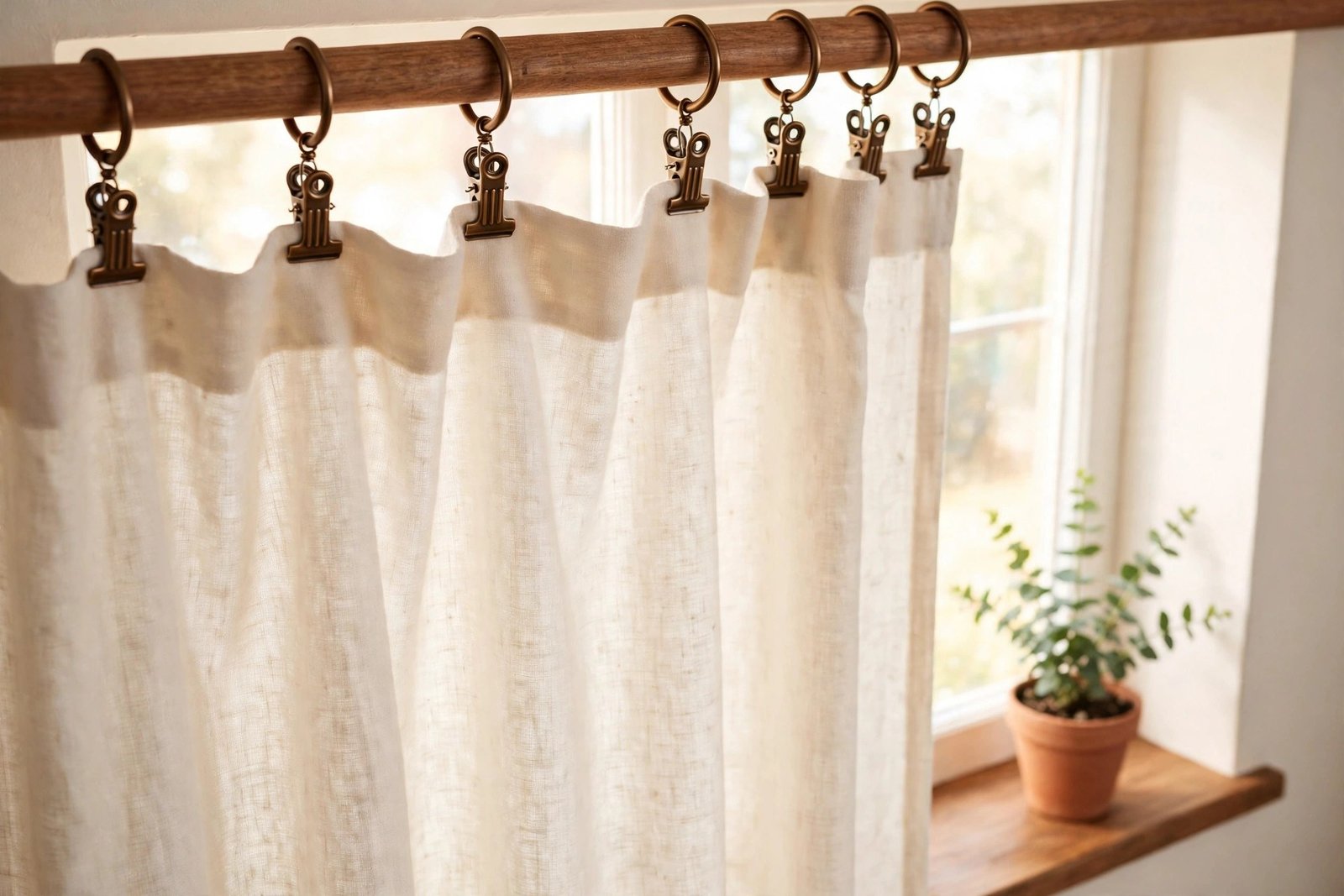
Curtains that end awkwardly above the floor make a room look like it is wearing trousers that shrank. Clip rings — curtain rings with a small clip — grip the top edge of the panel and slide onto the rod. They add the ring’s drop, about 5–8 cm, which is often exactly the missing length, and they make flat panels hang in soft, even folds. A pack costs $6–$10. Combined with letting the hem down to its last centimetre, most “too short” curtains reach the floor.
Refresh the colour with dye
Sunlight fades curtains unevenly, worst along the fold that faces the window. Fabric dye in a washing machine or a large bucket can even out and deepen the colour for $5–$8 a box. Stay in the same colour family, one or two shades deeper — dyeing pale blue curtains navy hides fading beautifully; trying to turn them red is a gamble. Natural fibres (cotton, linen) take dye best; synthetics take it weakly or not at all, so check the fabric first.
Add trim along the edge
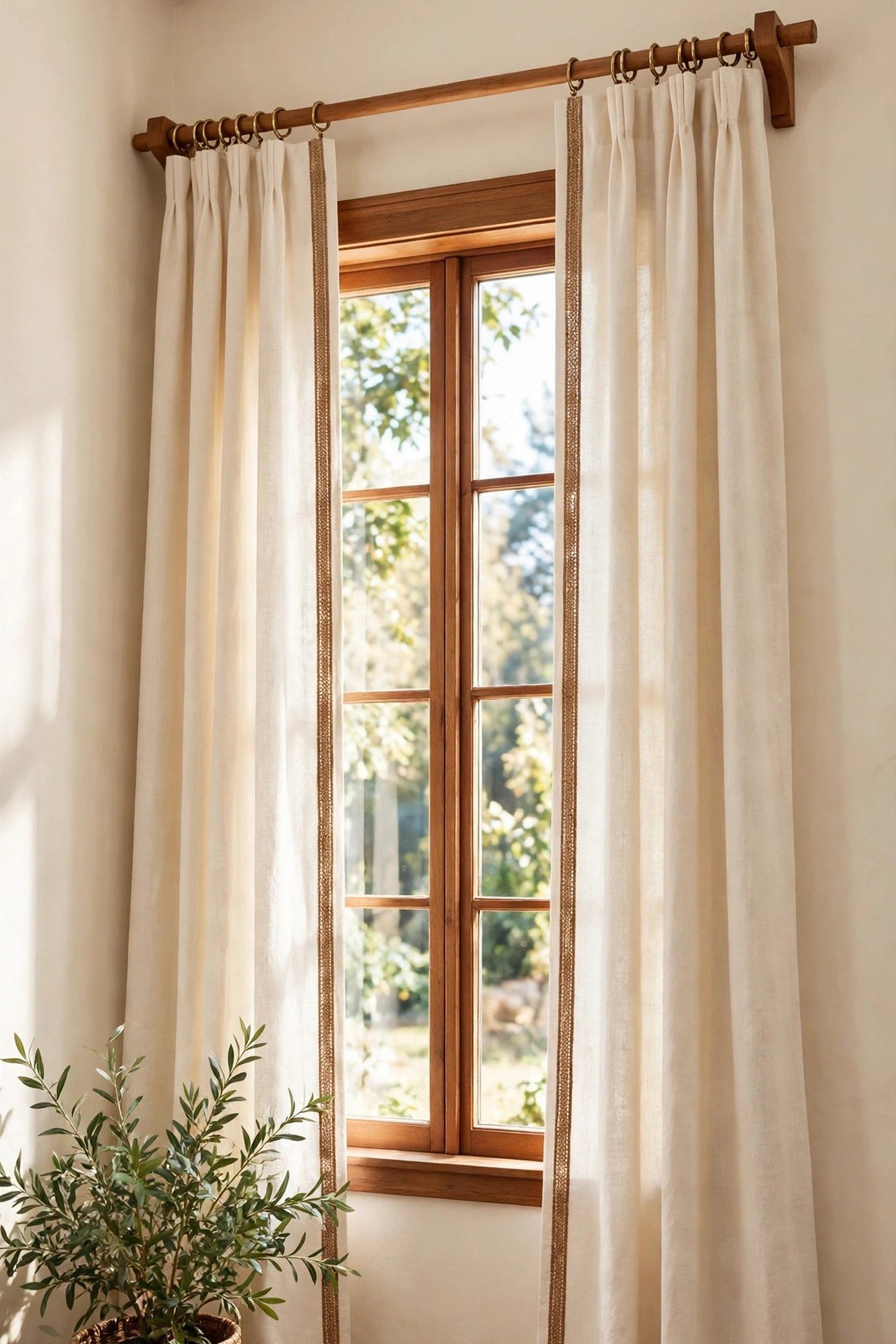
A band of iron-on or fabric-glue trim down the leading edge — the vertical edge you see most — makes plain curtains look made-to-measure. Pompom trim, a woven band, or a simple ribbon in a contrasting colour costs $4–$8 for a pair of panels. It also covers the most faded strip of fabric, which is usually that same sun-hit edge. The same trick — trim, a wash, and ten minutes — is the heart of the method for refreshing flat, boring cushion covers, so curtains and cushions can be revived together in one sitting.
Tiebacks and holdbacks
Panels that hang straight and closed-in make windows feel smaller and rooms darker. Simple rope, fabric, or magnetic tiebacks ($4–$8 a pair) pull each panel into a gentle curve at about a third of the way down, letting in more light and giving the window a dressed shape. In a rental, magnetic or wrap tiebacks avoid drilling holdback hooks into the wall.
Step by Step: A No-Sew Hem With Fusible Tape
Time: about 30 minutes per pair. Difficulty: beginner. Work on a stable ironing board and keep the hot iron away from little hands while it cools.
- Hang the curtains first. With the curtains on the rod (on clip rings if you are adding them), decide the finished length: just touching the floor, or 1 cm above it for easy cleaning.
- Pin or clip the fold. Take the panel down, fold the bottom up to your marked length, and hold it with clips or pins. Measure both ends and the middle — floors are rarely level.
- Press the fold. Iron the folded edge firmly to crease it, then unfold.
- Place the tape. Lay a strip of fusible tape along the inside of the fold, close to the crease, trimming away any old stitching or loose threads first.
- Bond it. Refold the hem over the tape and press with a hot iron for the time on the tape’s packet — usually 10–15 seconds per section, no steam unless the packet says so. Work along the hem in sections.
- Cool and check. Let the hem cool fully before hanging; the bond sets as it cools. Tug gently at a corner to test it before rehanging both panels.
Materials and Costs
- Fusible hemming tape, one roll — $3–$5
- Clip rings, pack of 12–14 — $6–$10
- Fabric dye, one box — $5–$8
- Iron-on or glue-on trim, enough for two panels — $4–$8
- Tiebacks, one pair — $4–$8
- Fabric glue (optional, for trim) — $3–$5
- Iron, measuring tape, scissors, clips or pins — usually already at home
Picking two or three of these upgrades for one window usually costs $10–$20 in total — a fraction of new curtains, and the panels can move to another room or window later, the same reuse thinking behind the DIY decor and simple crafts collection.

Hang Them High and Wide
While the curtains are down, check the rod. A rod fitted just above the window frame makes the window — and the room — look smaller and older. Repositioning the rod 10–15 cm above the frame and 10–15 cm wider on each side means the open curtains cover wall, not glass: more light, a taller-looking window, and panels that hang in longer, more elegant lines. It costs nothing but a few new screw holes, and it transforms even plain panels. If you are renting and cannot move the rod, clip rings still buy you height by using every centimetre of panel.
Mistakes to Avoid
- Buying replacements before washing the old pair. Dust-grey fabric looks like fading until it is washed. Always do the free reset first.
- Dyeing without checking the fabric. Polyester and other synthetics barely absorb standard dye and come out patchy. Test a hidden corner, and match the dye type to the fabric.
- Hemming by eye. Floors slope and panels stretch. Measure from the hung position at three points, or your “fixed” hem will slope too.
- Ironing fusible tape too briefly. A quick pass makes a weak bond that fails in the first wash. Full time per section, then let it cool untouched.
- Trim that fights the room. Trim in a clashing colour or style cheapens plain curtains instead of dressing them. Stay within the room’s colour family.
- Curtains still too short after every fix. If panels end more than about 10 cm above the floor after the hem and rings, accept it gracefully: add a contrasting band of fabric at the bottom with the same fusible tape, which looks like a deliberate design border.
Frequently Asked Questions
Will a fusible-tape hem survive washing?
Yes, if it was bonded for the full time stated on the packet and cooled completely before moving. Wash those curtains gently and avoid very hot water, which can soften the bond over many washes. A hem that does lift in one spot can simply be re-ironed back down.
My curtains are faded in stripes where the sun hit them. Can dye fix that?
Usually, yes — dye evens out moderate fading because the whole panel takes the new colour together, and going one or two shades deeper hides the contrast. Very bleached stripes on dark curtains may still show faintly; in that case, trim along the faded edge or hanging the panel with the paler fold turned to the wall side helps.
How long should curtains be, exactly?
The most finished look is panels that just touch the floor or hover about 1 cm above it. Slight pooling (2–3 cm extra) suits soft, romantic rooms but gathers dust; anything ending 10 cm or more above the floor looks accidental unless it is a café-style half curtain by design.
Can I use these fixes on lined or blackout curtains?
Mostly, yes. Fusible tape works on the outer fabric’s hem as long as you iron on the fabric side and test the heat on a hidden spot — some blackout coatings dislike high heat, so use the lowest effective setting. Clip rings and tiebacks work on any panel, and dye is the only fix to avoid on lined curtains, since the lining dyes differently.
1 thought on “Tired Curtains Making the Room Look Old: Easy DIY Upgrades and No-Sew Fixes”