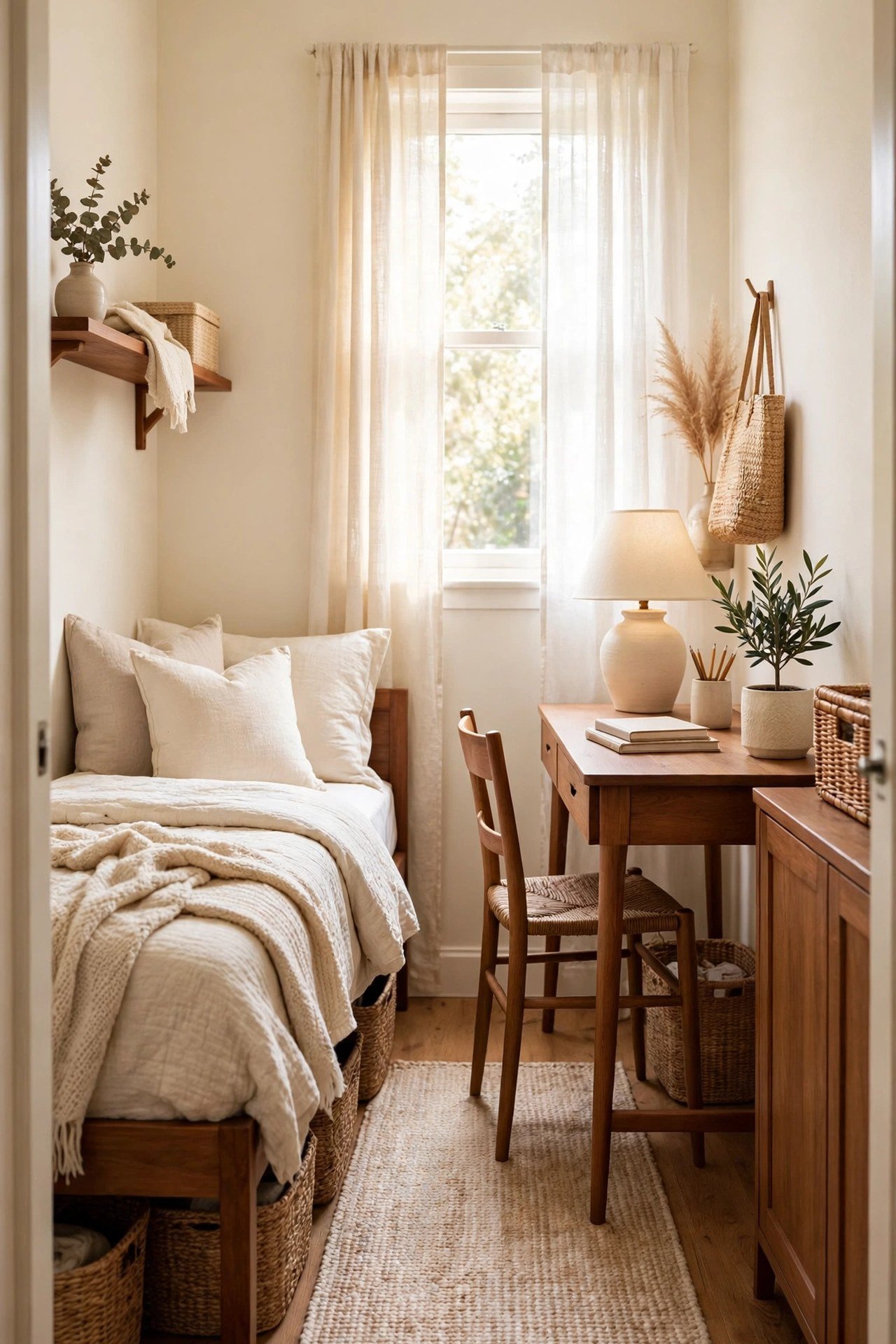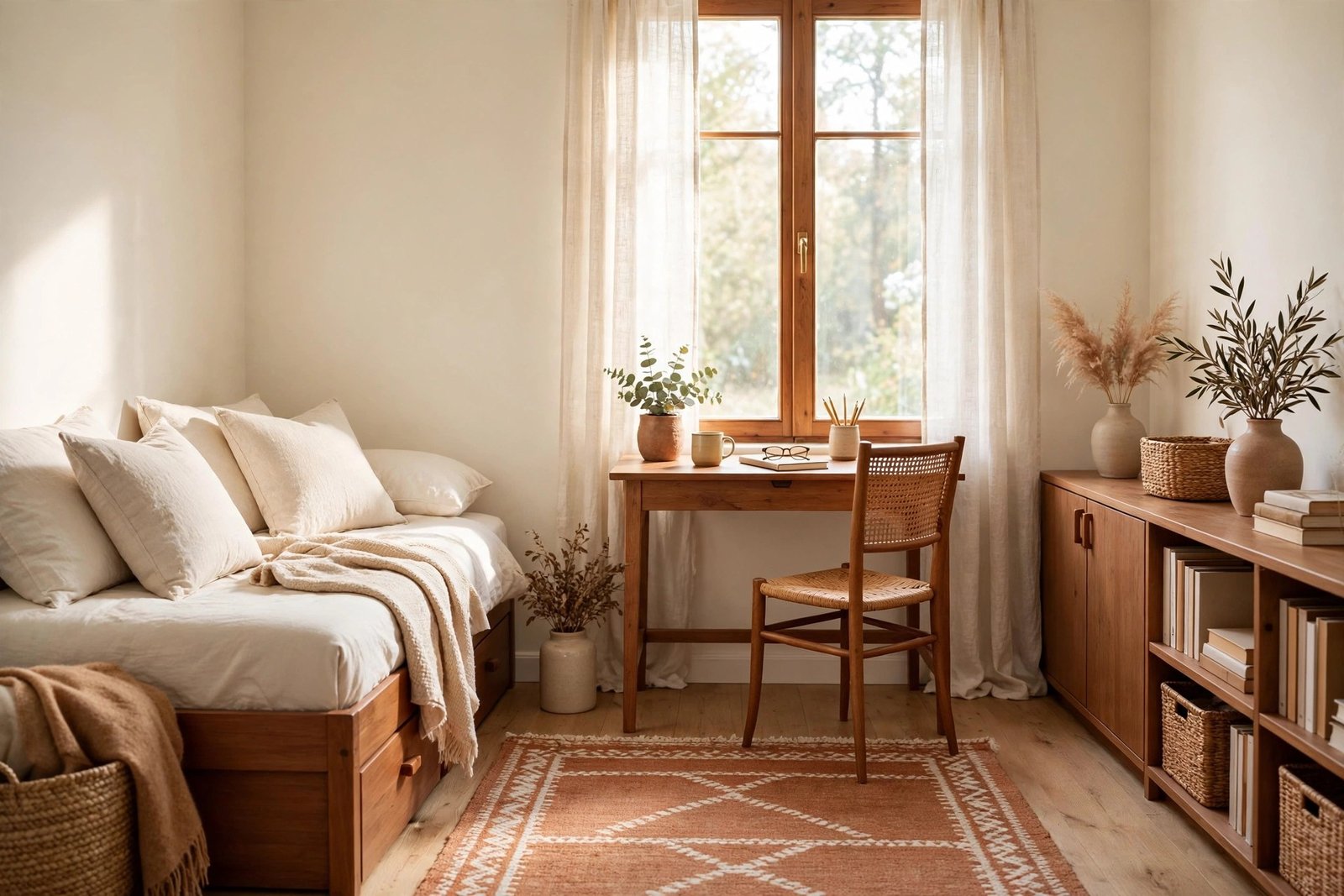
There is a room in many homes that never gets to be one thing. Monday to Friday it is the home office. When family visits, it is the guest room. The rest of the time, it quietly becomes the place where everything without a home goes to wait. Each job on its own is reasonable. Together, on show at the same time, they produce a room that always looks half-finished — a bed under a printer, a desk beside a suitcase, bedding stacked on the office chair.
The fix is not better storage, and it is not dividing the room into zones. It is choosing one base look for the room and making the other two jobs disappear into it. The calmest job leads — sleep. The office folds away into the room’s furniture and decor. Storage goes invisible behind things that look like furniture. Then the room converts, in about ten minutes, whenever a different job is needed.
Quick Answer
To run one small room as a home office, guest room, and storage without chaos, give the room a single base look: a calm guest room. Style a day bed or sofa bed as a sofa by day so the sleeping place reads as seating. Choose a desk that disappears visually — small, in the room’s colours, ideally inside an alcove or wardrobe opening — with a chair that could belong to a bedroom. Hide storage inside furniture-like containers: a lidded ottoman, under-bed boxes behind a valance, a closed wardrobe. Keep one palette across all three jobs so the room never changes identity, only arrangement.
The Principle: One Visible Personality
Chaos in a three-job room is a visibility problem. All three jobs are on stage at once, each with its own equipment, colours, and half-done tasks. Your eye reads “office, bedroom, and storeroom in an argument” and the room feels smaller and more stressful than its measurements suggest. Unlike a studio apartment, where one person lives in full view of everything and zones divide the space, this room serves different people at different times — so it does not need three areas. It needs one look that the other jobs borrow.
Choose sleep as the base look, because a guest room’s ingredients — a bed made calmly, a lamp, a clear surface, a picture — are the most restful and the most finished-looking. An office can hide inside a pretty room far more easily than a bed can hide inside an office. The desk and the storage then dress to match the bedroom, not the other way round. For the underlying bedroom styling, the method in the bedroom makeover under $50 is exactly the base this room needs: plain bedding, warm bedside light, one calm colour family.
The Sleep Layer: A Bed That Reads as a Sofa
The bed is the largest object in the room, so its daytime identity decides everything. A day bed or sofa bed dressed as a bed — duvet, pillows at the head, blanket folded at the foot — announces “spare room” all week and makes the office feel like it is camping. Dressed as a sofa, the same piece hosts the room properly: a fitted cover or a large throw laid smooth as a base, cushions standing along the back like sofa cushions, and one folded throw for colour.
Keep the real bedding invisible until it is needed. Pillows and the duvet can live in a lidded ottoman at the foot of the bed, inside a wardrobe, or in a flat box under the bed — out of sight, in the room, two minutes away. At night the conversion is simply: cushions to the ottoman, bedding out, lamp on. Guests should never have to move office equipment to reach their bed.
The Work Layer: A Desk That Disappears
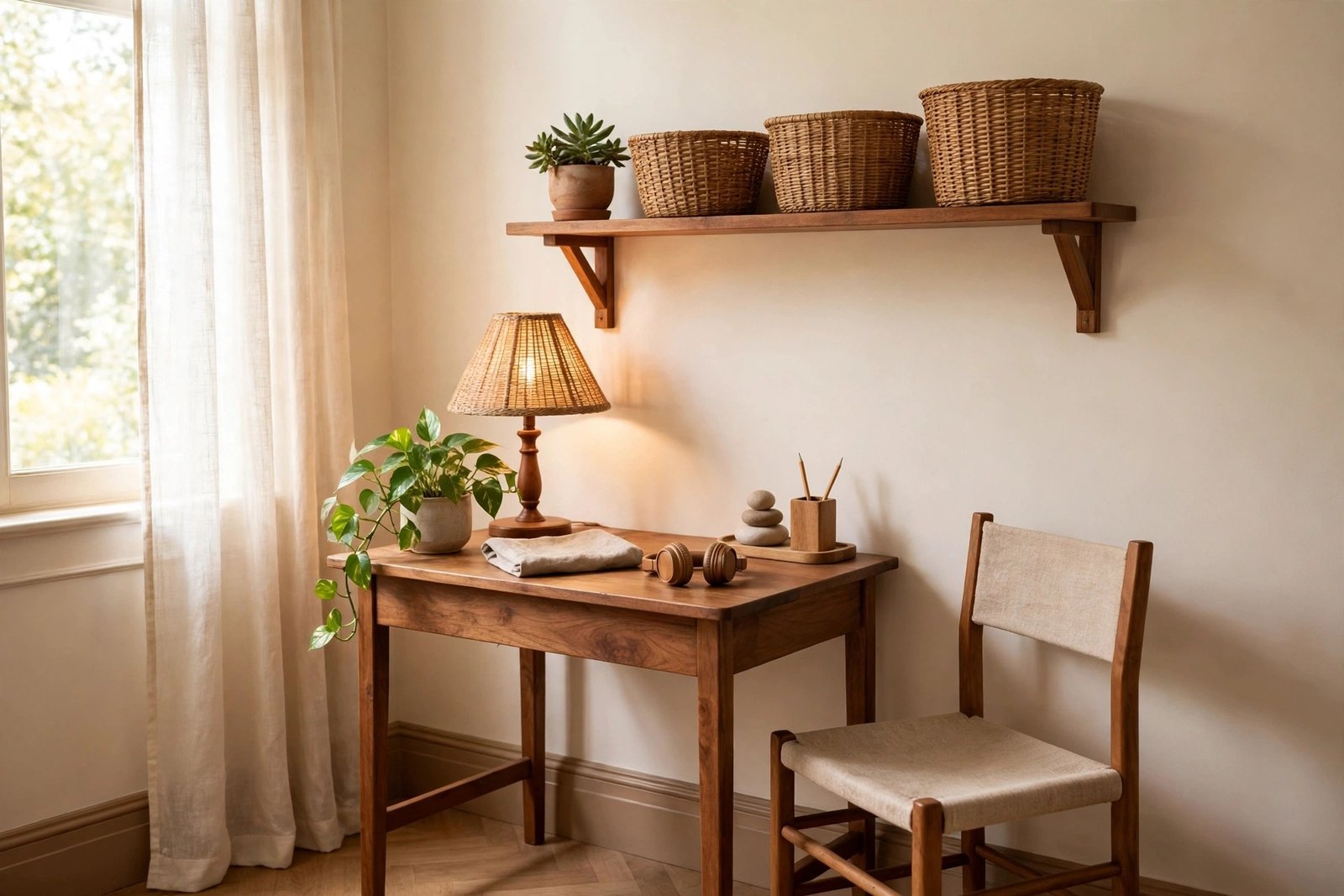
The office earns its place by being the room’s best-behaved job. Choose the smallest desk that honestly fits your work — for a laptop life, 100 cm wide and 50 cm deep is plenty — and put it in the room’s least visible spot: an alcove, the side wall away from the door, or inside a wardrobe opening whose doors close over it at night.
Style the desk to vanish. A desk in the room’s wood tone or painted colour, a chair that reads as a bedroom chair rather than an office chair (a simple upholstered chair with a cushion does both jobs), and a lamp that could be a bedside lamp. When work ends, the laptop, notebook, and chargers go into one lidded box or basket that lives on or under the desk and looks like decor — cables especially, because a nest of cables is the single loudest “office” signal there is. A screen can lean against the wall beside a plant or a framed print, so it reads as part of the arrangement.
This is deliberately different from dividing a studio apartment into zones with decor. There, one person needs all the jobs visible and separated at once. Here the jobs take turns, so the winning move is disguise, not division.
Storage: The Job That Should Never Be Seen
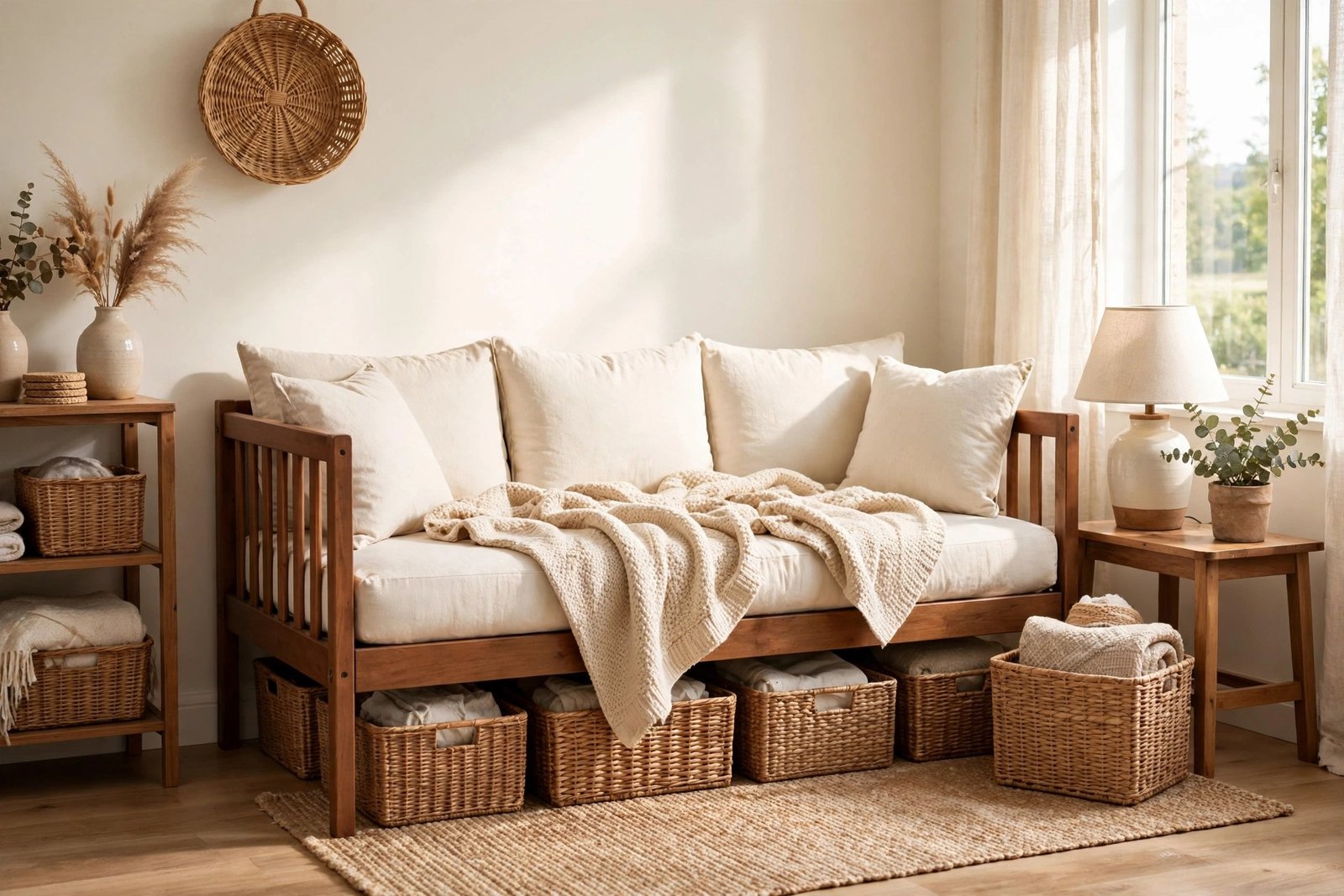
Storage is the third job, and its rule is simple: it may exist everywhere and be visible nowhere. Open shelves of boxes, stacked plastic tubs, and bags in the corner tell every visitor that this is the house’s overflow room. Closed, uniform, furniture-like storage tells no story at all.
Choose containers that pass as furniture or textiles: a storage ottoman that works as seating and a footrest, matching lidded boxes in one colour inside a wardrobe or on top of it in a neat row, under-bed boxes hidden by a bed skirt or valance so the bed looks like a bed. One finish, one colour family, nothing labelled outward, nothing stacked in the open. If something cannot be hidden, it probably belongs in a cupboard or loft instead.
One Palette Across All Three Jobs
What holds the disguise together is colour discipline. The bedding, the desk accessories, the storage boxes, the chair cushion, and the curtains should all live in one calm family. When the ottoman matches the throw and the desk box matches the bedding, the eye files the room under one word — calm — whichever job is currently set up.
Art does the same work on the walls: one generous picture that suits sleeping and working alike — a landscape, an abstract in the room’s colours — hung where it anchors the bed. Avoid office signals on the walls (pinboards of tasks, shelves of files) and spare-room signals (the ironing pile’s favourite chair). The walls should describe the base look only.
The Ten-Minute Conversion
Because everything has a hiding place in the room, switching jobs is a routine, not a project. Office to guest room: laptop and papers into the lidded box, desk chair turned or tucked, sofa cushions into the ottoman, bedding out and bed made, bedside lamp on, one clear surface with a glass and a small plant. Guest to office on Monday: the reverse. Storage never converts at all — it simply stays invisible through both, which is the proof the system is working.
A Sample Small Budget for a Three-Job Room
- Bed dressing: $15–$35 — a fitted cover or large throw and two sofa-style cushions in the room’s palette.
- Lidded ottoman or boxes: $20–$50 — one ottoman for bedding, or matching lidded boxes for the wardrobe top and under-bed.
- Desk disguise: $0–$25 — a lidded box or basket for laptop and cables; a cushion to turn the desk chair into a bedroom chair.
- Bed skirt or valance: $10–$20 — hides under-bed storage so the bed reads as furniture, not a warehouse.
- Finishing piece: $0–$15 — one picture or plant, moved from elsewhere in the home, to set the base look.
Every small-space method used here is gathered in one place: small-space decor ideas that work.
Mistakes to Avoid
- Zoning a room that takes turns. Dividing a spare room into three permanent mini-areas shrinks every job and keeps all the equipment on show. When jobs work different hours, disguise beats division.
- The bed dressed as a bed all week. A made-up spare bed in the middle of your office makes every workday feel temporary. Dress it as a sofa; make the bed when a guest is actually coming.
- Office equipment on the guest’s surfaces. Printer on the bedside table, files on the bed — the guest reads the room, correctly, as not meant for them. Everything work-related needs a lid or a door.
- Open, mixed storage. Clear tubs, labelled boxes, and stacked bags announce the storeroom. Closed, matching, furniture-like containers keep the third job silent.
- Three colour schemes for three jobs. Corporate grey desk gear, floral guest bedding, and bright storage boxes in one small room is the chaos in visual form. One palette, all jobs.
- A desk facing the door. The first view sets the room’s identity. Desk on a side wall or in an alcove, bed as the calm focal point — the doorway should say “guest room”, not “office”.
Frequently Asked Questions
Sofa bed or day bed — which works better in a three-job room?
A day bed usually wins. It is a real mattress, so guests sleep properly, and with a fitted cover and cushions along the back it passes as a deep sofa during the week. A sofa bed can work if it is comfortable to sit on daily; test the seat, not just the bed, because the room will use it as seating far more often than as a bed.
Where should the printer and files live?
Inside something closed: a wardrobe, a lidded cabinet, or a deep drawer of the desk if it has one. If the printer is used rarely, it can live in another room entirely and visit when needed. The rule for all work equipment is the same — a lid, a door, or another home.
How do I stop the room drifting back into a dumping ground?
Protect the base look with one rule: nothing enters the room unless it has a closed place to live there. The drift starts with one bag “for now” in the corner. A weekly two-minute check — surfaces clear, lids on, bed dressed as a sofa — keeps the room’s identity stronger than the drift.
Can this work in a really small box room?
Yes, with tighter casting: a single day bed, a wall-mounted drop-leaf desk that folds flat, and storage only under the bed and in one ottoman. The smaller the room, the more strictly the “one visible personality” rule matters, because a second job can only hide inside the first one’s furniture.