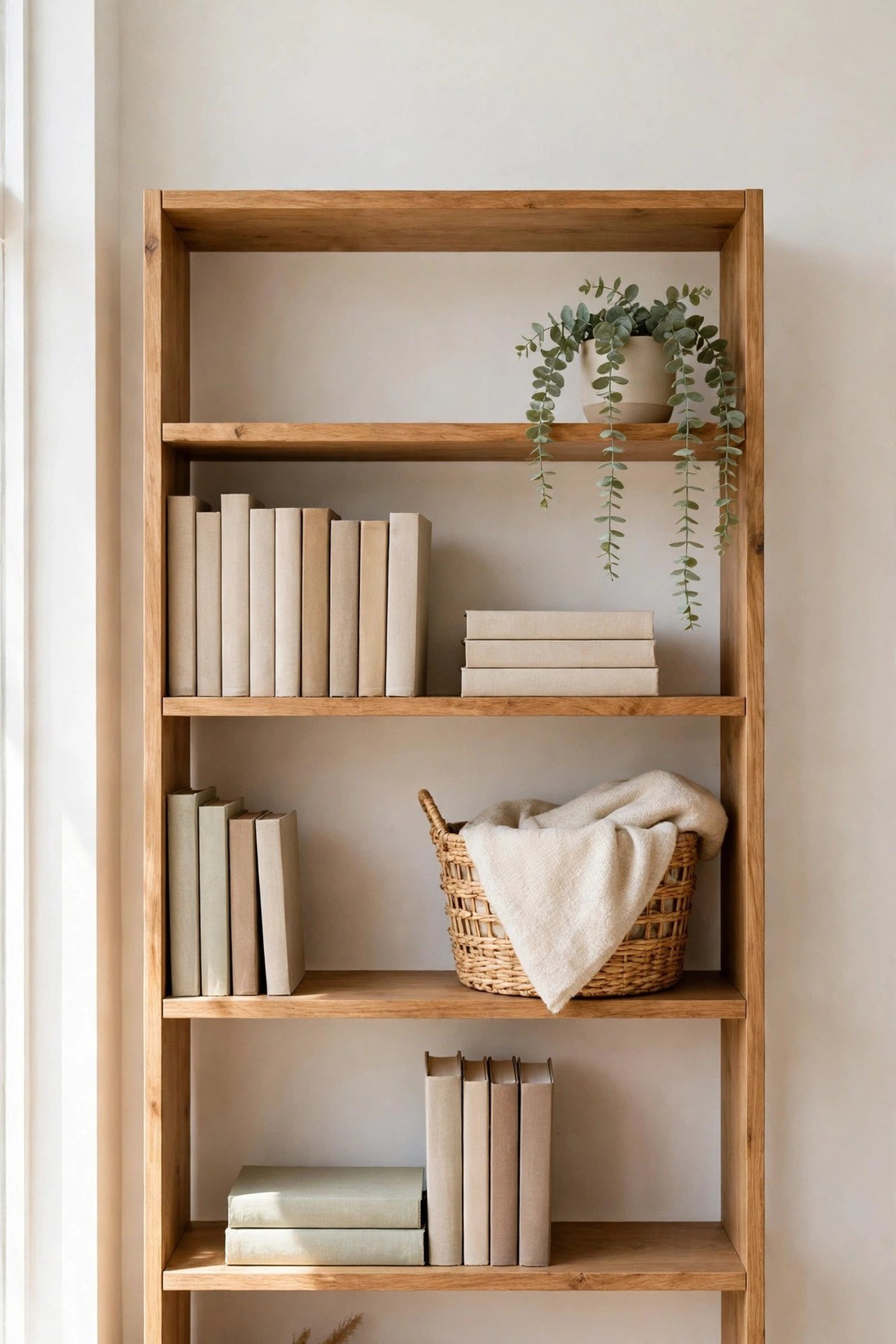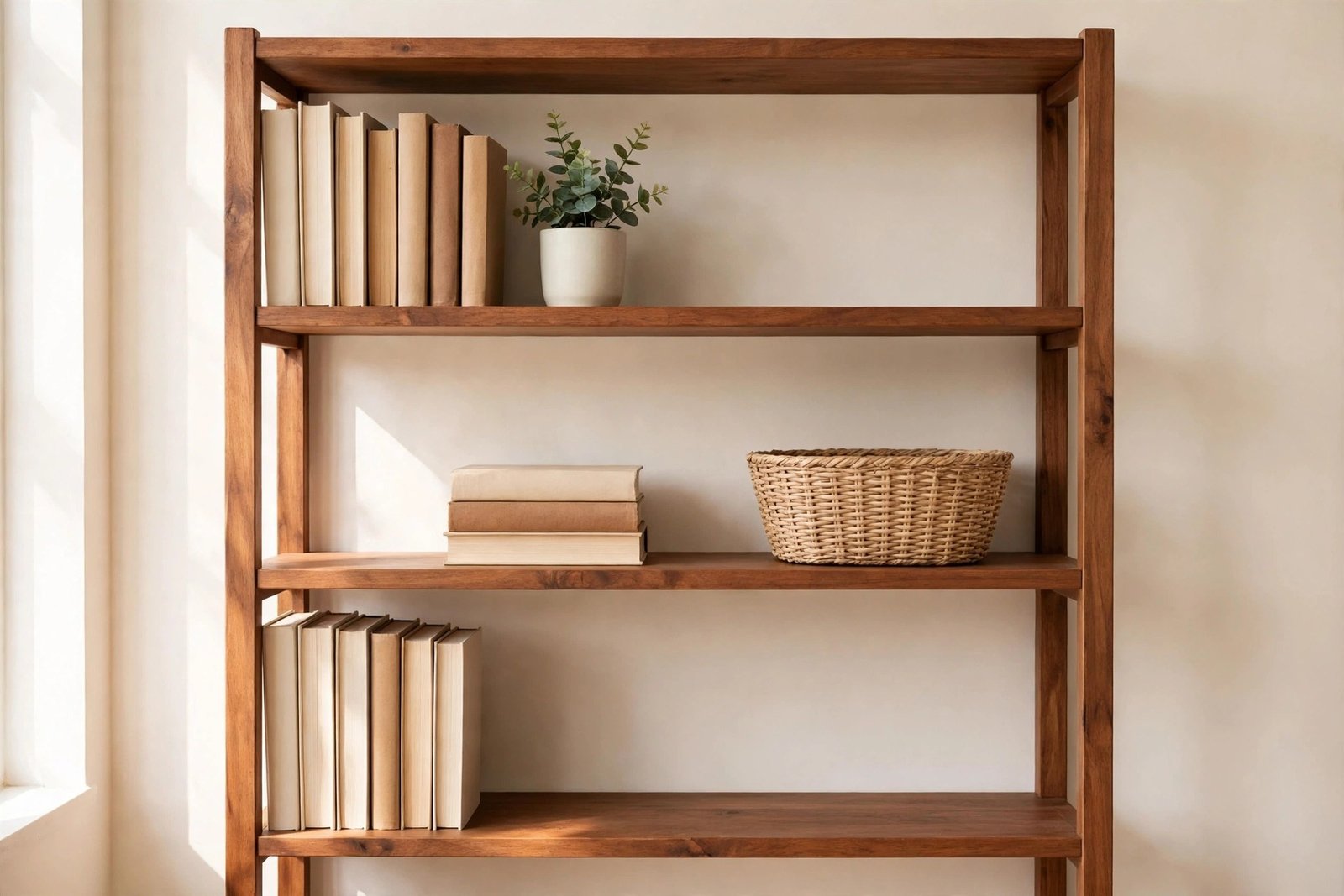
Most bookshelves are not badly stocked. They are badly arranged. Books crammed spine-to-spine on every shelf, a lone ornament marooned in a gap, souvenirs lined up like a departure lounge — the shelf holds good things and still looks like storage that happens to be vertical. Then someone tries to fix it by buying more decor, and the shelf gets fuller and messier at once.
Styled shelves follow a system, and the system is not about buying anything. It is a repeatable order of operations: empty everything, put back anchors first, mix books standing and stacked, group objects in odd numbers, and — the step everyone resists — leave real empty space on every shelf. This guide gives you the formula once, shelf by shelf, so you can reuse it on any bookcase in the house.
Quick Answer
To fix messy bookshelf styling, empty the shelves completely and start again with a system. Work shelf by shelf: place one large anchor object first (a stack of books, a plant, a basket or a framed piece), then add books in a mix of vertical rows and horizontal stacks, then a small group of two or three objects, then stop — leaving about a third of each shelf empty. Group book colours loosely, keep the tallest items at the ends of rows, and repeat the same few materials and colours on every shelf so the whole bookcase reads as one piece of furniture, not five different accidents.
Why Shelves Look Messy: Full Is Not Styled
A shelf reads as messy for three reasons. It is too full, so the eye cannot separate one thing from the next. Its contents are all the same height and weight, lined up in a single row like products in a shop. And nothing repeats — every shelf uses different colours and materials, so the bookcase never adds up to a whole. Notice that none of these is about what you own. The same books and objects, rearranged by a system, look calm. Styling is editing and placing, not acquiring, which is why this guide needs almost no budget.
The System: Five Steps, Every Shelf, Every Time
Step 1: Empty everything
Take every book and object off the bookcase and clean the shelves. Working from empty is non-negotiable — styling around existing clutter just rearranges the mess. Sort the pile into books, objects with presence (plants, baskets, boxes, framed pieces, bowls) and small bits. Anything that belongs in a drawer, a cupboard or another room leaves now.
Step 2: Anchors first
On each shelf, place the largest item first — this is the anchor the rest of the shelf is built around. Good anchors: a horizontal stack of three or four big books, a plant in a decent pot, a lidded basket or box, a framed print leaning at the back. Put anchors at different positions on different shelves — left on one shelf, right on the next, centre further down — so the bookcase zigzags instead of stacking everything in one column.
Step 3: Books two ways
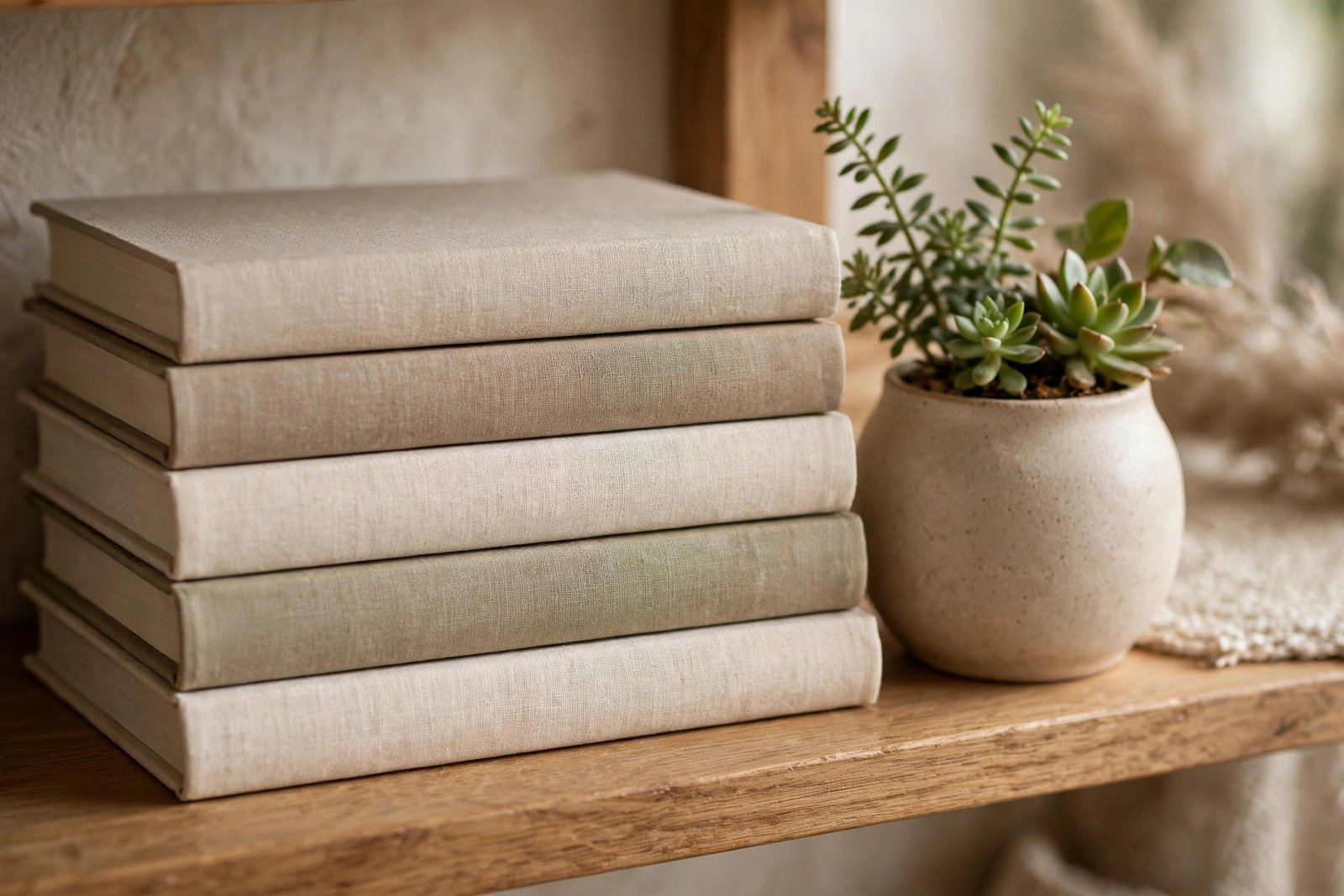
Return books in two arrangements, never just one. Vertical rows: a run of upright books, ideally held by the anchor or a bookend, with the tallest books at the outside of the row. Horizontal stacks: three to five books lying flat, which act as a low platform — an anchor in themselves, or a riser for a small object on top. A shelf that uses both arrangements gains rhythm; a shelf of only upright spines reads as a library stack, however tidy.
Step 4: Small groups, odd numbers
Add objects in groups of two or three, never single strays and never long rows. A small plant beside a stack. A candle, a tiny bowl and a framed photo as a triangle of heights. Leave a hand’s width between groups so each one reads separately. The containers you already own do heavy lifting here — a jar as a vase or a basket as a plant holder drops straight into this system, as shown in the guide to turning old jars, boxes and baskets into decor.
Step 5: Breathing space — then stop
Around a third of each shelf should stay empty. Empty space is not a gap waiting for a purchase; it is the frame that makes the groups visible. When a shelf looks right, stop, even if objects remain in the pile. Leftovers go to another room or a cupboard — a styled bookcase with a box of unused objects in storage beats a stuffed bookcase every time.
Colour and Repetition: The Glue Between Shelves
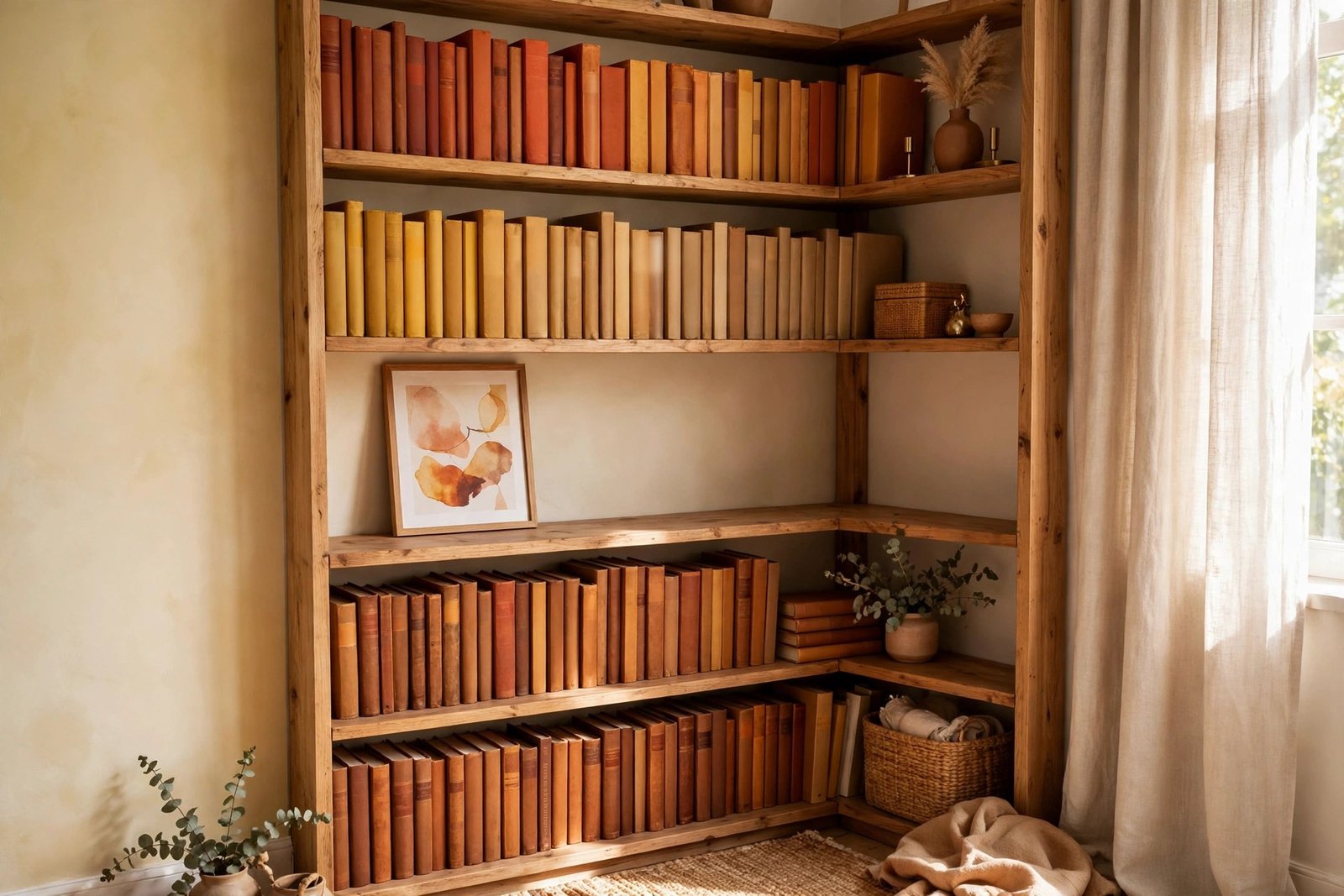
Within each shelf, the system places things. Across the whole bookcase, colour and repetition do the styling. Group books loosely by colour family — not a strict rainbow, which looks staged, but gentle clusters: dark spines together here, pale neutrals there. Or turn the loudest, most chaotic books spine-inward on one shelf if their covers fight the room (a trick to use sparingly, on rarely read shelves only). Then repeat two or three materials on every shelf — say wood, woven texture and one plant green — so each shelf rhymes with the others. This is the same one-family discipline that calms a display corner in the guide to turning wasted corner spaces into decor spots: a consistent group reads as one intentional place.
Step by Step: One Bookcase, Start to Finish
Time: 60–90 minutes for a standard five-shelf bookcase. Difficulty: beginner. Cost: $0–$10.
- Empty and clean (15 minutes). Everything off, shelves wiped, contents sorted into books, anchors, small objects and leave-outs.
- Choose the palette (5 minutes). Pick the room’s colours plus two or three materials to repeat (wood, basket weave, ceramic, plant green). Objects outside the palette go elsewhere.
- Place all anchors (10 minutes). One per shelf, zigzagged left-right-centre down the bookcase.
- Add books both ways (20 minutes). Vertical rows and horizontal stacks beside each anchor, tallest books at row ends, loosest colour grouping as you go.
- Add small groups (10 minutes). Two or three objects per shelf at most, in height triangles, a hand’s width from the books.
- The breathing-space check (5 minutes). Stand across the room. Any shelf with less than about a third empty loses one group to the leave-out box.
- The squint test (2 minutes). Squint at the bookcase: you should see a zigzag of anchors and calm patches of empty shelf, not a solid wall of stuff. Adjust the worst shelf only, then stop.
Materials and Costs
- Everything already on your shelves — $0
- One plant in a simple pot, if no shelf has a living anchor (optional) — $4–$8
- A basket or lidded box from elsewhere in the home (optional anchor) — $0
- Bookends, only if a row will not stand (optional) — $4–$8
- Cloth and basic cleaner for the empty shelves — $0–$2
The honest budget for this system is usually zero. If a shelf truly lacks an anchor, one plant or one moved basket fixes it better than a bag of new ornaments. More systems like this one are in the DIY decor and simple crafts collection.
Mistakes to Avoid
- Styling without emptying first. Shuffling objects on a full shelf keeps the same clutter in a new order. The system starts from bare shelves or not at all.
- Books upright on every shelf. One arrangement, repeated five times, looks like storage. Horizontal stacks are what break the library look and create platforms for objects.
- Filling every centimetre. A shelf with no empty space gives the eye nowhere to rest, and every group disappears into the mass. A third empty is the target, not the failure.
- Single stray objects. One small ornament alone on a shelf looks lost and emphasises the emptiness around it wrongly. Group in twos and threes, or remove it.
- A different style on every shelf. Seaside on shelf two, minimal on shelf four — the bookcase never becomes one piece. Repeat colours and materials down the whole unit.
- Anchors all in one column. Stacking every big item on the left makes the bookcase lean visually. Zigzag anchor positions shelf by shelf.
Frequently Asked Questions
How much of a shelf should really stay empty?
About a third, as a working rule. On a small shelf that might mean one group and one stack of books with clear space between them. If the squint test shows a solid mass, remove something — breathing space is the difference between a styled shelf and a stored one.
Should I organise books by colour or by subject?
Both, in layers: keep subjects together in broad zones of the bookcase (cooking on one shelf, novels across two), then within each run, nudge similar colours together. Heavy readers should keep subject order strict on the shelves they use daily and apply the colour grouping to display shelves instead.
What makes a good anchor object?
Anything large, calm and solid: a stack of big books, a healthy plant, a lidded basket, a leaning framed print, a wide bowl. One anchor per shelf, placed first. If an object needs explaining, it is not an anchor — anchors are the things the eye lands on and rests.
My bookcase is in a rented home and very plain. Can styling really change it?
Yes — styling is the one upgrade a plain bookcase fully allows, since it changes contents, not the unit. The system above, plus one repeated colour and one plant, makes the cheapest flat-pack bookcase read as a chosen piece of furniture. Nothing here needs a screw, a bracket or the landlord’s permission.