Your front door is the hardest-working piece of decor you own. It is the first thing guests see, the view you come home to, and the one display that works in every season — yet most doors get either nothing at all, or a different expensive setup bought four times a year.
There is a better system, and it is the rotation idea in miniature: build one good base setup once — a wreath base, a mat, and a pair of planters or lanterns — then make four small seasonal changes to that same base. This guide covers the base, the four swaps, renter-friendly versions, and the honest part nobody mentions: what actually survives outdoors.
Quick Answer
Set up a front door base that never changes: a plain wreath base (grapevine, twig or plain green), a simple coir or rubber mat, and a matching pair flanking the door — planters, lanterns or baskets. Then change only the dressing, four times a year: fresh flowers and a light ribbon in spring, lush greenery and a lantern glow in summer, a warm-toned wreath layer and gourds in autumn, and evergreen, pinecones and warm lights for the festive winter weeks. Each change takes ten minutes and a few dollars, because the expensive parts are already in place.
The Base Setup: Buy Once, Use All Year
- The wreath base: one sturdy plain base — grapevine or twig for a natural look, plain faux greenery for zero maintenance. Every seasonal version clips, ties or tucks onto this same base. Choose a size that suits the door: roughly half to two-thirds the door’s width reads generous; tiny wreaths look lost.
- The mat: a plain, hard-wearing coir or rubber mat in a natural tone. It grounds the setup, survives every season and never competes with the wreath.
- The pair: two matching elements, one each side of the door — planters, tall baskets, or lanterns. Symmetry is the cheapest elegance there is; a matched pair makes even a small porch look designed. The planters’ contents change seasonally; the planters do not.
- The light (if you add one thing): a lantern with a battery candle on a timer, or your porch light on a warm bulb. A door that glows at dusk looks decorated even in its plainest season.
Built once, this base follows the same core-and-layers logic as the simple decor rotation system indoors: a calm permanent core, light layers that swap. The base pieces live at the door all year — nothing extra to store.
Change 1: Spring — Fresh and Light
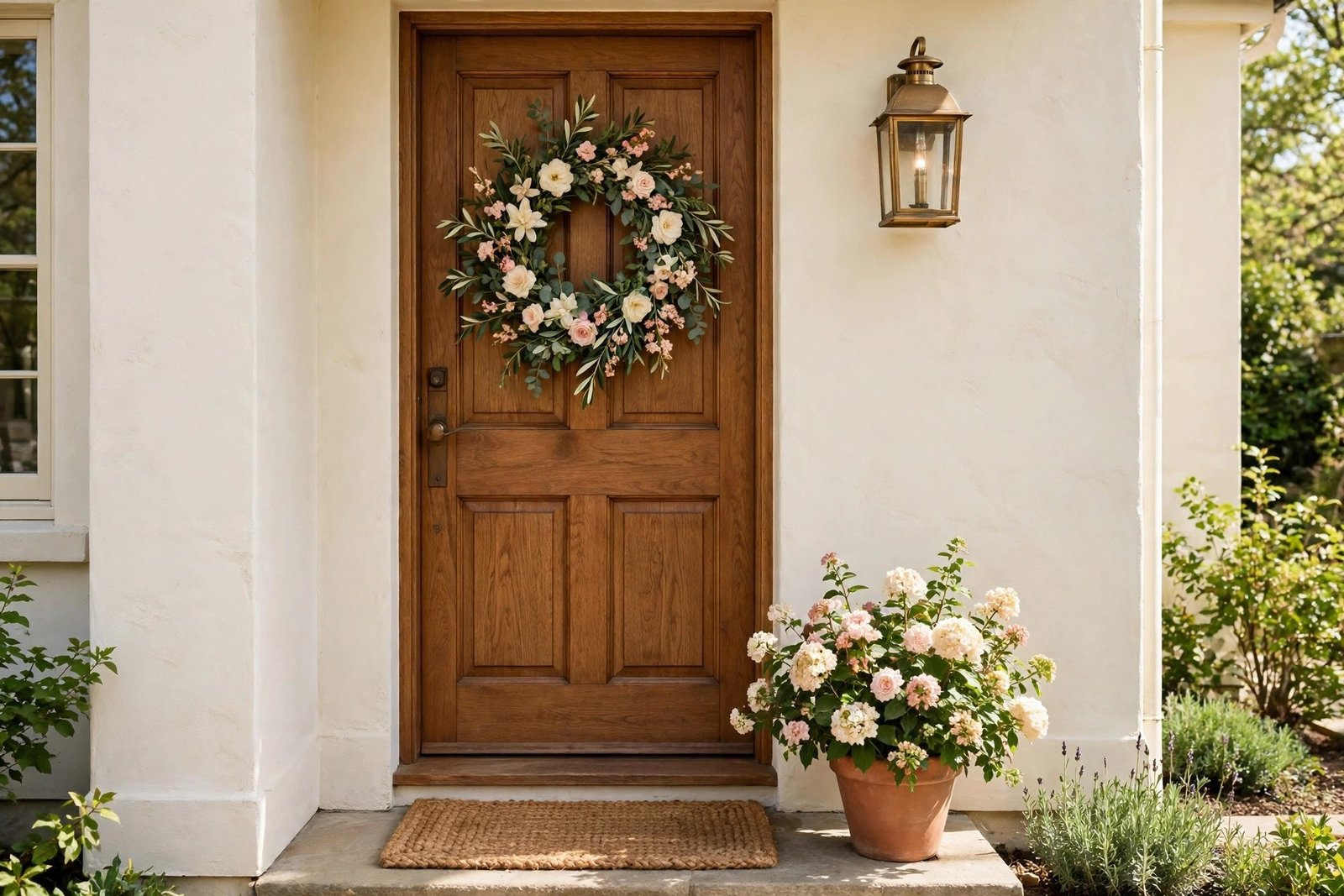
Tuck fresh or good faux spring flowers into the wreath base — blossom stems, tulips, or any soft-coloured spray — and tie on a ribbon in a pale colour. Fill the planters with spring flowers or fresh green plants, and swap the mat’s layer if you use a decorative top mat. Ten minutes of work, and the door sheds the winter completely. Keep the palette light: white, soft yellow, pale green, one blush tone.
Change 2: Summer — Green and Generous
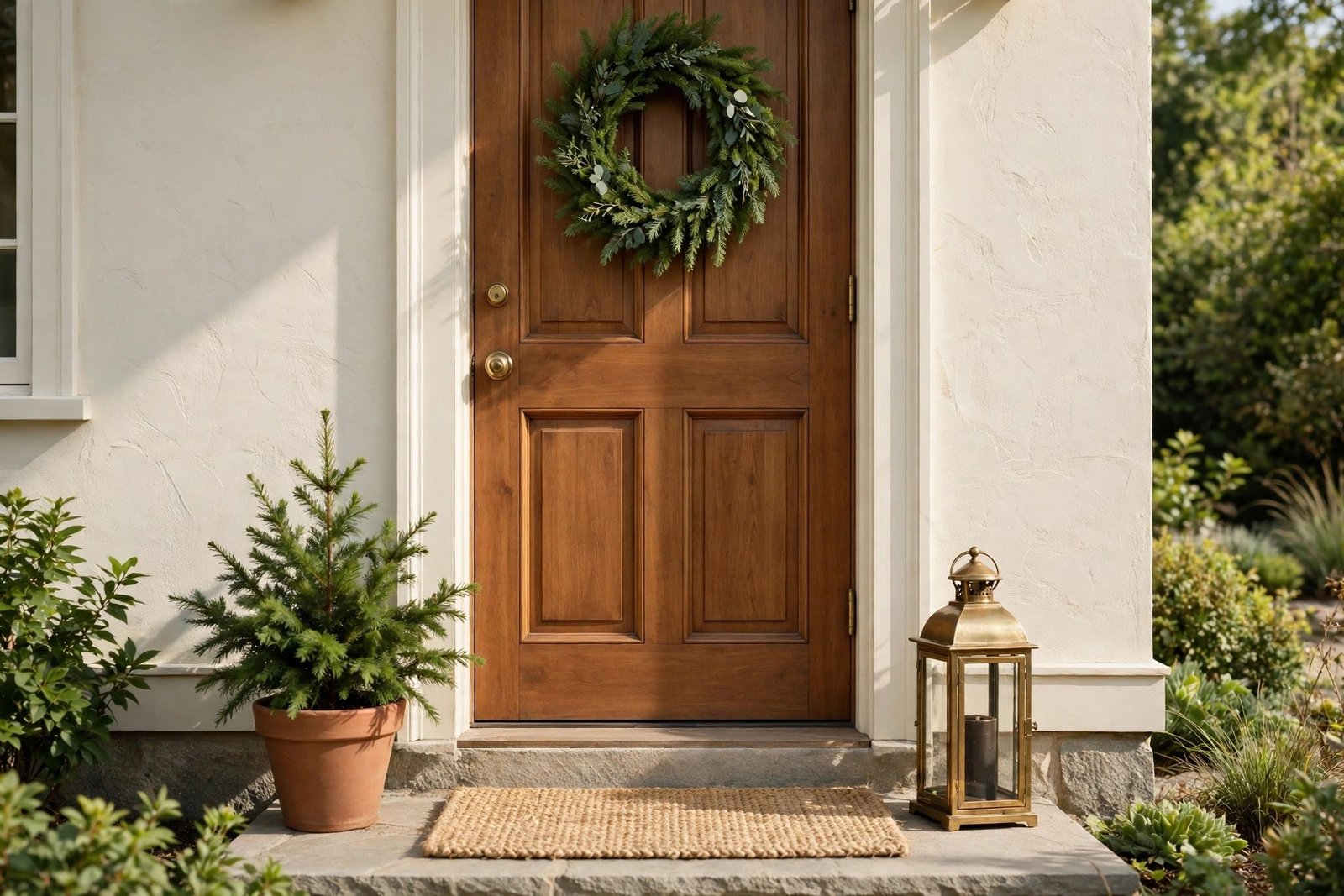
Summer asks the wreath to go lush: tuck in leafy greenery — real cuttings refreshed as needed, or full faux foliage — with a few strong-coloured flowers if you like them, or none at all for a calm all-green door. The planters go big and leafy too; summer is the season of abundance, and a generous green door looks cool and welcoming in the heat. The lantern comes into its own on summer evenings.
Change 3: Autumn — Warm and Layered
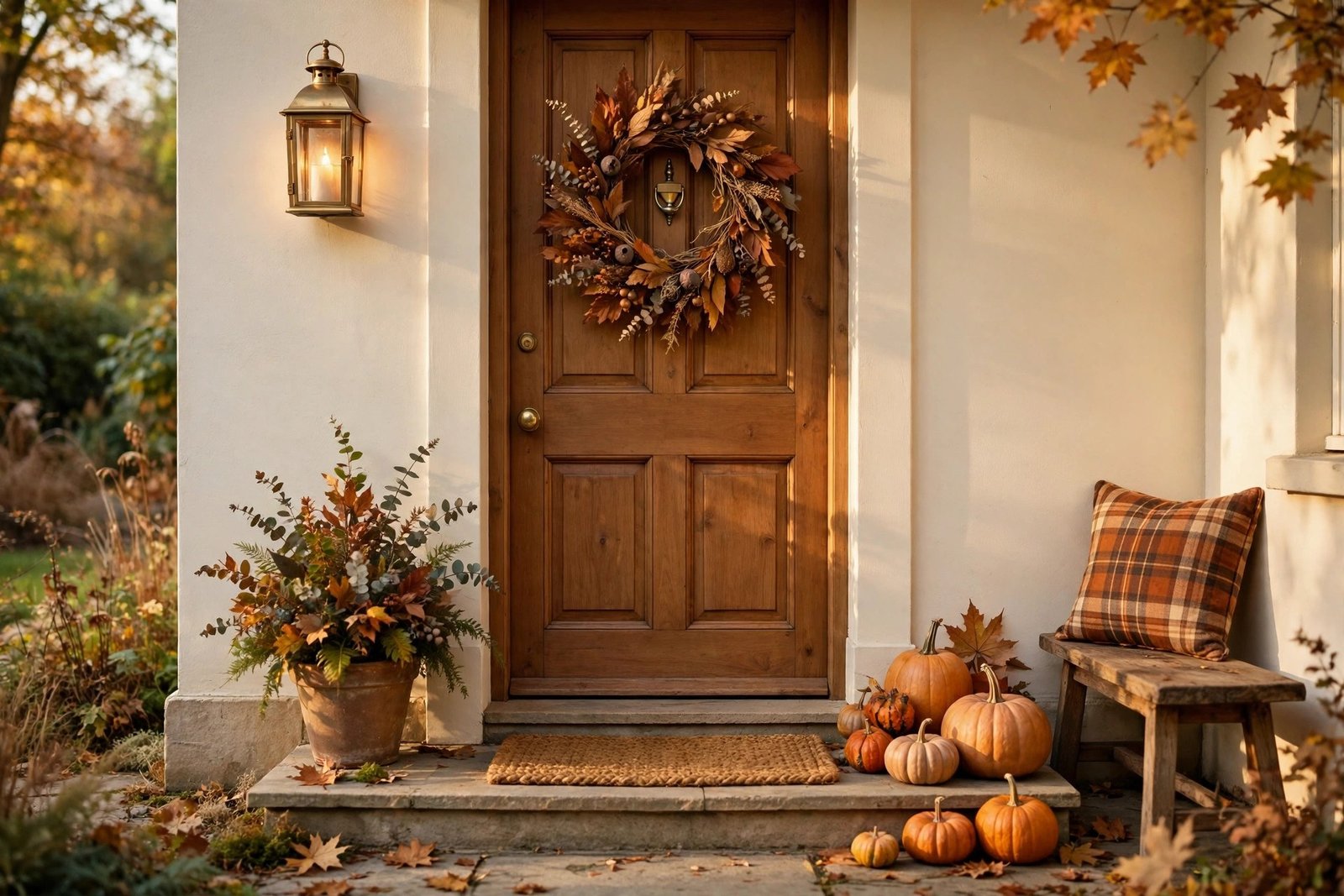
Keep the base, warm the dressing: dried grasses, wheat stems or branches with turning leaves tucked into the wreath, a ribbon in rust or deep gold, and the season’s easiest wins at the door’s feet — real pumpkins or gourds beside the planters, which switch to autumn plants or dried arrangements. The fixes in the guide to fall decor that looks cheap apply at the door exactly as indoors: real or matte materials, muted depth, orange as the accent rather than a flood.
Change 4: Winter and Festive Weeks — Evergreen and Glow
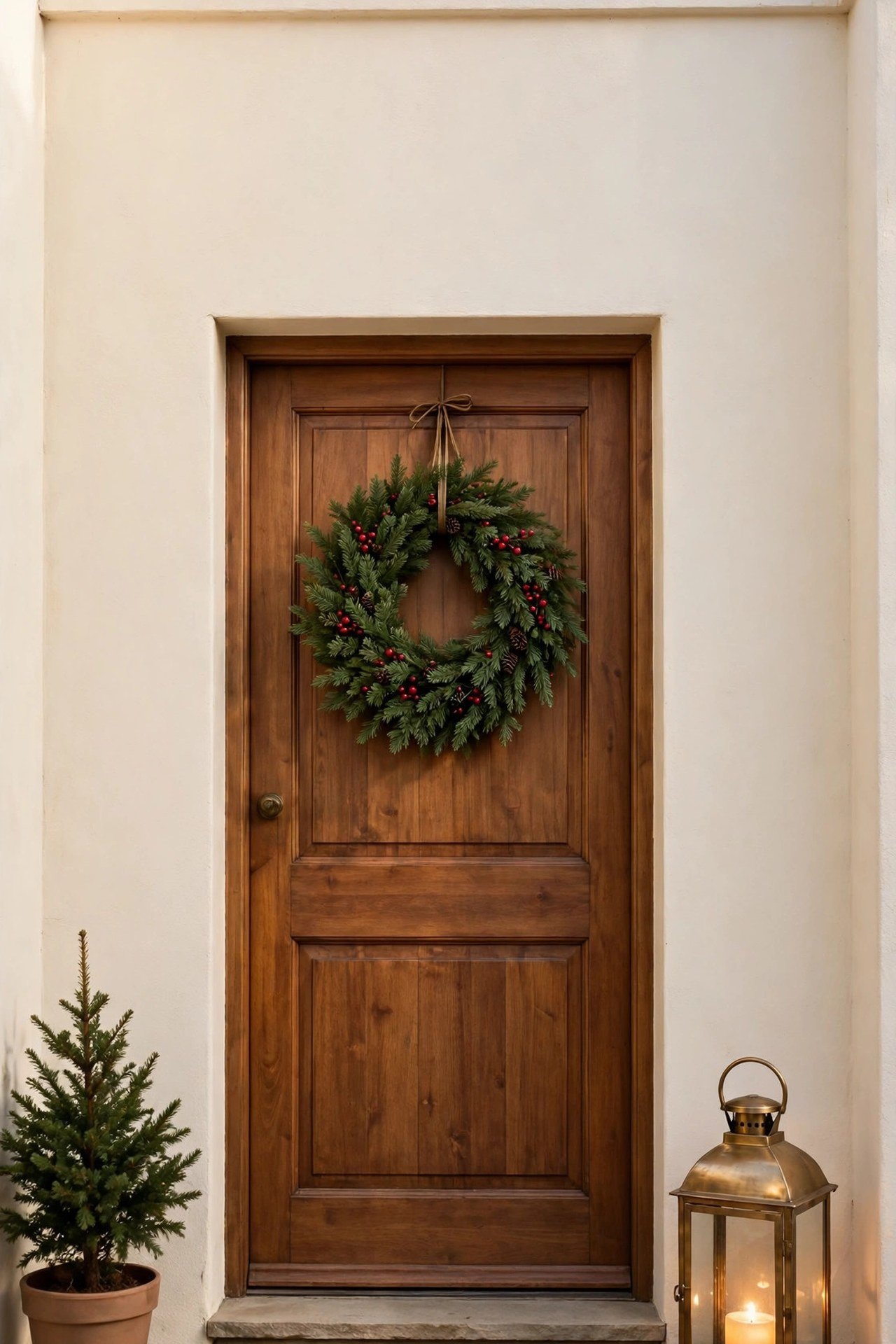
The winter change is the richest: evergreen cuttings or a full faux evergreen layer on the base, pinecones and a few baubles tucked in, a deep red or gold ribbon, and light — fairy lights woven through the wreath or the lanterns turned up as evenings darken. Planters take evergreen branches, cones and a few stems with berries. This is the version guests photograph, and it is still the same base, mat and pair underneath.
Renter-Friendly Versions
Almost every part of this system can be done without a single hole or permanent change:
- Over-door wreath hangers hook over the top of the door — no nails, no screws, gone in seconds. Removable adhesive hooks rated for outdoor use are the backup for smooth doors.
- No paint, no problem: if the door colour is not yours to change, let the wreath carry the colour instead — a slightly larger base dressed boldly does the same job.
- Freestanding everything: planters, baskets and lanterns simply stand; the mat lies flat. The entire setup leaves with you, and the door is untouched.
- Apartment doors and hallways: scale down to wreath plus mat plus one lantern; even an indoor hallway door benefits, and indoor pieces face no weather at all.
The Honest Part: Weather and Durability
- Sun fades. A south-facing door in strong sun will fade fabric ribbon and faux flowers within a season or two. Choose fade-resistant pieces for sunny doors, or accept ribbon as the cheap annual replacement it is.
- Rain rots and rusts. Natural dried materials look wonderful and last one season outdoors, sometimes less in a wet climate. Keep the most delicate pieces under a porch roof or use them on covered doors only; faux evergreen and metal survive anywhere.
- Wind rearranges. Lightweight wreaths and loose tuck-ins need wire or ties, not hope. Fix everything as if a storm is coming, because eventually one is.
- Real plants need real care. Planter plants at a door you pass daily get watered; plants at a side door you never use do not. Choose faux or very hardy plants for any door you cannot honestly commit to.
- Batteries and bulbs die quietly. Check the lantern monthly; a dead lantern reads as neglect, while a glowing one reads as care.
Step by Step: The Ten-Minute Changeover
- Strip the old dressing (3 minutes): untie and untuck the outgoing season from the wreath base; brush down the mat and planters.
- Dress the base (4 minutes): tuck in the new season’s material, working around the wreath evenly; add the ribbon last.
- Refresh the pair (2 minutes): swap or tidy the planter contents; check the lantern’s battery or candle.
- Step back and check (1 minute): view from the street or path, not from the doorstep — that is the view everyone else gets.
- Store the outgoing dressing in that season’s box, labelled — flat pieces only, which is all this system uses.
Materials and Costs
- Plain wreath base, grapevine/twig or faux greenery — $10–$20 (one-time)
- Coir or rubber door mat — $10–$18 (one-time, lasts years)
- A pair of planters, baskets or lanterns — $15–$35 the pair (one-time)
- Battery lantern candle with timer, if using lanterns — $6–$10
- Seasonal dressing per change — $0–$10 (garden cuttings, ribbon, a few stems)
- Over-door wreath hanger or outdoor adhesive hooks — $4–$8 (renter version)
The base costs $40–$80 once. After that, a full year of four seasonal doors costs less than one shop-bought “seasonal door set” — and looks better, because it was designed for your door.
Mistakes to Avoid
- Buying four complete setups. Four wreaths, four mats, four themes — quadruple cost and quadruple storage. One base, four dressings.
- A wreath that is too small. It is the most common door mistake. Measure: half to two-thirds of the door’s width is the generous range.
- Ignoring the weather reality. Delicate dried pieces on an exposed, rainy door last weeks, not a season. Match materials to your door’s exposure.
- One-sided decorating. A wreath alone on an otherwise bare, cluttered porch reads as an apology. Mat, pair and clear step complete the picture.
- Letting the changeover slide. Spring flowers in autumn quietly undo the whole system’s credibility. The changeover is ten minutes; tie it to the indoor changeover day.
- Blocking the door’s swing or the step. Planters belong to the sides, never in the walking line — a beautiful door nobody can comfortably open has failed.
More seasonal systems — rotation, storage, celebrations and swaps — are gathered in the seasonal and holiday decor collection.
Frequently Asked Questions
What if I have a porch or door colour I cannot change?
The base system never needed the door itself to change. Let the wreath do the colour work: dress the same base boldly per season, keep the mat neutral, and match the pair to each other rather than to the door. A well-dressed wreath on any door colour looks intentional, because the proportion and symmetry carry it.
How do I attach seasonal pieces to the wreath base without damaging it?
Tuck stems into the base’s weave, tie with thin wire or twine at the back, or use small clips — all removable, all reusable. Avoid glue: the whole system depends on the base surviving every changeover clean. A base that gets glued is a base you will replace within the year.
Can this system work for an apartment door in a hallway?
Yes, and it is the easiest version: no weather, no fading, no wind. Wreath plus hanger, a mat, and one lantern or a small basket beside the door. Indoor faux and dried pieces last for years in a hallway, so the seasonal dressings cost almost nothing after the first round.
When should each change happen?
When the season turns where you live — when the light and weather change, not on a fixed date. Most people find the natural moments are: when spring flowers first appear, when summer heat settles in, when leaves start turning, and when the festive weeks approach. Doing the door on the same day as the indoor rotation changeover keeps both systems honest.