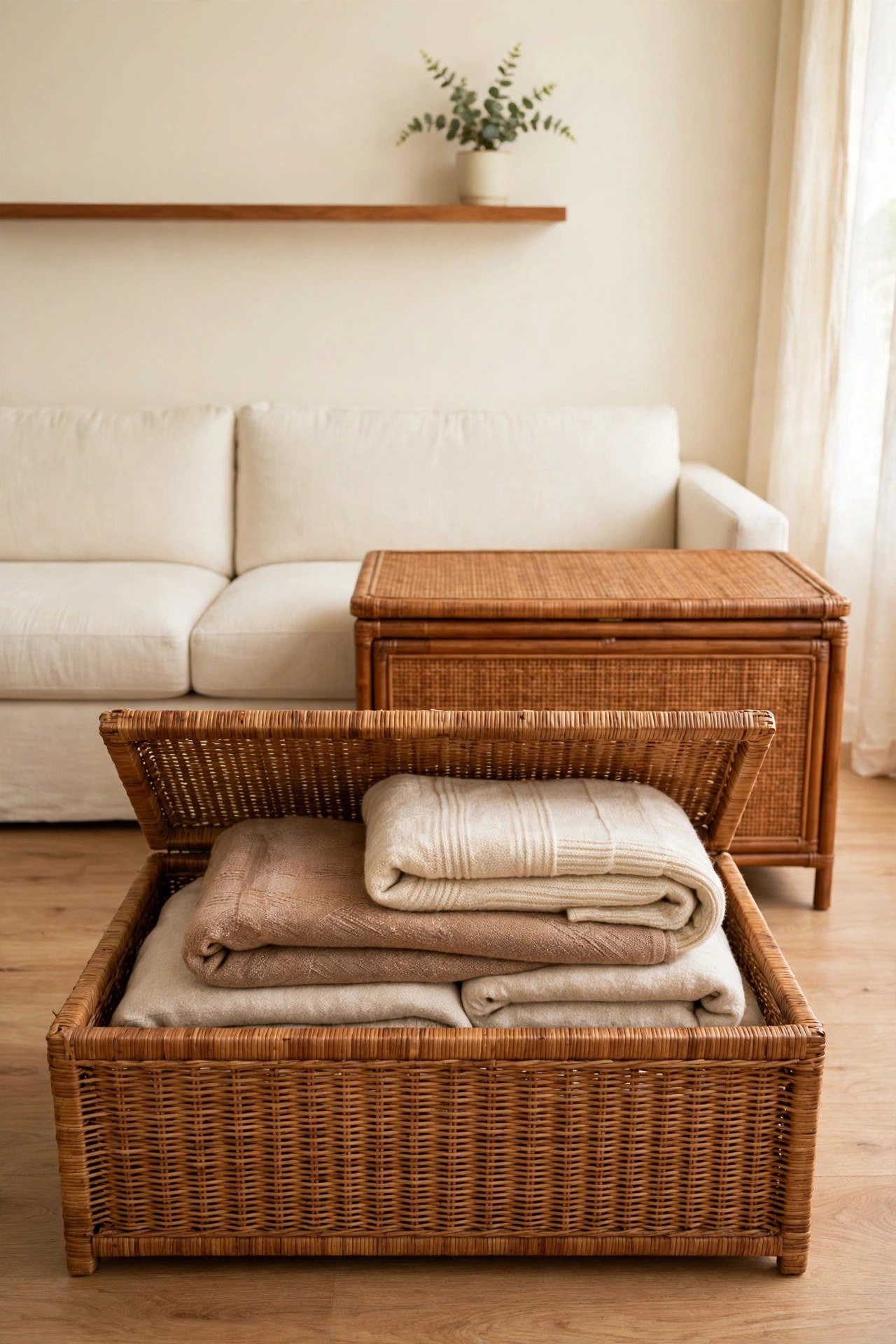
Some homes have a storage room. Most do not. In a small home, everything the household owns competes for the same few cupboards, and the things that lose the competition end up visible — stacked in corners, lined along walls, turning every room into a warehouse with furniture in it.
The way out is not more square metres. It is the storage hiding inside the furniture and dead space you already have: under beds, inside seating, behind doors, above eye level. This guide audits a small home room by room for that hidden capacity — and ends with the rule that makes hidden storage work instead of becoming a memory test. It is also the piece that pulls this whole category together: pretty storage, point-of-use homes and hidden storage are one system, and this is where they meet.
Quick Answer
A small home with no storage room gains storage by using the space inside and under furniture it already owns: lidded boxes under beds, storage ottomans and benches in living areas, hooks and slim shelves behind doors, boxes under stairs and sofas, and shelves in the dead space above eye level. Keep it findable with one rule — every hidden home gets a label inside its lid and a line on one simple list kept in a kitchen drawer — and the home gains a storage room’s worth of capacity without a single new room.
The Principle: Hidden, Calm and Findable
Hidden storage has one job: to hold the things a room needs nearby but does not need to display — spares, seasonal items, the rarely used, the bulky. What a room uses daily belongs in the point-of-use systems covered across this category; what it uses monthly belongs hidden. And hidden storage only works if it meets three tests: it is genuinely out of sight (a lid, a door, a skirt of fabric), it is dressed in the room’s materials so the hiding place itself reads as decor, and you can find what is in it without opening everything. The third test is the one most hidden storage fails — so it gets its own rule, below.
Room by Room: The Hidden Storage Audit
Living room: inside the seating
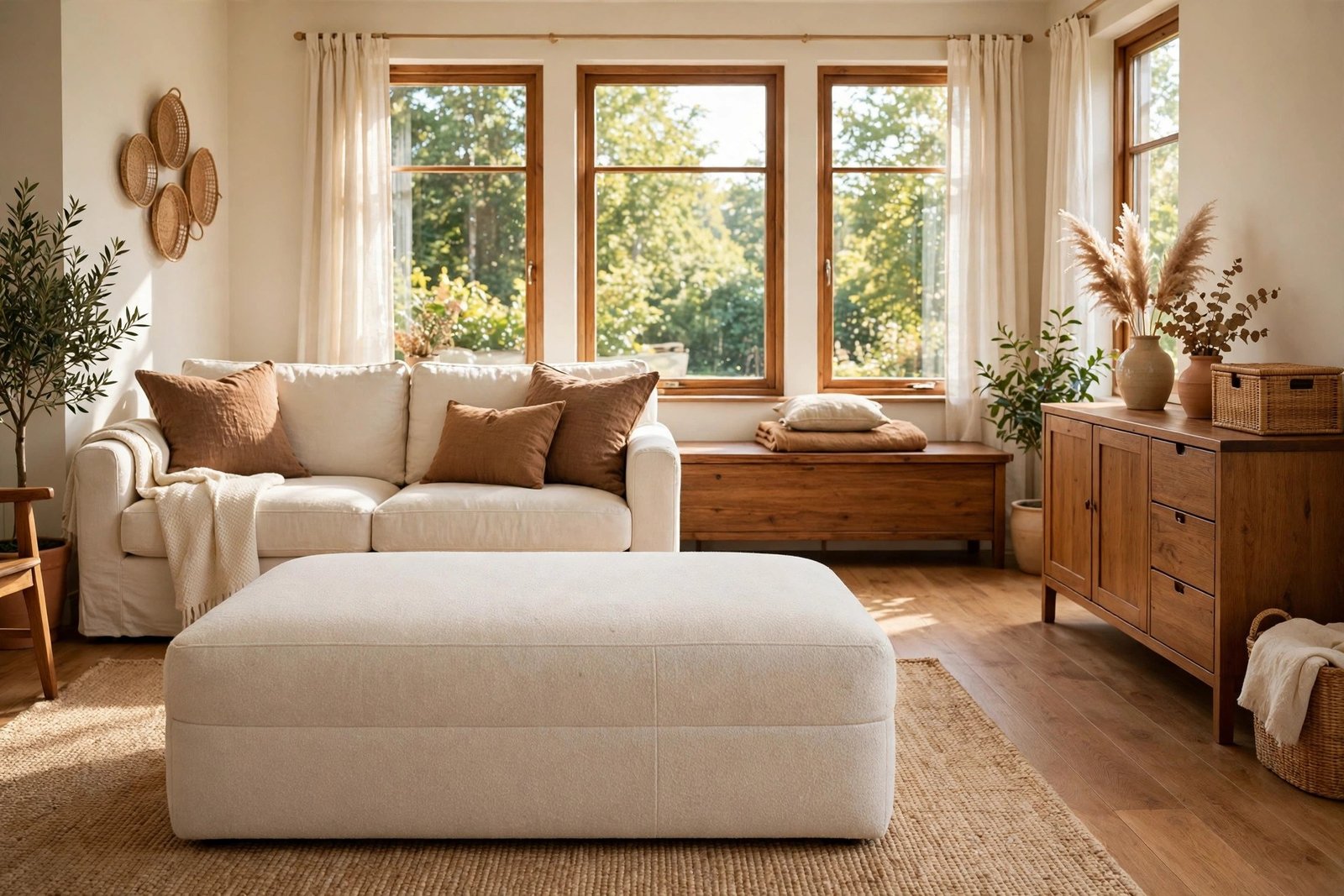
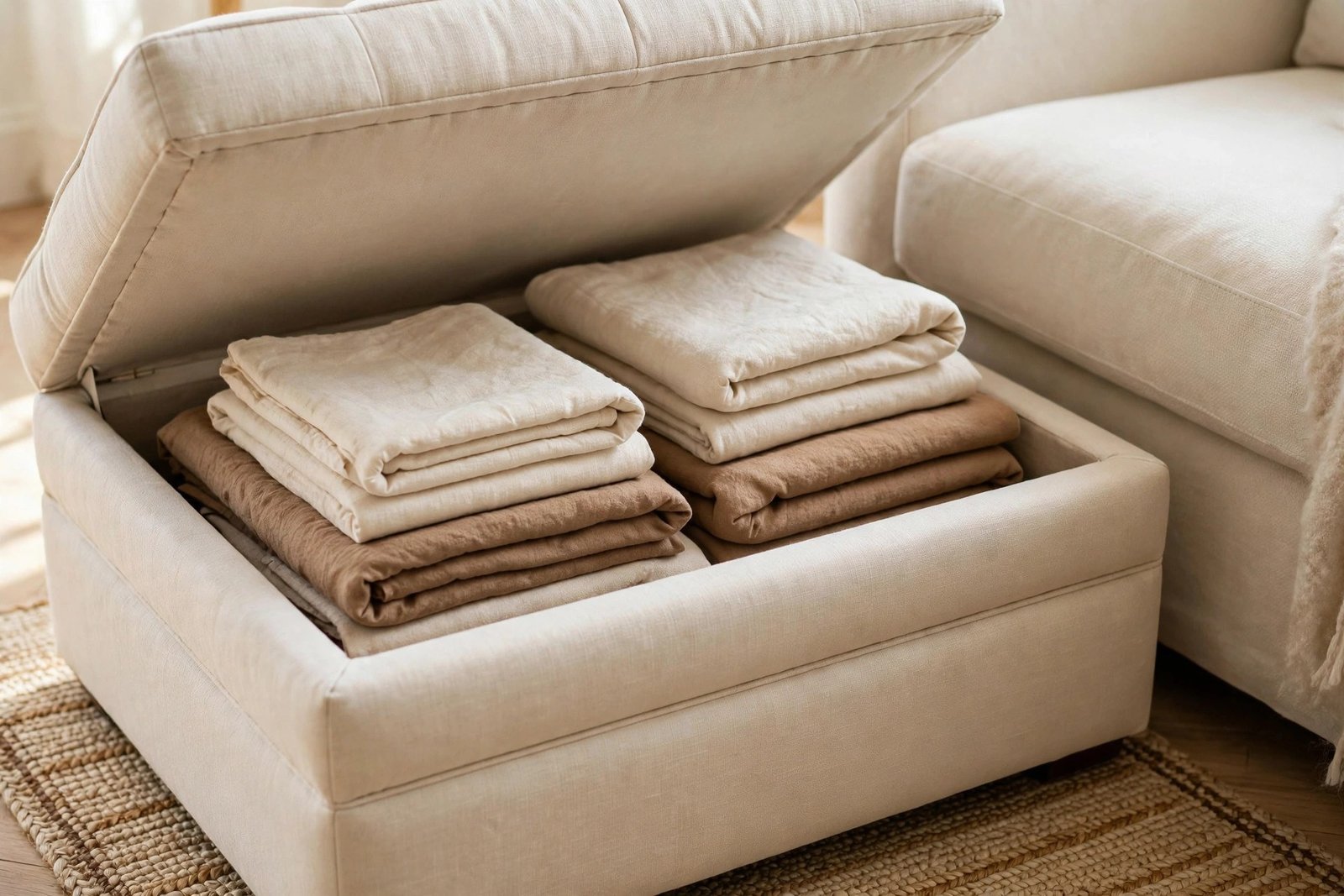
The living room’s hidden capacity lives in its furniture. A storage ottoman holds blankets, games or the toy rotation; a lidded bench under the window swallows cushions and crafts; the closed lower half of a sideboard takes the rest. This is the same furniture doing double duty as the pretty storage that looks like decor approach — the only difference is intent: pretty storage displays calm on the surface, hidden storage removes things from the surface entirely. Check under the sofa, too: many have 10–15 cm of clearance, enough for slim boxes of gift wrap, board games or the out-of-season throws.
Entryway: behind the door, above the door
Small entryways hide more than they show. Over-door hooks and slim racks hold bags and hats on the door’s back face; a shallow shelf above the door frame — space that is literally never looked at — takes a row of matching boxes for gloves, torches and the seasonal extras. The landing-zone system in the guide to decor-friendly entryway storage handles what arrives daily; the hidden layer above and behind the door handles everything else.
Bedroom: under the bed is a cupboard lying down
The single biggest hidden space in most homes is under the beds: a double bed hides roughly a wardrobe’s floor area. Low lidded boxes — one for spare and guest linen, one for out-of-season clothes, one for the rarely used — turn it into flat, ordered storage. Behind the bedroom door, hooks take dressing gowns and tomorrow’s outfit; a tall narrow shelf in the dead corner beside the wardrobe takes the overflow boxes. Keep daily things out of the under-bed zone, though: it is a monthly-access space, and anything you need weekly will make you resent it.
Kitchen and bathroom: the gaps and the heights
Kitchens hide storage in the kick-space under cupboards (shallow drawers exist for exactly this), on top of wall cupboards (matching boxes for the rarely used appliances and party pieces), and inside the dead corner cupboard with a simple carousel or boxes sized to reach. Bathrooms hide it in the vanity’s under-sink boxes and in a shelf above the door — the same above-door trick as the entryway, holding spare towels and back-stock where steam reaches least.
Everywhere: stairs, walls and dead vertical space
Under-stairs space — even a low triangle — takes boxes on a simple pull-out board. The wall strip between a door frame and the ceiling, the top of every wardrobe, the sliver behind a hinged door: small homes are full of these dead zones, and each one holds a shelf or a row of hooks. Audit with your eyes at ceiling height; the capacity is usually there, just never claimed.
The Findability Rule: Hidden Must Still Be Findable
Hidden storage fails in one predictable way: three months later, nobody remembers where anything is, boxes get opened at random, and the system collapses into rummaging. Prevent it with two habits that take minutes:
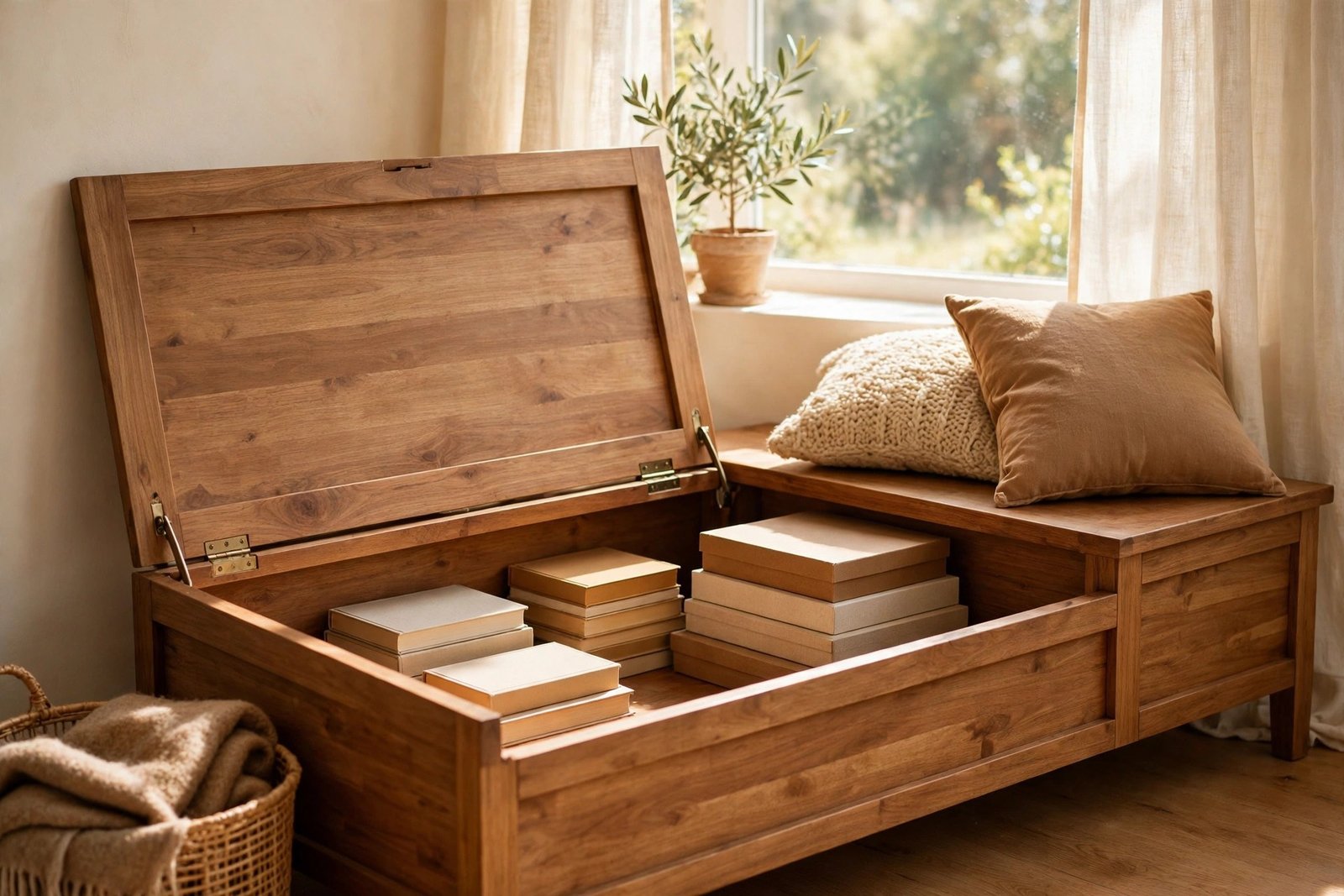
- Label inside the lid. Every box and ottoman gets its contents written inside its lid or on a card taped there — the outside stays calm, the inside tells the truth.
- Keep one master list. A single page — in a kitchen drawer, or a note on your phone — listing each hidden home and its contents in one line each: “Ottoman: blankets, board games.” Update it when a box’s contents change; the update is one line, and it is what separates a system from a stash.
- One category per hiding place. A box that holds spare linen and tax papers and batteries will be opened for all three and tidied for none. Hidden homes follow the same law as visible ones: one home, one job.
Step by Step: The One-Afternoon Audit
- Walk the home with a notebook, room by room, and list every candidate: under each bed, inside each seat, behind each door, above each cupboard, under the stairs. Measure the useful gaps roughly — height matters most.
- List what needs hiding: the visible stacks and corner piles, room by room. Match each pile to a hiding place in the same room or the nearest one — hidden storage that requires a journey will not be used.
- Buy or gather the containers last — matching lidded boxes sized to the measured gaps, in each room’s palette. Containers bought before measuring are how new clutter is born.
- Fill, label inside the lids, and write the master list as you go. Photograph the list if paper worries you.
- Live with it a month, then adjust: the box you open weekly moves to an easier home; the one never opened can go deeper. The audit is a draft; the month makes it accurate.
Materials and Costs
- Low lidded under-bed boxes, 2–3 per bed — $10–$18 each
- Storage ottoman or lidded bench, if seating needs replacing — $40–$90
- Over-door hooks/rack — $8–$15 each
- Above-door or high shelf boards and brackets — $10–$25 per shelf
- Matching boxes for tops of cupboards and stairs space — $8–$15 each
- Labels/cards for inside lids — $0–$4
Mistakes to Avoid
- Hiding daily things. Under-bed boxes and above-door shelves are monthly-access homes. Bury the daily and you will leave it out instead — the system fails by design, not by discipline.
- Hidden storage with no labels or list. Unlabelled hidden storage is just losing things indoors. The inside-lid label and the one-page list are not extras; they are the mechanism.
- Containers before measurements. Dead space is irregular — 12 cm under one sofa, 20 under a bed. Measure the gaps first, or the boxes join the piles they were bought to fix.
- Filling every hidden space to the brim. A hiding place packed solid cannot be searched or added to. Leave each box a little slack; the goal is a home that works, not a record attempt.
The Bigger Picture: One System, Every Room
Look back across the rooms and the pattern of this whole category emerges: things used daily live at their point of use in pretty, closed storage that matches the room; things used monthly live hidden inside the furniture and dead space; everything is labelled where the eye does not have to see it; and a two-minute reset keeps the surface honest. Entryway, kitchen counter, wardrobe, toy basket, linen shelf — they were never separate projects. They are one idea applied at different depths: a home where storage is designed as carefully as decor, because in a small home, storage is most of the decor. Browse the full home organisation with decor collection to see the system room by room.
Frequently Asked Questions
Won’t I just forget everything I hide?
That is the failure the findability rule exists to prevent. Inside-lid labels tell you what a box holds the moment you open it, and the one-page master list tells you which box to open. Homes that skip both do get forgotten — which is why the list, not memory, is the system.
Where do I start if the budget is small?
Under the bed. It is the largest hidden space, needs only two or three low boxes, and immediately absorbs the bedroom’s worst piles — spare linen, seasonal clothes. Second: behind doors, where hooks cost almost nothing. Ottomans and benches come last, when furniture is being replaced anyway.
Does under-bed storage get dusty and forgotten?
Lidded boxes solve the dust — that is why lids are non-negotiable there — and the master list solves the forgetting. Vacuum under the bed when the boxes come out for a seasonal swap; the boxes themselves keep their contents clean between times.
Hidden storage or pretty visible storage — which should come first?
Visible first, for the daily things: a room calms down fastest when what is out is contained and matched. Hidden storage second, to absorb the monthly and seasonal load so the visible systems stop overflowing. Done in that order, each layer protects the other — and the small home ends up feeling, finally, like it has room to spare.