There is a particular moment every parent knows: you sit down in your own living room in the evening, look around, and realise the room no longer belongs to you. Blocks under the coffee table, a toy kitchen colonising the corner, soft toys holding a meeting on the sofa, and small plastic pieces migrating toward every doorway. The children are asleep. The toys are still running the house.
The answer is not a playroom you do not have, and it is not banning toys from the living room — children live in the home too, and play near the family is good for everyone. The answer is containment that respects both sides: toys get a real, reachable home in the room, and the room keeps its calm, grown-up look. This guide sets up that truce with rotation, matching closed storage, a defined play zone and one short evening ritual.
Quick Answer
Kids’ toys take over the living room because everything is out at once, stored in open boxes that display the chaos, and free to spread across the whole room. Contain them by rotating toys — only a portion out at a time, the rest stored away and swapped weekly — keeping the out-portion in closed baskets and furniture that match the room’s colours, defining one play zone (a rug is enough), and finishing each day with a five-minute reset the children help with. The toys stay in the room; the visual takeover ends.
Why Toys Win the Living Room
Everything is out at the same time
Most toy takeovers are a numbers problem. When every toy a child owns is available at once, the floor fills simply because there is more toy than floor. Children do not play with more toys when more are out — they play with a handful and scatter the rest. The surplus is not play value; it is visual noise with batteries.
The storage shows the mess instead of hiding it
Open toy chests and clear boxes put the jumble on permanent display. Twenty bright, mismatched shapes behind no door read as clutter even when they are technically “put away.” In a room styled for calm, the storage itself has to be part of the decor — closed, matched, and quiet in colour.
Play has no boundary
Without a defined play area, toys travel: a puzzle starts on the rug and finishes under the dining table. Children accept boundaries easily when the boundary is physical and visible — they just rarely get one.

Step 1: Rotate — Only Some Toys Out at Once
The single most effective change costs nothing. Divide the toys into three or four groups of similar size — a building set and books in one, vehicles and figures in another — and put all but one group away: in a cupboard, under a bed, in a lidded box in another room. The group that stays out is this week’s collection. Next week, swap.
- Play gets better, not worse. With fewer choices, children play longer with each toy, and the “new” group arriving each week feels like a small event — old toys become interesting again.
- The room’s maths changes. A third of the toys on the floor is a third of the mess, and one basket now genuinely holds everything that is out.
- Keep safety in the sorting: toys with small parts stay in the stored groups or in a closed box on a shelf, out of reach of any child under three — rotation is also the easy way to separate age groups in a mixed-age house.
Step 2: Closed Baskets That Match the Room
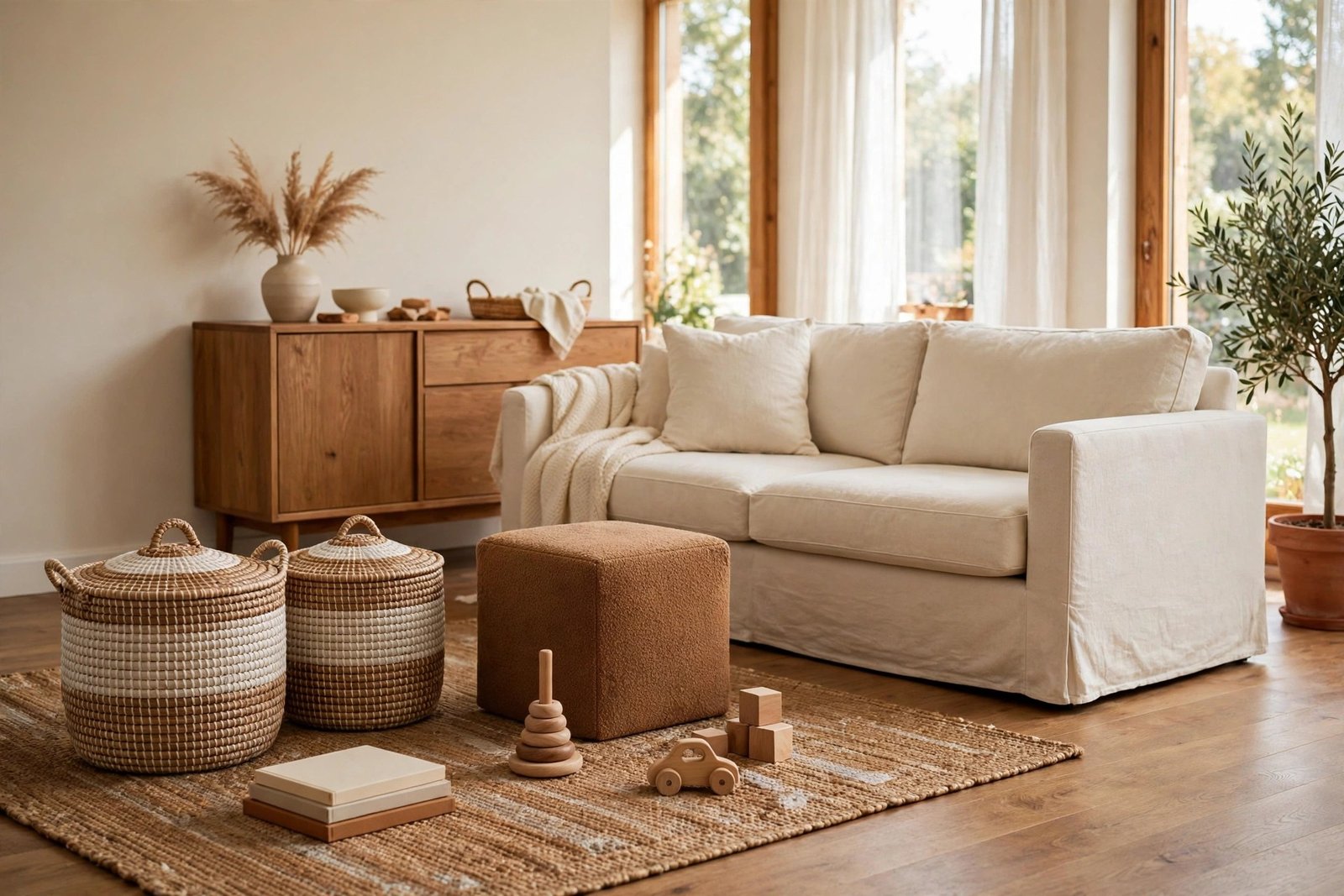
The toys that are out need a home the eye can rest on. Choose two or three closed baskets or lidded boxes in the living room’s own palette — the same woven texture as your other baskets, the same wood tone, the same fabric family — and let those be the toy storage, full stop.
- Closed beats open. A lid turns forty small shapes into one calm object. It also makes the evening reset a thirty-second job: sweep, drop, lid.
- One basket per type, kept small. Smaller baskets fill faster, which is the point — when one overflows, something rotates out. Big chests invite everything.
- Same palette as the room’s other storage. This is the grouping rule behind the guide to pretty storage that looks like decor: matched, closed containers read as furniture styling, whatever they hold. Toy baskets that match the room stop announcing “toy corner” and simply look like the room.
Step 3: Give Play a Zone
Decide where play happens and mark it with the oldest trick in decorating: a rug. The play zone is the rug beside the sofa, or the corner near the window — somewhere with floor space that is not a walkway. Toys live in their baskets at the zone’s edge, and play happens on the rug.
- The rule is spatial, not strict: toys can travel a little, but the home base is the zone, and the reset returns everything to it.
- Anchor the zone with furniture — the baskets on one side, a small chair or cushion on the other — so it reads as a designed corner of the room rather than a spill.
- Hard floors need the rug most: it softens noise, defines the boundary visually, and makes kneeling-level play more comfortable.
Step 4: Furniture That Hides Toys
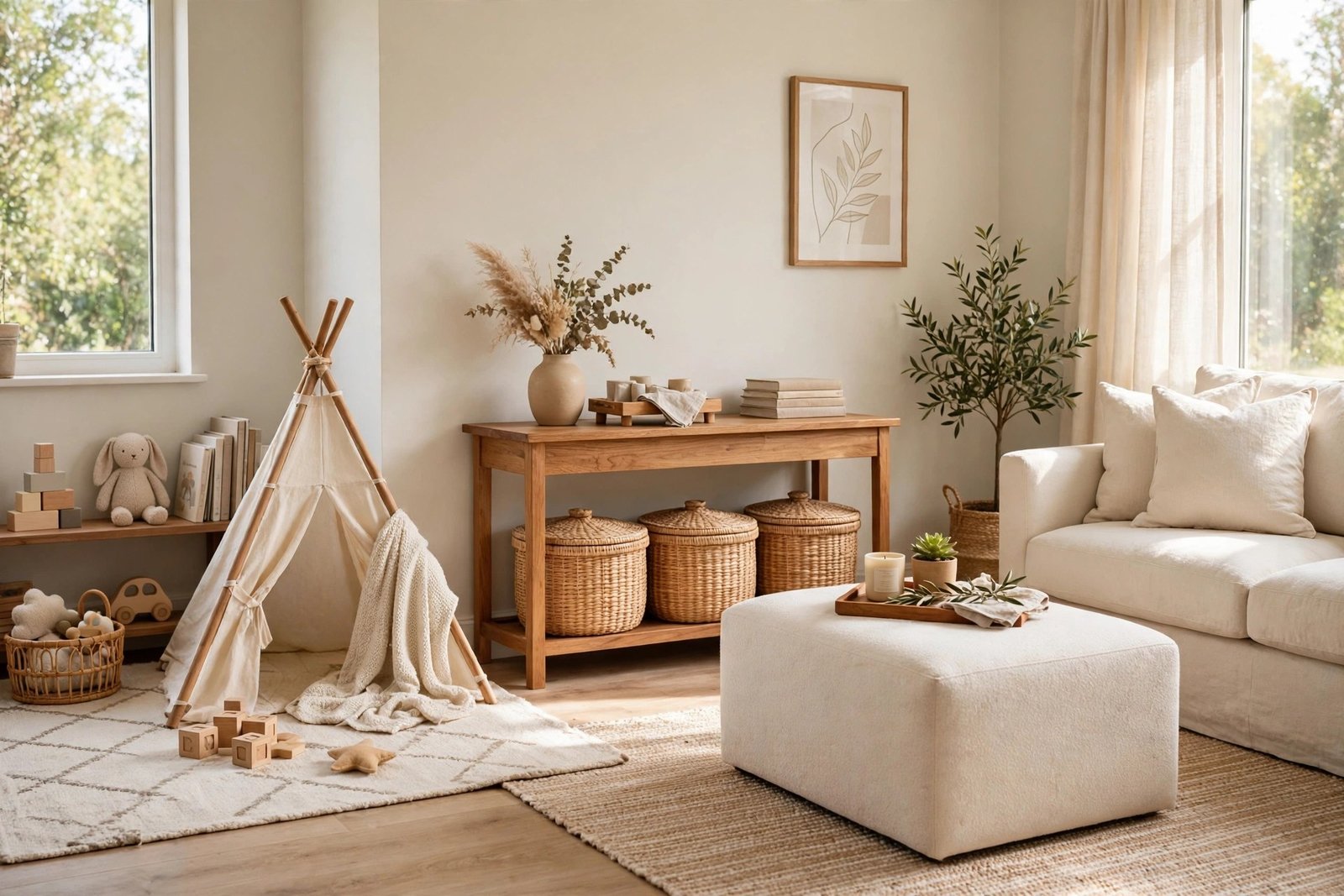
When baskets are not enough — board games, craft supplies, the big play sets — let furniture do the hiding. A storage ottoman in front of the sofa, a lidded bench under the window, or the closed half of a sideboard can each swallow a category of toys while working as ordinary, good-looking furniture all day. Choose pieces in the room’s materials so the storage stays invisible; the room-by-room approach in the guide to hidden storage in every room shows the same trick working in the rest of the house. Practical points: pick benches and ottomans that are stable and will not tip when a child climbs or leans, prefer soft-close or lightweight lids little fingers can manage safely, and keep the heaviest items in low furniture, never on high shelves above play space.
Step 5: The Five-Minute Evening Reset
Systems survive on rituals, and this one is short enough for tired people — including the small ones. When play ends for the day, set a timer for five minutes and reset together: toys back into their baskets, baskets back to the zone’s edge, cushions back on the sofa. Children who “own” the reset treat it as the end of play rather than a chore imposed on it, and the room you sit in at 8 p.m. is a living room again. Whatever does not fit in the baskets is the signal — something rotates out this week. For the full set of room-by-room systems in this spirit, browse the home organisation with decor collection.
Materials and Costs
- Closed baskets or lidded boxes in the room’s palette, 2–3 — $10–$20 each
- A rug to define the play zone, if the room lacks one — $30–$80, or move one from another room
- Storage ottoman or lidded bench — $40–$90
- Lidded boxes for the rotated-out groups (cupboard/under-bed) — $8–$15 each
- Small labels or picture tags for baskets (pre-readers find their own basket) — $0–$4
Mistakes to Avoid
- A giant open toy chest. It displays the jumble, encourages dig-and-scatter, and swallows small pieces forever. Closed, smaller, matched containers win on every count.
- Rotating without storing properly. Groups dumped in bin bags in a corner become their own clutter. The stored groups need the same lidded boxes, in their out-of-the-way home.
- Toy storage in a clashing palette. Primary-coloured plastic bins in a calm neutral room shout all day. The toys are colourful enough; the storage should be the quiet part.
- A reset only adults do. If tidying is a grown-up punishment delivered after bedtime, it breeds more mess, not less. Five minutes, together, with a timer, is a game — finishing it is the routine.
- No overflow rule. Birthdays and gifts add toys constantly. Without one-in-one-out (or one-in, one-rotated-out), every system drowns by spring.
Frequently Asked Questions
How many toys should be out at once?
A useful guide: everything out should fit in the room’s toy baskets with the lids closing, plus the one or two large items that live in the play zone. For most living rooms that means roughly a quarter to a third of the total collection. If the reset takes longer than five minutes, too much is out.
What about big toys that fit nowhere — play kitchens, ride-ons?
Give the biggest item a permanent “parking spot” in the play zone and style around it: parked neatly against the wall, it reads as part of the corner. If two big items compete, one joins the rotation — a month in storage makes it exciting again. Big items stored in the open elsewhere in the room are what actually reads as takeover.
My children resist tidying. How does the reset survive?
Make it smaller and more predictable: same time (right after dinner or before bath), same short timer, same song if that helps. Sorting into two or three baskets is a task a three-year-old can finish; sorting into a huge chest is not. And rotate generously at first — less out means a reset they can actually win.
Are open shelves with toy bins ever a good idea?
In a dedicated playroom, yes. In a living room you also relax in, closed storage is kinder to the eye — the shelf itself can stay, but give the toys uniform lidded boxes on it rather than open bins, and keep one shelf section for the room’s own decor so the unit still belongs to the living room.
