
Every living room has two inventories: the things that belong to the room, and the things that are just passing through — remotes, chargers, blankets, books in progress, toys on tour, paperwork waiting for a decision. The first list decorates the room. The second list is the clutter, and it looks like clutter for one simple reason: it has nowhere to hide. Open surfaces become its home, and a room whose surfaces are covered reads as messy no matter how clean it is.
The fix is not to own less of a life. It is to give the passing-through things closed, good-looking places to land — storage that reads as furniture and decor, so the room looks styled even on an ordinary Tuesday. This guide explains where living room clutter really comes from, ranks the storage types that actually hide it, and gives you a room-by-room placement plan.
Quick Answer
Living room clutter builds up because everyday items have no closed home within reach of where they are used. Fix it with pretty, closed storage: lidded baskets and boxes in matching materials, and furniture that doubles as storage — a storage ottoman, a trunk or lidded coffee table, a sideboard or cabinet with doors. Keep one closed container within arm’s reach of every seat, match containers so they read as a designed set, and pair the system with a gentle one-in-one-out rule so the hidden storage never silently overflows.
Where Living Room Clutter Actually Comes From
It is tempting to blame the amount of stuff, but most living rooms hold a reasonable amount. The real causes are three quieter ones.
Items in transit with no destination
A book being read, a blanket in nightly use, a charger that serves the sofa — these are not clutter by nature. They become clutter when using them means leaving them out, because putting them “away” means carrying them to another room. Anything that must travel to be stored will live on the nearest surface instead. Storage works when it sits at the point of use.
Open storage that displays the mess
Open shelves, clear boxes and gaping baskets do hold things — they just hold them in full view. A shelf of mixed everyday objects looks busy even when it is perfectly arranged, because the eye reads variety as clutter. Closed doors, lids and opaque containers are what convert “stored” into “gone.”
Containers that match nothing
A plastic tub here, a cardboard box there, a gift bag doing duty as a toy bin: each container may be tidy inside, but the collection looks improvised, and improvised reads as messy. The same objects in three matching baskets read as a deliberate design choice. Much of “pretty storage” is simply consistency.
If the sheer number of small visible objects is also part of the problem, do the edit first — the grouping and breathing-space system in the guide to fixing a room cluttered with small decor items pairs with this guide: edit what is on show, then hide what is in use.

The Pretty Storage Taxonomy, Ranked
1. Furniture that doubles as storage (best)
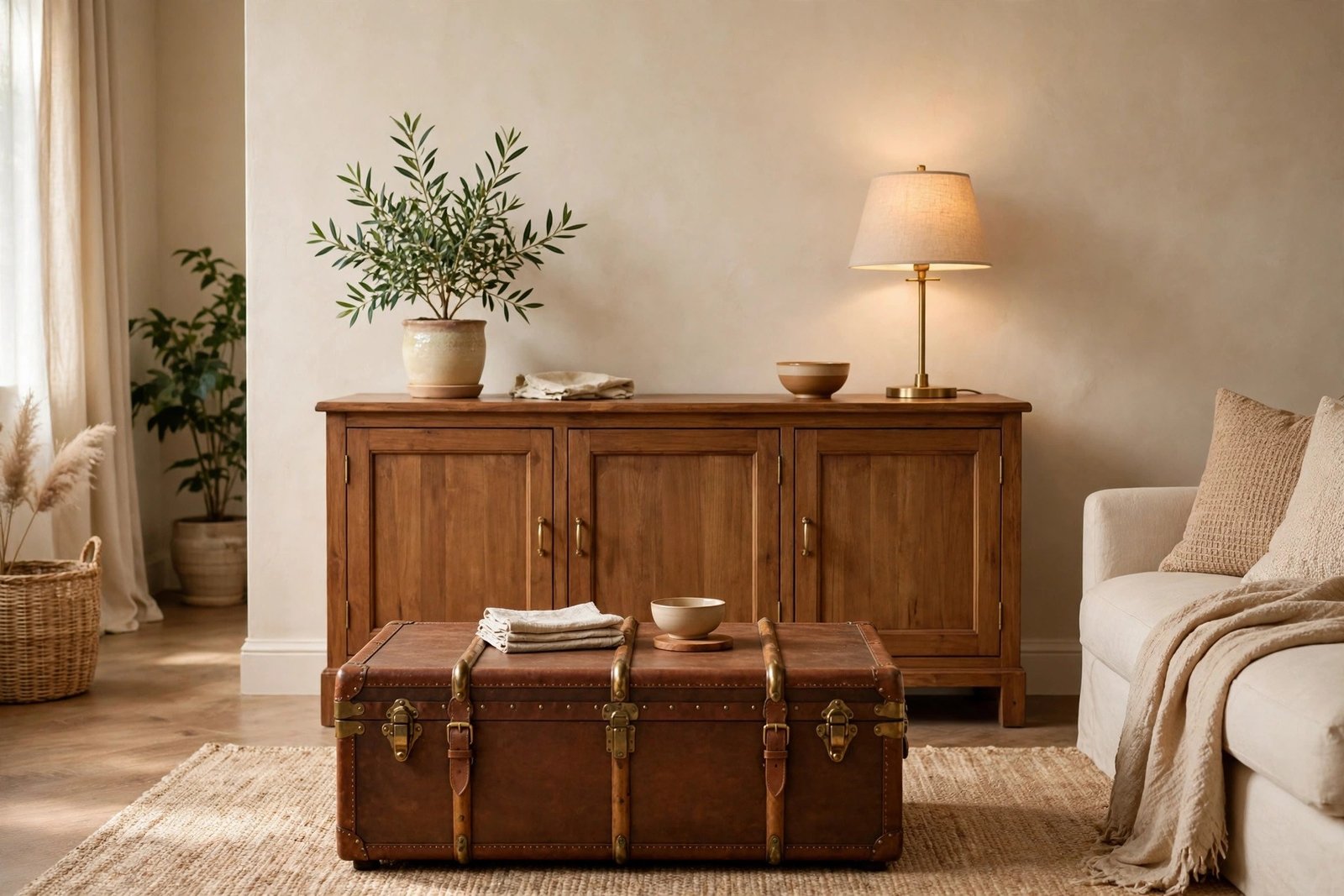
The champions, because they add zero visual boxes to the room. A storage ottoman swallows blankets and board games while serving as footrest or extra seat. A trunk or lidded chest as a coffee table hides the entire “evening kit” — remotes, chargers, books, knitting — under one handsome lid. A sideboard or low cabinet with doors takes the biggest loads of all: games, paperwork, toys, spare everything, behind doors that make the room look more furnished, not less.
2. Lidded baskets and boxes in matching materials
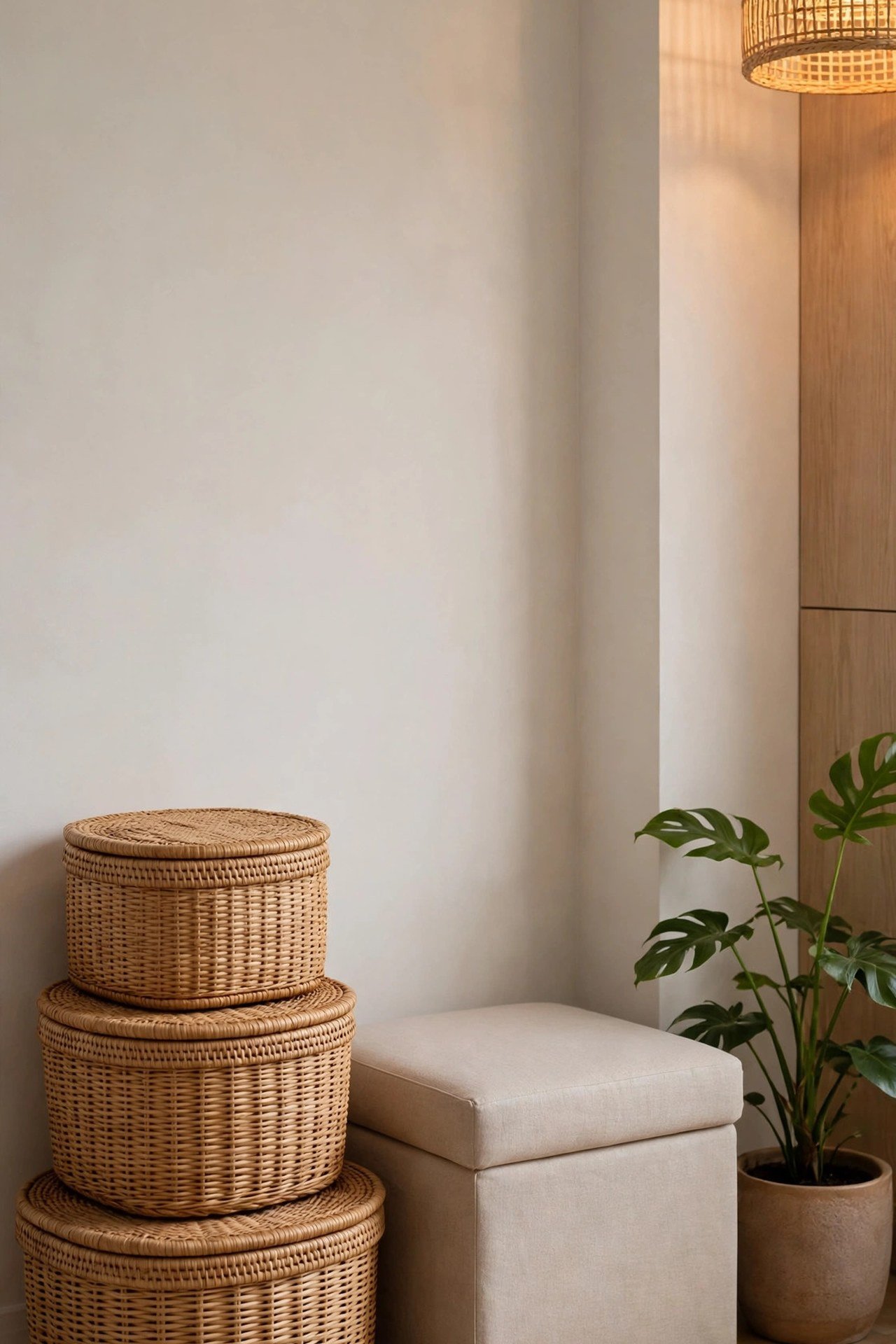
The flexible layer. Woven baskets with lids, fabric boxes, wooden crates with tops — in one material and colour family, repeated around the room. One beside the sofa for blankets, one by the reading chair for books and chargers, one in the corner for toys. Lids are non-negotiable: an unlidded basket is a display of its contents.
3. Closed cabinets and bookcases with doors
For rooms with a lot to hide, a bookcase with doors on the lower half (or a fully doored cabinet) hides the working clutter while the open top carries the styled layer — books standing, a plant, one framed piece. It is the same split a good sideboard makes: beauty on show, life behind doors.
4. Trays and shallow bowls (for the truly daily)
The one honest exception to “closed.” Remotes and the current book are used too often to lid away. A tray on the coffee table or side table corrals them into one deliberate-looking group — three objects on a tray read as styling; the same three loose on the table read as mess. Keep the tray small so it cannot grow.
Whatever you choose, protect what goes inside the way you would anything stored long-term — clean, dry, and not packed airless-tight — the same principles set out in the guide to storing seasonal decor without damage.
Step by Step: Placing Storage Where Clutter Lands
- Do a surface audit at the end of a normal day. Photograph every surface. Circle what is sitting out that is not decor. That circled list is your storage shopping list — nothing more, nothing less.
- Assign each circled group a home at its point of use. Blankets beside the sofa, toys in the corner they colonise, paperwork in the sideboard near where it gets sorted. If a group’s home is more than a few steps away, it will not be used.
- Start with one doubling piece of furniture. The ottoman or trunk usually removes the largest visible pile in one move. Choose it in the room’s palette so it reads as furniture first.
- Add matching lidded baskets for the rest. Buy or gather them in one material and tone, sized to their contents with a little room to spare — a basket filled to the brim loses its lid and its point.
- Put one container within arm’s reach of every seat. This is the rule that keeps the system alive on tired evenings: nobody crosses a room to put a remote away, but anyone will lift a lid beside them.
- Tray the true dailies. Remotes plus the current book, on one small tray. Everything else dailies-looking goes in the containers; the tray is not an overflow.
- Set the one-in-one-out companion rule. From now on, a new everyday item entering the room’s storage sends a similar one out — to its proper home, to donation, to the bin. Hidden storage fails silently when it fills; this rule is the gauge that stops it.
Give it a week of ordinary life before judging. The test of pretty storage is not how the room looks after a tidy — it is how it looks at 9 pm on a Wednesday without anyone tidying at all. The same landing-spot thinking fixes the other end of the arrival route: the entryway storage that hides shoes, bags and keys applies this exact system at the front door.
Materials and Costs
- Storage ottoman — $35–$90
- Trunk or lidded chest for a coffee table — $50–$130 (second-hand often $25–$60)
- Lidded baskets, matching set of 3 — $20–$45
- Fabric storage boxes with lids — $8–$15 each
- One tray for the daily items — $5–$12, or a board or shallow basket you own
- Sideboard or doored cabinet, if the room needs a heavy lifter — $90–$250, or repurpose a cabinet from another room
- Labels for inside lids (so closed storage stays findable) — $0–$3
Start with the ottoman and one basket set; most rooms are transformed for under $80.
Mistakes to Avoid
- Buying open storage for everyday clutter. Open shelves and clear boxes organise the mess into view, not out of it. Everyday things need doors, lids or opaque sides.
- One giant container for everything. A single huge box becomes a rummage pit where nothing can be found, so things stop being put away. Several smaller, labelled-by-location containers beat one cavern.
- Mismatched containers collected at random. A plastic tub, a shoebox and a gift bag may each be tidy, but together they read as improvised. One material, one colour family, repeated — that repetition is the “pretty” in pretty storage.
- Storage placed far from where things are used. A beautiful basket in the spare room stores nothing, because nothing travels that far. Point of use or it does not work.
- Skipping the one-in-one-out rule. Closed storage hides growth until the day every lid stops closing — and by then the overflow is bigger than the original problem. The rule keeps the hidden volume honest.
Frequently Asked Questions
How much storage does a living room actually need?
Work from your surface audit, not a formula. Most living rooms are transformed by one doubling piece of furniture (ottoman, trunk or sideboard) plus two or three lidded baskets — one per clutter landing spot. If lids close easily with a little room left, you have enough; if you are forcing them, the one-in-one-out rule needs a turn before you buy more.
Are baskets really better than a proper cabinet?
They do different jobs. Cabinets and doubling furniture hide the big, permanent loads and make the room look furnished. Baskets handle the flexible, changing loads — this month’s toys, this season’s blankets — and can move as life changes. Most rooms need one of the first kind and a few of the second.
What do I do with paperwork and post that lands in the living room?
Give it one closed home: a lidded box or one drawer of the sideboard, labelled as the paper tray, with a weekly sort. Paper is the clutter most likely to colonise every surface because every piece feels temporary. One box, sorted weekly, keeps it invisible and findable.
How do I keep closed storage from becoming forgotten storage?
Two habits: label the inside of each lid with what lives there, and tie a quick sort to something regular — the season change works well, the same moment you rotate decor. If a container’s contents have not been touched in a year, they do not need a prettier box; they need a new home outside the living room.
The goal was never a room with nothing in it. It is a room where everything in use also has somewhere to disappear to — behind a door, under a lid, inside a piece of furniture that looks good doing its second job. Build that, and the living room stays the calmest room in the house without anyone having to wage war on it.
3 thoughts on “Living Room Clutter With Nowhere to Hide It: Pretty Storage That Looks Like Decor”