
Every home has a soft, shapeless overflow problem. Towels live on the back of a door, spare sheets share a chair with the laundry, the guest bedding is in a bag somewhere — possibly. Linen is bulky, it multiplies quietly, and because it has no obvious home, it ends up everywhere except one.
The fix is a small system, not a big cupboard: sort the linen into honest categories, give the whole collection one home in matching closed storage, fold it so shelves read calm instead of stuffed, and let the labels do the remembering. Linen stored this way stops being clutter with a guilty conscience and becomes one of the prettiest, quietest storage zones in the house.
Quick Answer
Linen, towels and bedding extras look chaotic because they are uncategorised, overstocked and folded every way at once. Give them a home by sorting everything into three groups — in use this week, spares, and guest sets — keeping only what the household’s wash routine actually needs, storing each group in matching closed boxes or baskets on one set of shelves, folding every item the same way in complete sets, and labelling inside the lids so anyone can find and return things.
Why Linen Piles Look Messy
Nothing is categorised, so everything jumbles
A shelf holding daily towels, the good guest sheets, a beach towel and three pillowcases of unknown origin cannot be searched without being disturbed — so it is always disturbed. Categories are what make storage restful: a hand that knows which box it wants never rummages.
There is more linen than the laundry cycle needs
Most linen collections grew by gifts, sales and “just in case.” But a household’s real requirement is set by its wash rhythm: what is in use, what is in the wash, and one clean change. Everything beyond that is not preparedness — it is volume looking for a home it will never quite find.
Every fold is different
Sheets folded in thirds beside towels folded in quarters beside a duvet cover rolled in hope: the shelf reads as laundry, not storage. Folding consistency is pure visual calm, and it costs nothing but a decision.

Step 1: Sort Into Three Honest Categories
Empty the linen out — all of it, from every shelf, bag and chair back — and sort it on a bed into three groups:
- In use: the sets and towels in this week’s rotation. These live in the most reachable spot.
- Spares: one clean change per bed and per bathroom — the set that goes on while the other is in the wash. This is the group that tries to grow; hold it to the wash-cycle rule: in use, in wash, one spare. A third spare set per bed is where collections start needing furniture.
- Guest sets: the bedding and towels kept for visitors. One complete set per regular guest situation is enough for most homes; two if guests overlap. Guest linen earns its space — but as one labelled set, not as a stratum through every shelf.
Anything worn thin, stained beyond rescue or belonging to a bed size you no longer own leaves now — to the rag bag, the charity shop or the pet blanket. Be honest in the sorting and the storage problem usually shrinks by a third before you have bought a single box.
Step 2: One Home — Matching Closed Boxes and Baskets
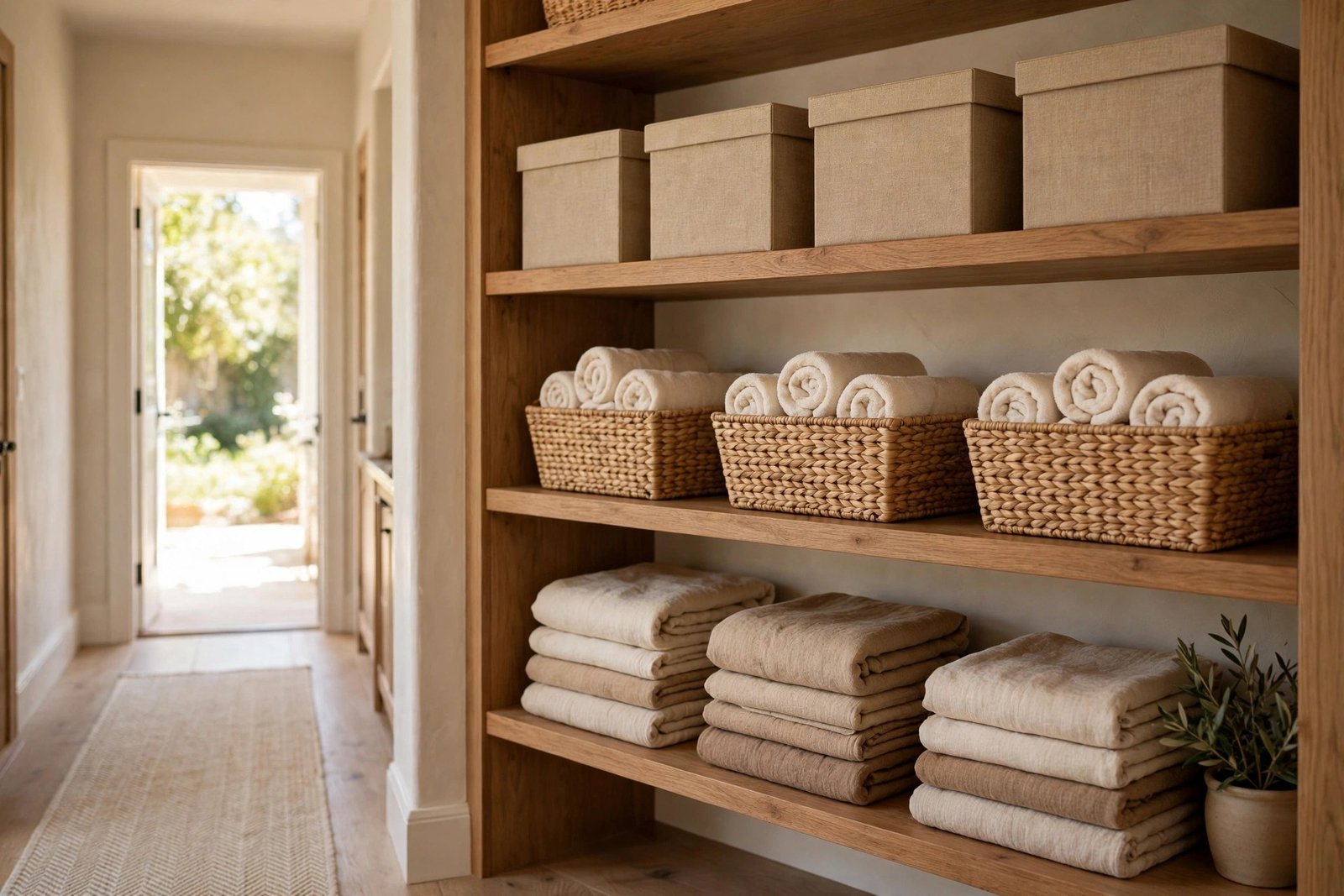
Choose one home for the whole collection: a linen cupboard if you have one, a set of shelves in a hallway or bedroom, or the top of a wardrobe. Then put the categories into matching closed boxes or lidded baskets — one style, one colour family, repeated — a box for bed linen, one for towels, one for the guest set, one small for extras like table linen and spare pillowcases.
- Closed, because linen is soft and shapeless — boxes hold its shape and give the shelf clean lines; the protection rules in the seasonal storage guide (clean before storing, dry, protected from dust) apply to stored linen word for word.
- Store sets together: a full sheet set folded into its own pillowcase is the oldest trick in linen storage and still the best — one bundle, one bed, no hunting for the matching case.
- Reachable order: in-use and spares at hand height, guest sets and rarely used extras higher or deeper.
Step 3: Fold for Visual Calm
Inside the boxes, folding is the decor. Pick one fold width for towels and one for sheets, and use it for everything: stacks of even height, edges aligned, colours grouped light to dark the way a wardrobe rail is ordered. Three even stacks in a box look like a shop shelf; the same linen in mixed folds looks like a laundry basket that gave up. Folded sets also stack honestly — you can see at a glance how many clean changes you actually hold.
Step 4: Labels Inside the Lids
Linen’s problem is that it all looks similar at arm’s length. Solve it where it cannot spoil the view: a small label inside each box lid — “Double sheets,” “Bath towels,” “Guest set” — plus, for sheet sets, the size marked on the inside of the bundle’s pillowcase. Labels inside lids keep the outside of the storage calm and the inside foolproof, which matters in a shared house: a system anyone can return things to correctly is a system that survives.
A Practical Note on Airing and Damp
Linen must go away completely dry — a towel folded warm from the dryer but still damp at the core will smell musty within weeks and perfume the whole box. Store in a ventilated spot rather than a sealed plastic tub in a damp room; fabric boxes and baskets breathe, which is another reason they suit linen. If a stored set does come out smelling stale, a wash and a line-dry in moving air resets it — prevention, though, is just the dry-before-storing rule.
Materials and Costs
- Matching lidded boxes or fabric baskets, 4–6 — $8–$16 each
- Small labels or a label maker tape for inside lids — $0–$6
- Shelf, if the home needs creating (hallway or wardrobe top) — $15–$40, or an existing shelf cleared
- Cedar or lavender sachets for stored sets, optional — $4–$9
The sorting and folding — the steps that do the real work — are free. Most homes need a handful of boxes at most, and only after the sort has shrunk the collection to its true size. Homes with no cupboard at all can hide the boxes using the room-by-room approach in the hidden storage guide — under-bed and ottoman space suit spare and guest sets well.
Mistakes to Avoid
- Buying boxes before sorting. Boxes sized for the unsorted mountain will be half-empty monuments to linen you should not have kept. Sort first; measure what survives.
- Keeping “just in case” linen without a case. A spare set has a job — the wash change. A fourth set has no job, only volume. Name the job or let it go.
- Storing sets split across places. Sheet in one box, cases in another, duvet cover on a chair: that is not storage, it is a treasure hunt. Bundled sets, one home.
- Labels on the outside in a styled room. If the boxes sit on open shelves in a bedroom or hallway, outside labels add visual noise. Inside the lid does the same job quietly.
- Sealing damp linen in plastic. Plastic tubs in a warm room trap moisture against fabric. Dry fully, store breathable, ventilate the spot.
Frequently Asked Questions
How many towel and sheet sets does a household actually need?
Follow the wash cycle: per bed, two sets (one on, one clean spare) cover almost every household; a third only if laundry happens less than weekly. Per bathroom, two towels per person in rotation plus the guest set. More than that is rarely used — and it is the rarely-used third that fills the cupboard.
There is no linen cupboard at all. Where does the home go?
One shelf is enough: the top shelf of a wardrobe, a hallway shelf above door height, or lidded boxes under the bed for spares and guest sets. The home matters more than the furniture — categories, matching boxes, one place. See the home organisation with decor collection for the same one-home logic applied in every room.
Are guest sets worth the space in a small home?
One, yes — folded as a single bundle, it takes less room than the scramble it prevents. Keep it complete (sheet set, towels, pillowcases together in its own box) so a guest arriving never triggers a house-wide search. If guests are rare and space is brutal, the honest alternative is your best spare set doing double duty — decide once, and stop storing both.
How do I keep the system tidy when others do the laundry?
The labels inside the lids are the system: they tell every folder where things go without a briefing. Keep the fold simple enough to copy, and keep categories few — three or four boxes get maintained; twelve micro-categories get abandoned. A two-minute shelf straighten during the weekly wash keeps drift from compounding.
