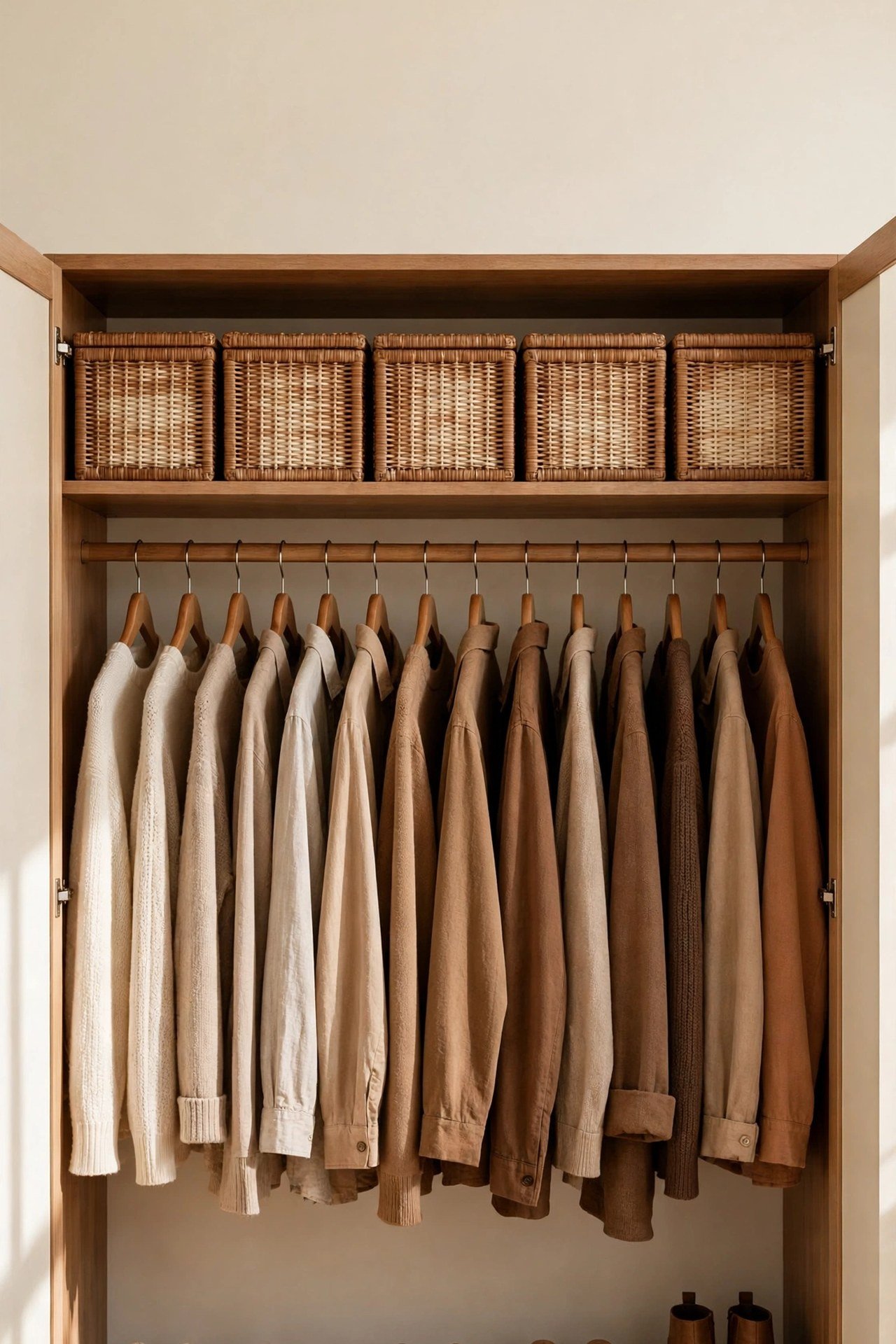
Here is a frustrating truth about wardrobe areas: you can clean one completely — every item washed, folded or hung, nothing on the floor — and it still looks untidy. The clothes are clean. The space is not dirty. Yet the eye reads disorder, and the calm, finished feeling never arrives.
That is because “looks untidy” is almost never a cleanliness problem. It is a visual problem: mismatched hangers at mixed heights, clothes hung in no order, open shelves holding fifteen different boxes, shoes in a wandering line, and not one inch of empty space for the eye to rest in. This guide fixes the visuals — hangers, order, matching boxes, breathing space and one finishing layer — and it is honest about the secret: open wardrobes need visual discipline more than they need storage products.
Quick Answer
A wardrobe area looks untidy even when it is clean because the eye reads visual inconsistency as mess: mixed hangers, random colour order, different-shaped boxes and bags, shoes out of line and shelves filled edge to edge. Fix it with visual rules, not more storage: switch to one type of hanger in one colour, hang clothes in a light-to-dark or colour-family order, put open-shelf storage into matching closed boxes, align shoe pairs into one straight row, and deliberately leave one shelf section empty. Finish with one styled touch — a small plant or a lamp.
Why Clean Still Looks Untidy: The Eye Reads Patterns
Standing in front of an open wardrobe, you do not actually inspect cleanliness. Your eye takes in the whole area in a second and judges it by pattern: are lines level, do shapes repeat, is there rhythm — or is every inch different from its neighbour? A row of identical hangers at one height reads as a pattern — calm. A row of wire, wood, plastic and padded hangers at five heights reads as noise — untidy, even though every shirt is spotless. Every fix in this guide works the same way: it replaces noise with pattern. Pattern, conveniently, is mostly free: it costs order, not products.
Fix 1: Matching Hangers — The Biggest Single Change
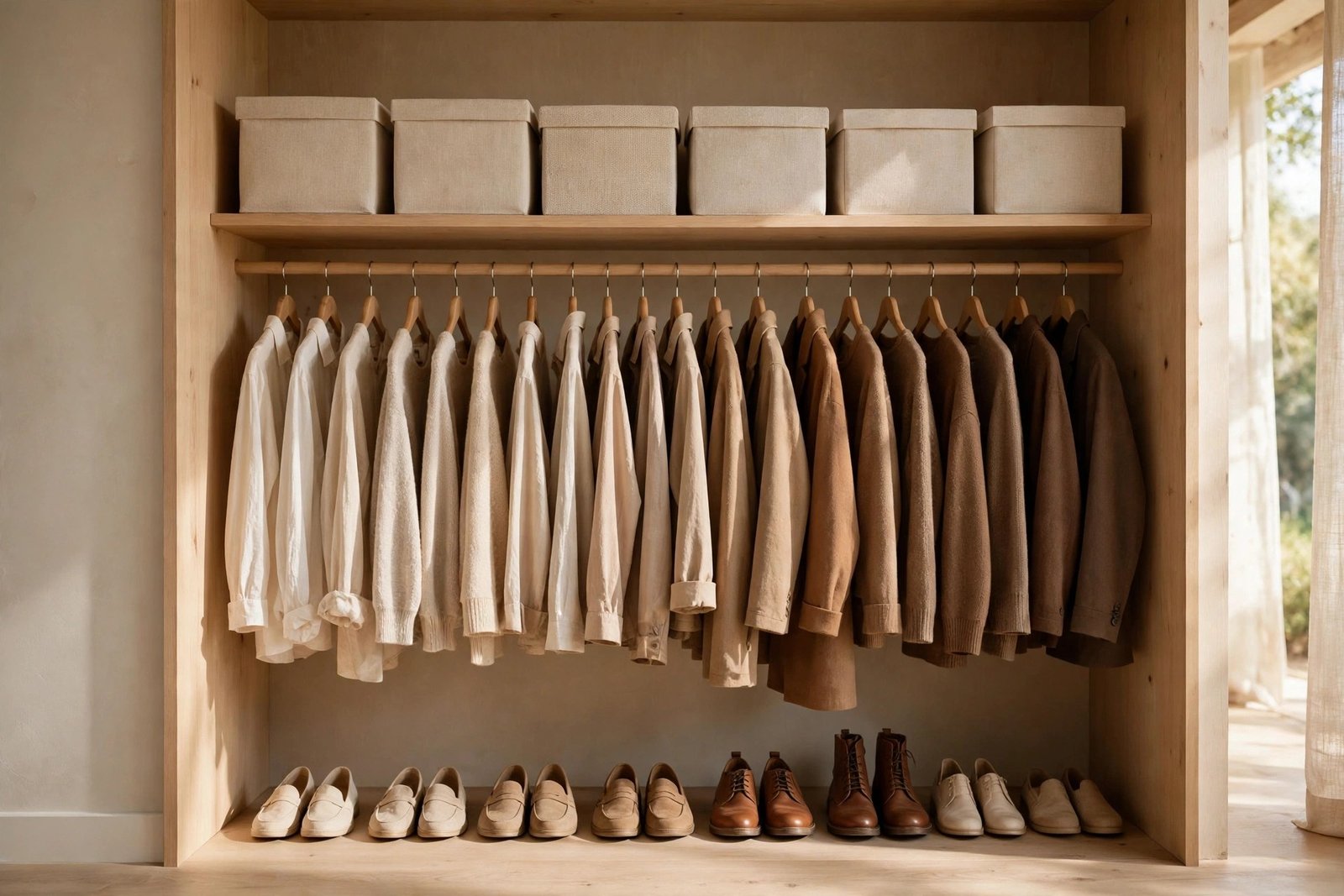
If you change only one thing, change this. A wardrobe hung on one type of slim hanger, in one colour, transforms instantly:
- Heights level out. Identical hangers put every garment’s shoulder at the same line, and that single straight line is most of what “tidy wardrobe” photos are actually showing.
- Space appears. Slim matching hangers take less rail than a mixed collection of chunky ones, so clothes hang with air between them instead of crushed together — and uncrowded clothes read as cared-for.
- Do it in one go, in one colour that suits the room. Half-matching is still visual noise; the effect comes from total repetition. Old hangers go to the spares drawer, the charity bag or the dry-cleaner return — not back onto the rail “for now.”
- Face every hanger the same way and hang every garment facing the same direction. It takes one pass and costs nothing, and the rail suddenly looks like a shop rail — in the good way.
Fix 2: Hang in Colour Order
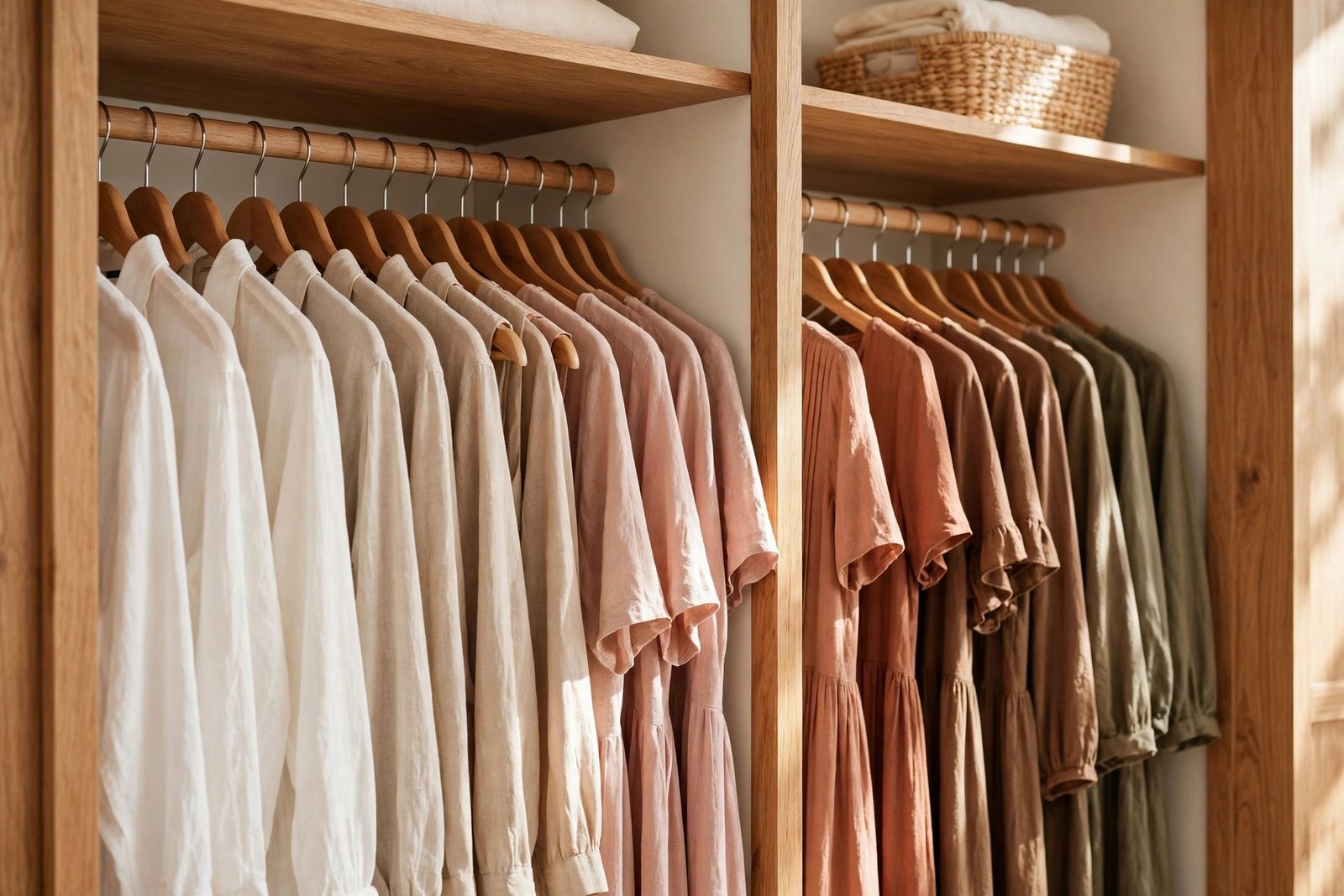
With the hangers matched, give the rail an order the eye can follow. Light to dark is the classic: whites and creams at one end, through mid-tones, to dark colours and black at the other. Grouping by colour family works too — all the blues together, all the warm tones together. Either system beats the usual arrangement, which is “wherever there was a gap.” Two extra refinements:
- Keep one gap between groups. A few centimetres of rail between colour families makes the order visible. Packed tight, even a perfect gradient reads as a crush.
Fix 3: Open Shelves Need Matching Closed Boxes
Open shelves are where wardrobe areas go to look chaotic: bags, boxes from three different shops, a hat, a tangle of scarves, each a different size and colour. The visual fix:
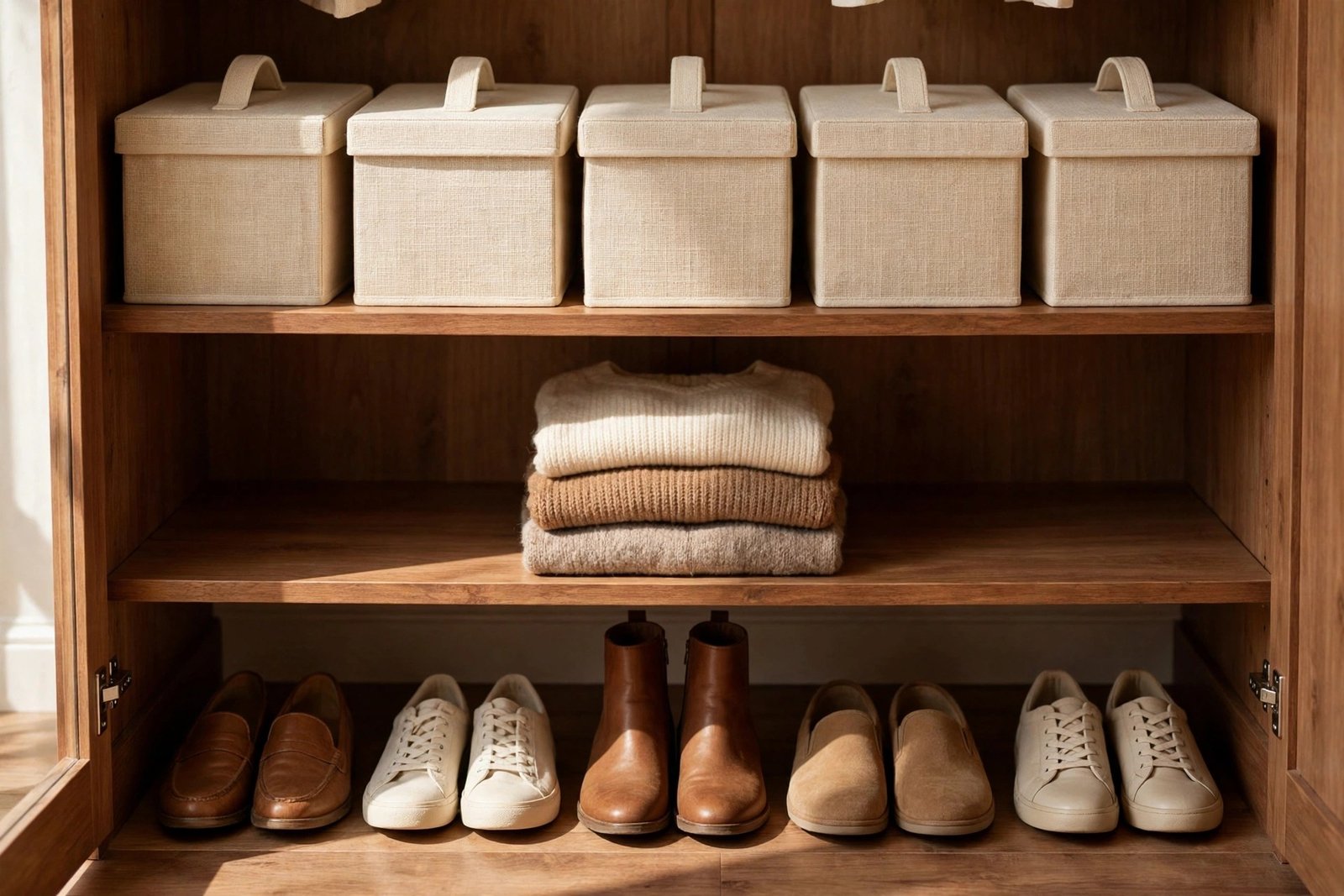
- Everything on open shelves goes into closed boxes — all the same. One box style, one colour, one size family, repeated across the shelf. Identical boxes read as architecture; the contents become irrelevant to how the area looks.
- Lids on, labels small and consistent (or on the inside of the lid). The point is that the shelf presents a calm, repeated surface — what is inside is covered by the seasonal storage guide‘s rules for keeping stored things clean, dry and protected.
- Folded knitwear follows the same law: one fold width, stacks of similar height, colours grouped. Three even stacks look styled; five uneven ones look like laundry.
- Leave one shelf section empty. This is the fix people resist and the one that changes everything. An entirely full area gives the eye nowhere to rest, so it reads as overflow no matter how neat. One empty section — a whole cubby, a clear stretch of shelf — is the breathing space that makes the rest look deliberate. If the section will not stay empty, give it the single plant from the finishing layer below, and nothing else.
Fix 4: Shoe Rows, Aligned
Shoes are the floor-level version of the hanger problem: pairs at angles, one shoe forward, one back, a stray single. Straighten the geometry:
- Pairs together, toes aligned on one straight front line, heels even. A row of shoes aligned by the toe looks like a display; the same shoes scattered by two centimetres each look like a hallway after a party.
- One row deep where possible. Two rows hide the back pair and invite rummaging disorder. If depth forces two rows, put the rarely worn pair behind — and accept that the front row is the one the eye judges.
Fix 5: The Finishing Layer — Make It a Corner, Not a Cupboard
Open wardrobe areas sit inside rooms, and they look finished when they borrow one move from the room itself: a small styled touch. A little plant on the empty shelf section, a warm lamp on the dresser beside it, a framed print or a mirror on the wall above the shoe row — one touch that says “designed corner,” and turns visible storage into part of the room’s decor. This is the same point-of-use, looks-like-decor approach that calms the tech-and-paper trio in the guide to small decor fixes for books, remotes and chargers: everyday things, given homes that read as styling.
Step by Step: The One-Afternoon Visual Reset
- Empty one section at a time — the rail first. As clothes come off, the no-longer-worn leave the system entirely (charity/sell pile), so it is rehung with only what stays.
- Swap the hangers as each garment goes back: onto a matching hanger, facing the same way, in colour order, grouped by length.
- Box the shelves: sort shelf contents, place them in the matching closed boxes, label inside the lids, and choose which section stays empty.
- Align the shoes into one toe-straight row; box the off-season pairs onto the shelf.
- Add the finishing touch and step back to the doorway — the view you will actually live with — and adjust from there.
The Honest Part: Discipline Beats Products
Everything above can be bought in an afternoon, and all of it will fail by next month without the small discipline that open storage demands. A closed wardrobe forgives a sloppy hang-up; an open one displays it. The discipline is genuinely small: hang things back in their colour group (ten seconds, while the hanger is in your hand), return shoes to the line, put the box back in its gap. Five minutes once a week — laundry time is the natural moment — re-straights anything that drifted. If that rhythm sounds unlikely in your household, that is useful honesty too: doors, a curtain across the opening, or closed boxes for everything are the kinder design. Choose the system your real habits can keep; it will look tidy because it is runnable, not because it was once arranged. More ideas in this spirit fill the home organisation with decor collection.
Materials and Costs
- Matching slim hangers (bundle of 30–50) — $12–$25
- Matching closed storage boxes with lids (set of 4–6) — $18–$40
- Shoe rack or low shelf, only if the row currently lives on bare floor — $15–$35
- Small plant or a warm lamp for the finishing layer — $6–$20, or moved from another room
- Labels for inside box lids — $0–$3
- A curtain or fabric panel, if you choose the honest closed option for an open frame — $10–$25
Mistakes to Avoid
- Buying boxes before deciding the visual system. Six beautiful boxes in four styles are just expensive noise. Decide the one box, the one hanger, the one colour — then buy multiples of exactly that.
- Matching hangers but keeping the random order. Hangers fix the top line; order fixes the colour noise. Either alone helps; the transformation is both.
- Filling the empty section “just for now.” The breathing-space section is the system, not spare capacity. The first item parked there restarts the overflow look.
- A reset with no weekly rhythm behind it. The one-afternoon overhaul is the start, not the fix. Without the five-minute weekly straighten — or honest doors — the visual noise rebuilds within weeks.
Frequently Asked Questions
Does this apply to wardrobes with doors too?
Partly. Behind closed doors, the visual rules matter less day to day — but matching hangers still level the rail, colour order still makes choosing outfits faster, and mornings still start calmer. Apply the cheap fixes (hangers, order, alignment) and skip the finishing layer; nobody needs a styled corner they cannot see.
I can only afford one fix. Which gives the most change?
Matching hangers, without contest. They level every garment’s line at once, create visible space on the rail, and cost the price of one bundle. Colour order is free and comes second; boxes third, because shelves are usually a smaller part of the view than the rail.
What if I share the wardrobe area with a partner who won’t follow the system?
Divide by territory rather than by rules: each person’s section gets the visual treatment within itself — their hangers matched in their half, their clothes in their order. Two ordered halves still read as a calm whole, and nobody has to police anyone. A shared middle shelf of matching boxes covers the communal overflow.
How do I handle children’s wardrobe areas?
Lower the bar and keep the pattern: matching hangers in a fun colour still level the line, boxes still beat piles, and one empty section is unrealistic — aim instead for one clear surface. Kids grow out of systems quickly, so spend on the rail and boxes you can re-use, and let the colour order be approximate.