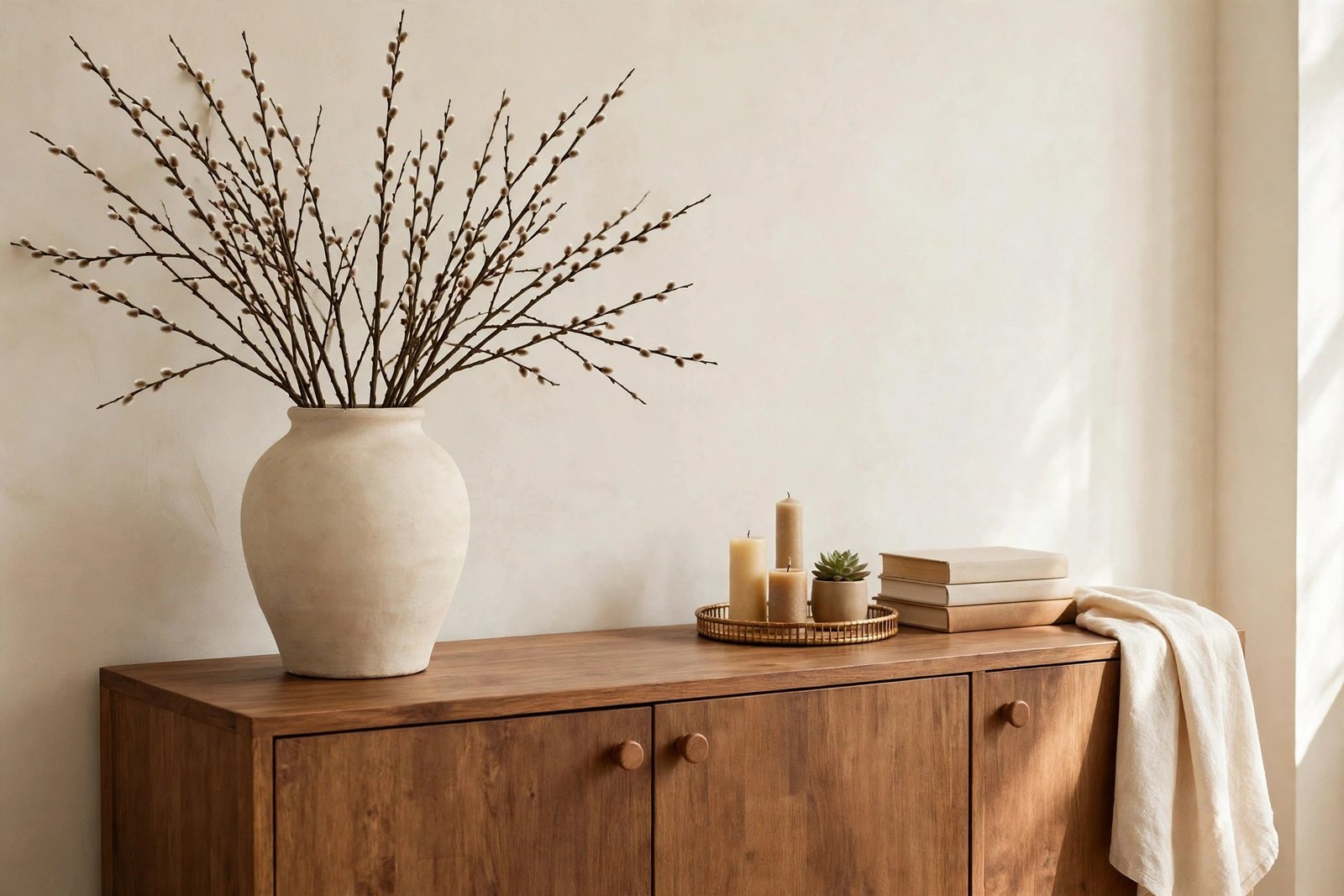
Your room is clean. Everything is dusted, nothing is dirty, nothing is even out of place. And yet it looks cluttered — busy, restless, somehow untidy. If that sounds familiar, the problem is probably sitting on your shelves in plain sight: too many small decor items, each one pretty on its own, together creating visual noise.
Small pieces are the easiest decor to buy. They are cheap, they fit anywhere, and each one feels like a tiny improvement. But decor does not add up the way we hope. Past a certain point, every new small item makes the whole room look worse, not better. This guide explains why that happens — it comes down to grouping, scale and empty space — and gives you the editing system that fixes it without throwing away the things you love.
Quick Answer
A room looks cluttered with small decor items when the pieces are spread out evenly, all at a similar small size, with no empty space between them. The fix is an edit, not a purchase: gather everything, group what stays into tight clusters of three on trays or in corners, replace several small pieces with one larger statement piece on each main surface, and leave roughly a third of every surface empty. Store the edited-out pieces in a rotation box so they can come back in a different season or room — nothing has to be thrown away.
Why Small Items Read as Clutter: The Three Causes
Cause 1: No grouping
Objects that stand alone, spaced evenly along a shelf or mantel, each demand the eye’s attention separately. Ten separate demands feel like noise. The same ten objects gathered into two or three tight groups read as two or three calm arrangements. Grouping is the single biggest difference between “collection” and “clutter”, and it costs nothing.
Cause 2: No scale contrast
When everything on a surface is roughly the same small size, nothing leads and nothing rests — the eye skims across a bumpy, even row and registers fussiness. Real displays mix sizes: one tall or large anchor piece, one or two medium pieces, small pieces only as accents inside the group. Without that contrast, even beautiful objects flatten into texture.
Cause 3: No negative space
Empty space is not wasted space; it is what makes the filled space readable. A shelf with no gaps at all forces the eye to process every object at once. Leave breathing room — a stretch of bare shelf, an empty section of mantel — and the pieces that remain suddenly look chosen instead of stored.
The Edit System, Step by Step
- Gather everything (15 minutes). Take every small decor item off one surface at a time — or the whole room, if you are feeling brave — and put them all on a table. A surface that is completely empty for a moment shows you the “calm” baseline you are aiming to keep some of.
- Sort into three piles: love it, like it, and “why do I own this”. Be honest; the third pile is usually bigger than expected.
- Choose one anchor per surface. From the love-it pile, pick the largest or tallest piece for each shelf, mantel or table. That piece leads; everything else on that surface must support it or leave.
- Build clusters of three. Group pieces in odd numbers — three is the classic — at mixed heights: something tall, something medium, something low. Place a cluster, then step back. If a piece does not fit a cluster, it does not go back on the surface.
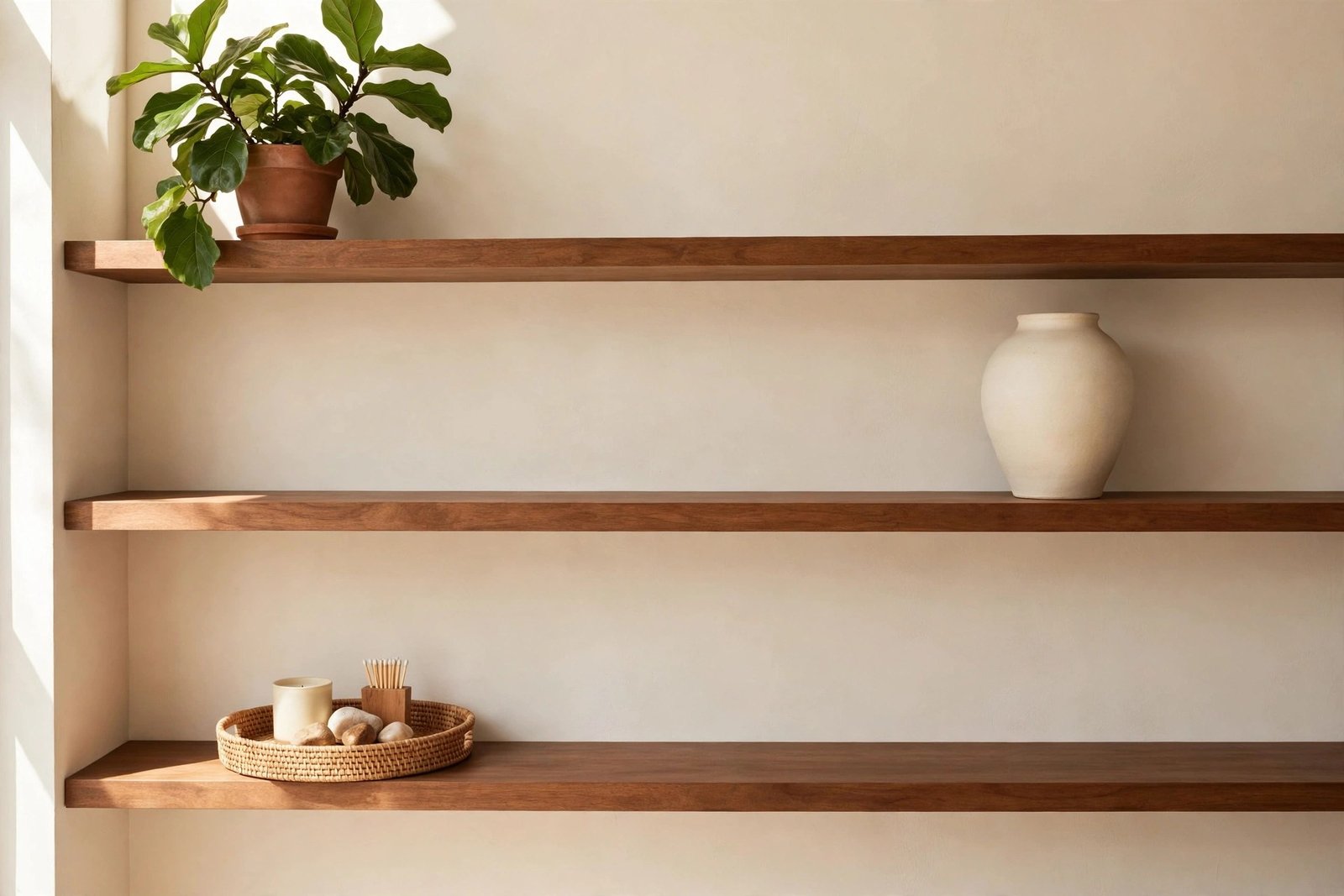
- Use a tray to make it official. A tray, shallow basket or board under a cluster turns “things standing near each other” into one deliberate arrangement, and it makes dusting a lift-and-wipe job. On shelves, the same effect comes from grouping tightly against one side rather than centring each piece.
- Enforce the breathing-space rule. Aim for about a third of each surface left empty. If a finished surface has no visible bare stretch, remove one more piece.
- Box the rest for rotation. Everything edited out goes into one lidded box, stored away — not displayed elsewhere in the same room, or the clutter just migrates. Bring pieces back at a season change and swap them for the current display.
Shelves are where this system pays off fastest, and they have extra rules of their own — weight at the bottom, books as building blocks, space on every shelf — set out in the guide to bookshelf styling that looks messy and the simple system that fixes it.
One Large Piece Beats Five Small Ones
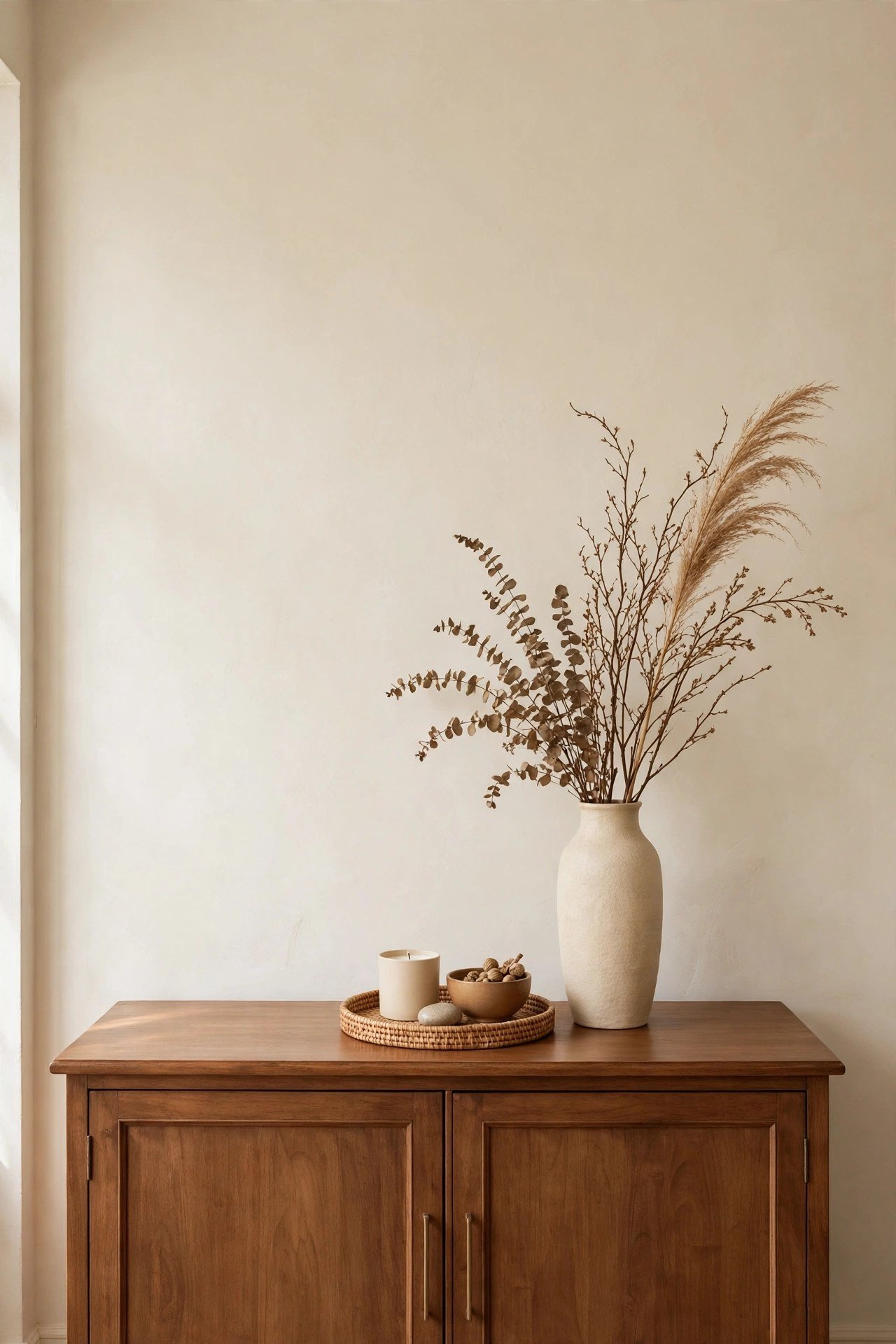
If a surface still looks fussy after grouping, the problem is scale, and the cure is a swap: replace a cluster of small pieces with one larger object — a big vase, a framed print leant against the wall, a plant with presence, a stack of two or three substantial books with one object on top. One large piece gives the eye a single place to land, and it photographs the way the rooms you admire photograph. This does not have to mean buying: most homes already own the large piece — it is currently outnumbered in a corner, or serving as storage. Move it to the main surface and demote the small crowd.
Where the Edited-Out Pieces Go
The rotation box is what makes this system painless, because nothing is being thrown away — it is being rested. Pack the box by the same rules you would use for anything fragile or fabric-based: wrapped, dry, labelled, and in a spot that does not eat a whole closet. The deeper guidance on protecting pieces in storage is in the guide to storing seasonal decor without damage. Swap the display every few months or at a season change: the room feels newly decorated, and the total number of objects on show stays low.
This clutter pattern is also one of the eight in the overview of decor mistakes that make a finished room feel wrong — if several surfaces in several rooms bother you, that checklist will tell you what else to test.
Materials and Costs
- One tray, shallow basket or board per main surface — $5–$12 each, or reuse what you own
- One lidded rotation box — $3–$6
- Tissue paper for wrapping fragile pieces going into storage — $2–$4
- One larger anchor piece, only if the home truly lacks one — $10–$30 second-hand
- Labels for the rotation box — $0–$2
Most of this edit costs nothing at all: the pieces, the surfaces and the box are usually already in the house.
Related Mistakes to Avoid
- Buying organising products before editing. More boxes, baskets and display stands for the same number of objects just gives clutter a uniform. Edit first; organise what survives.
- Spreading items evenly to “balance” a shelf. Even spacing is what shop stockrooms do. Homes look better with clusters and gaps — asymmetry with breathing room beats a tidy row.
- Moving the clutter to another room. If every edited piece reappears on a different surface, the house total is unchanged and the other room inherits the problem. The rotation box, not relocation, is the exit.
- Keeping everything because each piece was a gift or a bargain. A piece can be appreciated in rotation rather than on permanent display. Being stored carefully and brought out in its season is not rejection — it is how collections stay enjoyable.
- Going fully bare in one dramatic purge. Stripping every surface makes a room feel empty rather than calm, and most people re-buy within a month. Keep the clusters you love; the goal is edited, not empty.
Frequently Asked Questions
How many decor items should a shelf or mantel have?
There is no magic number, but the working test is grouping and space: if the pieces form one to three clear clusters with visible empty stretches between and around them, the count is fine — that might be five pieces or nine. If they form one continuous row with no gaps, it is too many, even if the count is small.
What if I genuinely love all my small pieces?
Then rotation is your system, not reduction. Display a third of the collection at a time, grouped properly, and store the rest well. Every swap will feel like new decor arriving, and each piece gets the space to actually be seen — which is what loving them should look like.
Does minimalism have to mean cold and empty?
No. This edit is not minimalism; it is composition. Warmth comes from materials, textiles and light, not from object count. A room with three well-grouped clusters, soft furnishings and warm lamps feels warmer than a room crowded with forty small ornaments, because the eye can settle long enough to notice the warmth.
How do I stop the clutter creeping back?
Use the one-in rule: a new small piece earns its place by joining an existing cluster and displacing something into the rotation box. And repeat the gather-everything edit once or twice a year — it takes twenty minutes once the system exists, because the box and the clusters are already set up.
1 thought on “Too Many Small Decor Items? Why Your Room Looks Cluttered and How to Fix It”