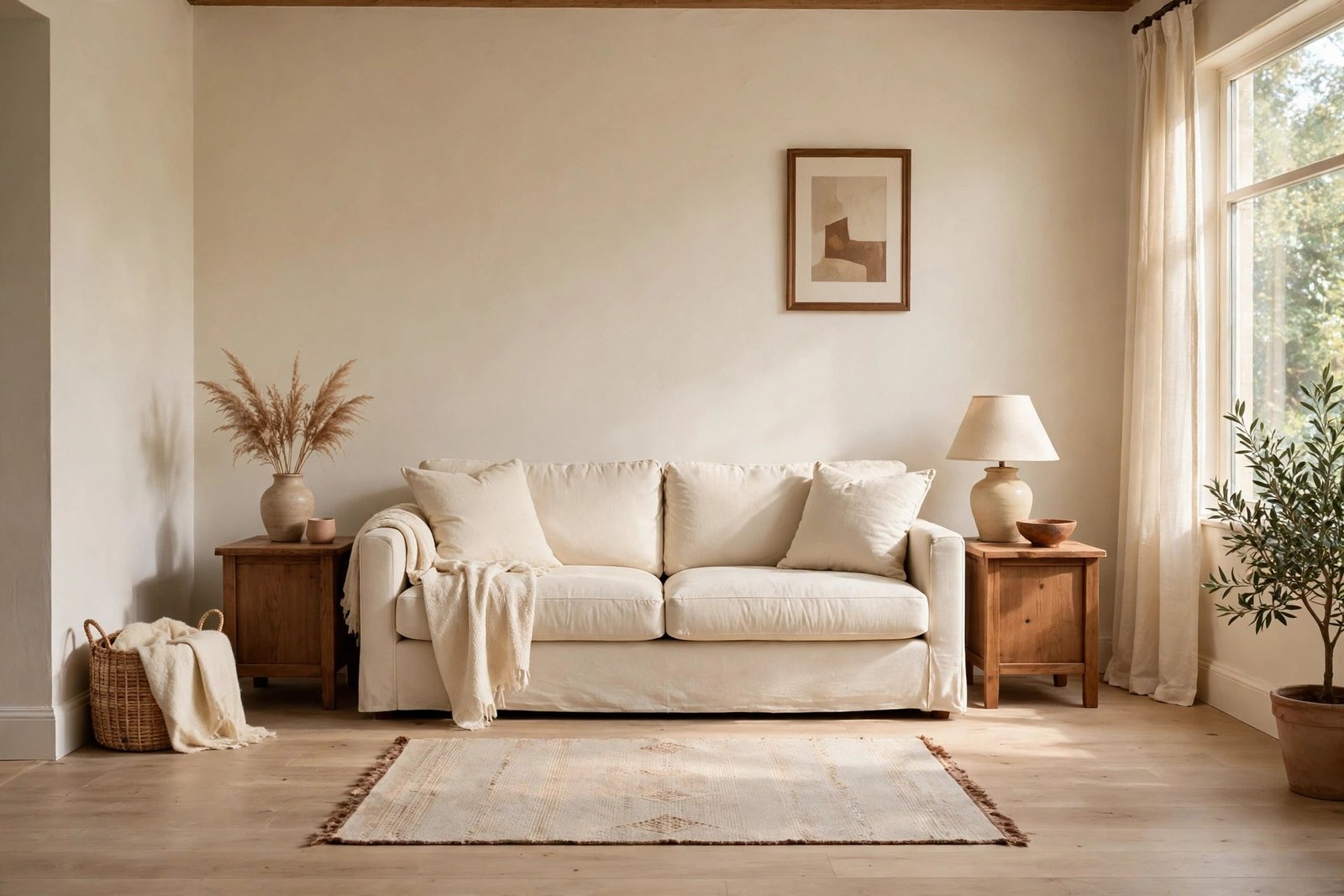
Some rooms have everything they are supposed to have: a sofa, a rug, curtains, pictures, cushions, a lamp. Nothing looks broken or dirty — and yet the room still feels wrong. It does not feel calm, comfortable, or properly finished.
In most cases the problem is not your furniture or your taste. It is one or more of eight small, very common decor mistakes. Each is easy to miss because the room looks “done” at first glance, yet each sends the wrong signal to your eyes. The good news: every one can be spotted in about ten seconds, and most fixes cost nothing.
Quick Answer
A finished room usually feels wrong because of small proportion and placement mistakes, not bad furniture. The eight most common are: a rug that is too small, curtains hung too low or too short, art hung too high, furniture pushed against every wall, too many small decor items, one harsh ceiling light, colours with no simple palette, and missing soft layers. Check your room against the list below, fix the biggest one first, and the room starts to feel right fast.
How to Check Your Room in Five Minutes
Stand in the doorway and take a photo of the room with your phone. Then study the photo, not the room. A photo shows the scene the way a stranger sees it, and the mistakes below jump out far more clearly — a floating rug, a curtain stopping mid-wall, a picture hovering near the ceiling. Work through the eight in order: each gives you the ten-second test, why it feels wrong, and the headline fix. Three have full guides of their own on this site, linked as you go; the rest you can fix today with what you own.
The 8 Mistakes, One by One
1. The Rug Is Too Small
The 10-second test: Does the rug sit in the middle of the seating area like a small island, with the sofa and chairs on bare floor around it and no furniture legs touching it?
Why it feels wrong: A rug is meant to group furniture into one conversation area. A small rug breaks the group apart, leaving separate pieces instead of one settled space.
The headline fix: The front legs of the sofa and chairs should stand on the rug. If yours does not reach, layer it over a larger plain base or move it to a smaller job. Full sizing rules and rescue fixes are in the guide to choosing the right rug size and fixing a rug that is too small.
2. Curtains Hung Too Low or Too Short
The 10-second test: Is the rod fixed just above the window frame, and do the curtains end well above the floor?
Why it feels wrong: Low rods cut the wall into short sections and make the ceiling feel lower; short curtains look like an afterthought.
The headline fix: Raise the rod close to the ceiling, let the curtains fall to the floor or just touch it, and hang them wider than the window. Measuring rules and fixes for curtains you already own are in the guide to fixing curtains hung too low or too short.
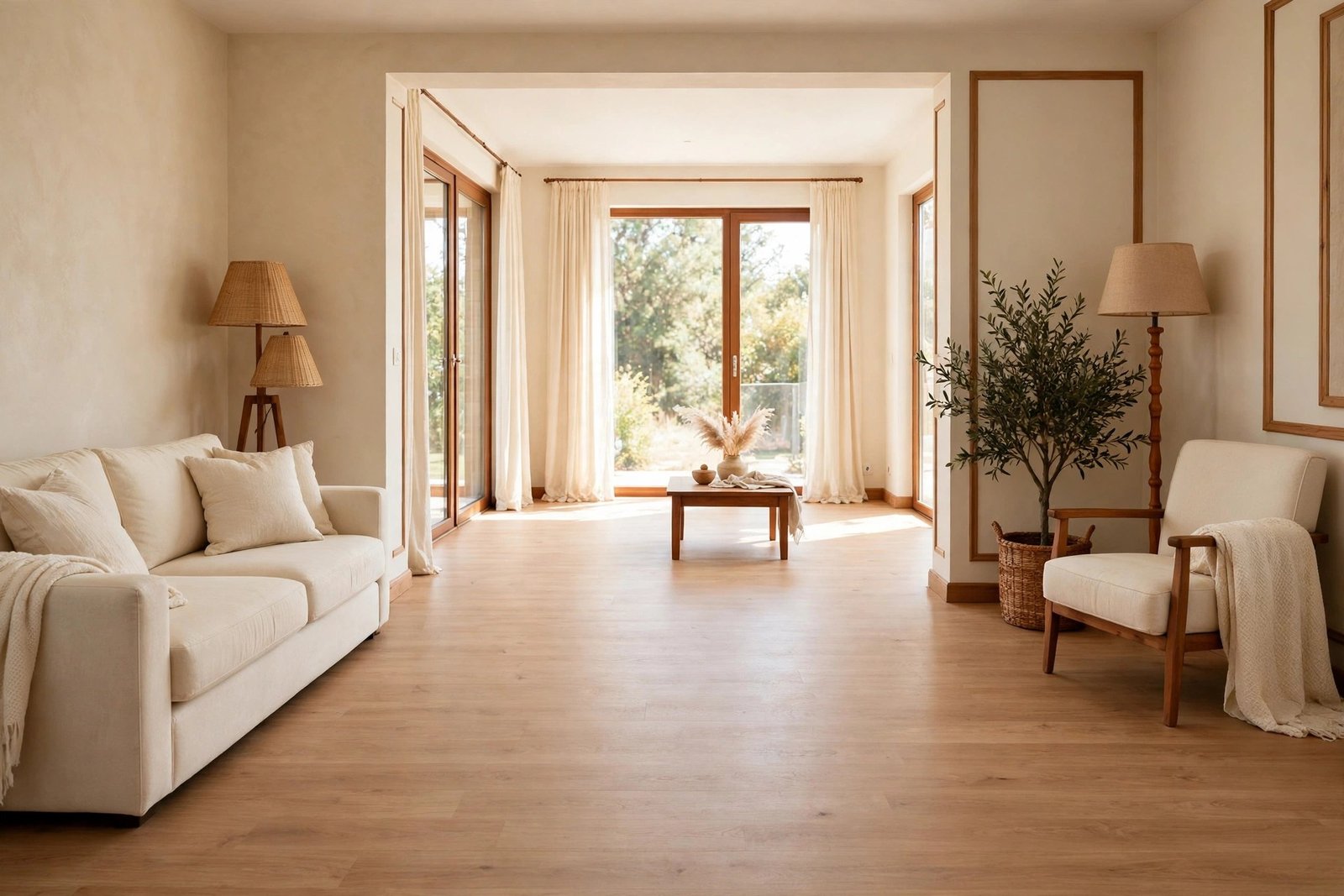
3. Art Hung Too High
The 10-second test: Standing before your largest picture, do you have to lift your chin to see its centre? Is there a wide band of empty wall between the top of the sofa and the bottom of the frame?
Why it feels wrong: Pictures hung near the ceiling disconnect from the furniture below. The seating area underneath then feels bare and unfinished, however good the art is.
The headline fix: Hang art with its centre at average eye level — about 145 cm (57 inches) from the floor. Above a sofa or console, the frame’s bottom edge should sit roughly 15–20 cm above the furniture.
4. Furniture Pushed Against Every Wall
The 10-second test: Is every piece backed against a wall, leaving a big empty space in the middle of the room?
Why it feels wrong: The room reads like a waiting room: an awkward unused centre, seats stretched too far apart for comfort — and, ironically, the room usually feels smaller, not bigger.
The headline fix: Pull the sofa forward — even 10–15 cm off the wall changes the feel — and anchor the seating group on the rug, facing itself. Only the biggest storage pieces truly need to touch a wall.
5. Too Many Small Decor Items
The 10-second test: Count the small objects on one surface. If more than about five sit spread out in a row, none larger than a book, the surface is reading as clutter, not decor.
Why it feels wrong: Many small items at the same size create visual noise. The eye cannot rest anywhere, so the room feels busy and untidy even when it is perfectly clean.
The headline fix: Group small pieces into tight clusters on trays, swap several small pieces for one larger one, and leave some surface completely empty. The full editing system is in the guide to fixing a room that looks cluttered with small decor items.
6. One Harsh Light in the Middle of the Ceiling
The 10-second test: In the evening, is the room’s only light one bright ceiling light, casting sharp shadows and making colours look grey or yellow?
Why it feels wrong: A single overhead source lights a room like an office. It flattens faces, dulls warm colours, and leaves the corners — where comfort lives — in shadow.
The headline fix: Add lamps at different heights — one near the seating, one in a dark corner — with warm-white bulbs instead of cold daylight ones. Two or three low, warm pools of light calm the room instantly, no electrician needed.
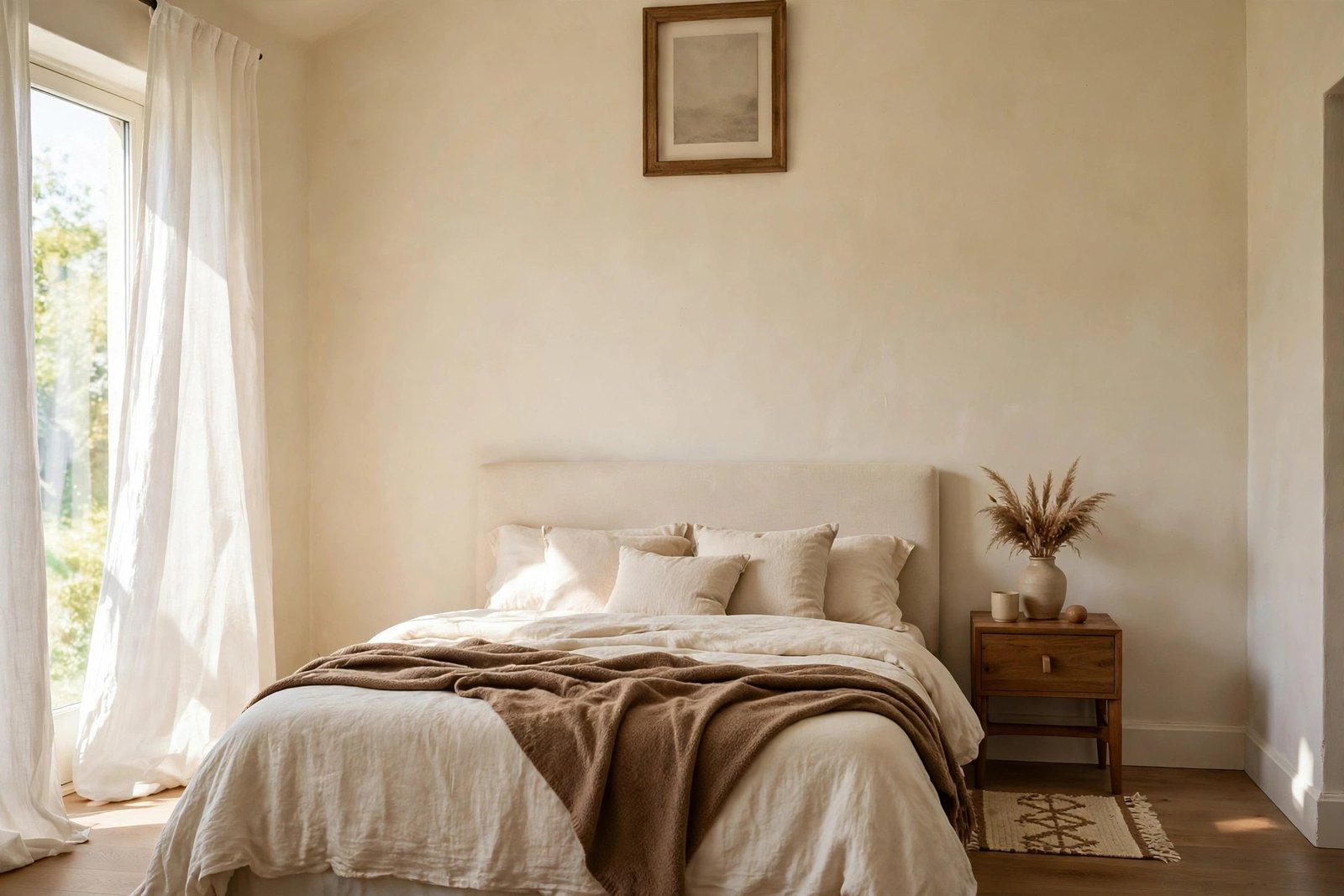
7. Colours With No Palette
The 10-second test: Name the colours in your photo. If you pass five or six strong colours and none of them repeats anywhere, the room has no palette — just pieces that each looked nice in the shop.
Why it feels wrong: Without a simple repeated palette, nothing connects. Every item competes for attention, and the room feels restless even when everything in it is good quality.
The headline fix: Choose three colours — one main, one supporting, one accent — mostly by editing, not buying. Move out the pieces that belong to no colour story, and repeat each of your three colours at least twice in the room.
8. The Room Has No Soft Layers
The 10-second test: Can you count the textiles in the room on one hand — hard floor, hard table, bare seats, no throw, no cushion mix, nothing soft but the sofa?
Why it feels wrong: Rooms are mostly hard surfaces, and hard surfaces feel cold, echo slightly, and read as “unfinished” no matter how good the furniture is.
The headline fix: Add the soft layer in this order: curtains (mistake 2), a rug your feet actually land on (mistake 1), cushions in two or three palette colours, and one folded throw. You need few — but in the right places.
The Fix Order: What to Do First
Do not try to fix all eight in one weekend; you will exhaust yourself and overspend. Use this order, from biggest visual impact to smallest:
- Placement first (free): pull furniture off the walls and group it properly; lower any too-high art. This changes the room’s whole geometry for $0.
- The big two anchors: sort the rug and the curtains — rehang, layer or reposition what you own before buying anything.
- The clutter edit (free): cluster, tray and remove. Keep out only what earns its place; store the rest in a rotation box.
- Light: add or move lamps; change bulbs to warm white.
- Colour and softness: edit down to a three-colour palette and fill the soft-layer gaps with textiles in those colours.
Stop after each step and live with it for a day or two. Steps 1 and 2 alone often remove the “something is wrong” feeling entirely.
Materials and Costs
- Tape measure and painter’s tape for testing positions — $3–$6
- Picture hooks and a small level for rehanging art — $4–$8
- Warm-white bulbs (2700–3000K) for existing lamps — $4–$8 for a pack
- One tray for grouping small items — $5–$12, or use a board or shallow basket you own
- A lidded box for the decor rotation — $3–$6
- One larger plain base rug, only if the layering fix is needed — $25–$60
Most rooms need only the first few items, and many need none.
Related Mistakes to Avoid
- Replacing everything at once. The “wrong” feeling comes from placement and proportion, not from your furniture. Buying a new sofa to fix a rug problem is the most expensive mistake on this page.
- Fixing in a random order. Choosing cushions before fixing placement and palette just means choosing them twice.
- Matching everything perfectly. A room where every item shares one style, wood tone and colour looks like a showroom, not a home. The palette connects pieces; it does not clone them.
- Overcorrecting into emptiness. Removing clutter does not mean removing character. Kept pieces — grouped, given space, in your palette — will finally be seen.
Frequently Asked Questions
How do I know which mistake my room has?
Take the doorway photo and test the eight items in order — most rooms have two or three, one usually clearly the worst. If the photo looks fine but the room still feels wrong in person, check mistake 6 (light) and mistake 8 (soft layers): those two are felt more than seen, so they hide from photos.
Can a room feel wrong if it follows all the “rules”?
Yes, briefly — rooms also feel wrong when brand new and unfamiliar, or when everything was bought at once so nothing has any contrast or history. The fix is time and small personal layers, not more shopping. If all eight checks pass, live in the room for a few weeks before changing anything.
Is it worth fixing these mistakes in a rented home?
Almost all of them, yes — placement, rug layering, the clutter edit, lamps, palette and textiles need no permission and leave no marks. Curtain rods and picture hooks may need landlord approval or removable hooks, and good options exist for both. Proportion fixes are a renter’s best friend: they cost nothing.
What if my room has all eight mistakes?
Then you are in a good position: the room improves noticeably at every step of the fix order. Start with placement and art height on day one (free, one hour) and work down the list one step per week. A room with eight small mistakes is far easier to rescue than a room with one big expensive problem.
1 thought on “Room Looks Finished but Feels Wrong: 8 Common Decor Mistakes and How to Fix Them”