
It is the most common window mistake in home decor, and most people never notice it in their own rooms: curtains hung with the rod fixed just above the window frame, panels that end a hand’s width above the floor — or worse, at the windowsill of a tall window. The curtains themselves may be lovely. The proportions are what let them down.
Low, short curtains shrink a window, cut the wall into awkward sections, and make the ceiling feel lower than it is. The encouraging part: this is one of the easiest mistakes in a home to fix. Sometimes it needs nothing more than moving a rod. Sometimes the curtains you already own can be rescued with a hem trick. This guide covers the rules first, then the fixes — including the ones for curtains that are already too short.
Quick Answer
Fix low or short curtains with three rules: hang the rod high, close to the ceiling (about 10–15 cm below it, or at least 15–20 cm above the window frame); let the curtains fall long, just touching the floor or ending 1–2 cm above it; and make them wide — the rod should extend 15–30 cm past each side of the window, with fabric about 1.5 to 2 times the rod width. If your current curtains end up too short at the correct height, let down the hem, add a band of fabric at the bottom, or move them to a smaller window and start again with the right length.
The Three Rules, With Real Numbers
Rule 1: Height — the rod goes near the ceiling
The rod’s job is to make the window look tall, and it can only do that from above. Fix it roughly 10–15 cm below the ceiling, or — in rooms with very high ceilings — at least 15–20 cm above the top of the window frame. Every centimetre of wall between the frame and the rod is wall the curtain will “borrow” to make the window appear larger. A rod fixed directly on top of the frame does the opposite: it advertises exactly how small the window is.
Rule 2: Length — curtains should meet the floor
For living rooms and bedrooms, the finished look is a curtain that just touches the floor (“kissing” it) or stops 1–2 cm above it so it hangs clean and is easy to sweep under. Curtains that end 10–20 cm above the floor read as a mistake — like trousers that are too short. Sill-length curtains belong on small kitchen and bathroom windows, not on a room’s main window. A slight puddle of extra fabric is a deliberate, soft style in some rooms, but a gap never is.
Rule 3: Width — wider than the window, fuller than you think
Extend the rod 15–30 cm beyond each side of the frame so the open curtains cover wall, not glass — the window looks bigger and loses less light. Then give the fabric room to fold: total curtain width should be about 1.5 to 2 times the length of the rod. One narrow panel stretched flat across a wide window looks mean and thin no matter how pretty the fabric is.
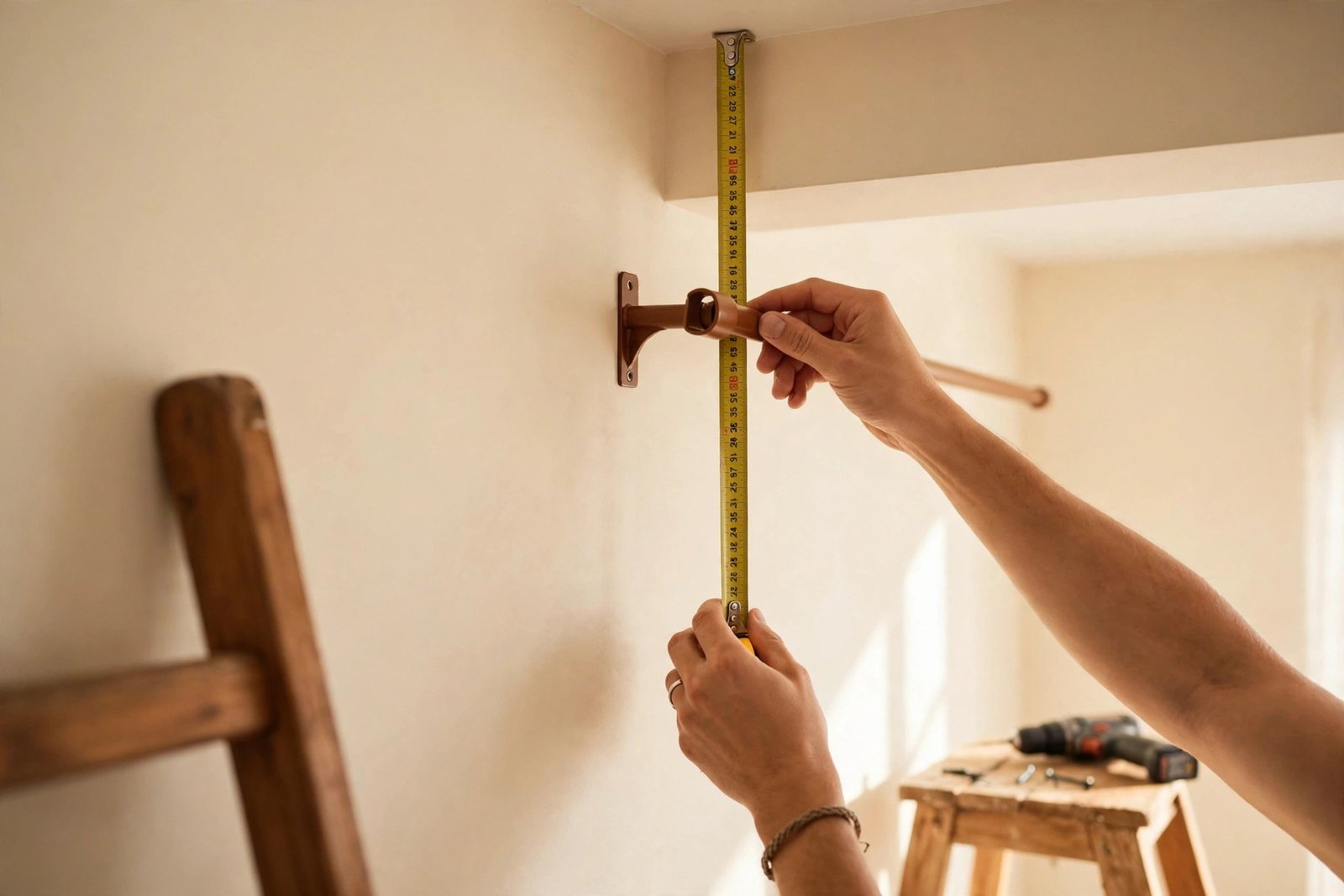
Step by Step: Measuring and Hanging It Right
- Decide the rod height. Measure from the floor to where the rod will sit — near the ceiling as per Rule 1. Mark both bracket points with a pencil and check they are level.
- Measure the drop. From the rod position, measure down to the floor. Subtract 1–2 cm for clearance. That number is the finished curtain length you need — measure it before you buy, hem, or move anything.
- Set the width. Window width plus 30–60 cm total gives the rod length; multiply by 1.5–2 for the fabric width you are aiming for.
- Fix the brackets into solid material — studs or proper wall plugs — because a wide, full curtain is heavier than it looks. Work from a stable step stool or ladder, keep three points of contact, and do not lean out sideways to reach a far bracket; move the stool instead.
- Hang, then judge from across the room. Curtains should be checked from the doorway, not from underneath. Steam or iron out packing creases — a correct curtain with creases still looks wrong.
Already Own Short Curtains? Five Rescue Fixes
Raising the rod to the right height often reveals the real problem: your existing curtains now end mid-wall. Before replacing them, try these in order:
- Let down the hem. Most curtains carry a hidden reserve of 5–10 cm in the bottom hem. Unpick it, press the fold flat, and re-hem at the longest possible length. This alone saves many pairs.
- Add a fabric band at the bottom. Sew or fuse a band of a second fabric — a plain stripe, a deeper shade of the curtain colour, or a simple linen-look strip — across the bottom. Done evenly on both panels, it looks like a design detail, and it can add 15–30 cm.
- Change how they hang. Clip rings add 3–5 cm of drop compared with a rod pocket, because the panel hangs from below the rod instead of around it. Sometimes that small difference is exactly enough.
- Move the pair to a smaller window. A too-short curtain for the living room is often the perfect length for a bedroom or landing window. Swap the rooms before you spend anything.
- Layer them. If the panels are also narrow, hang them as the decorative outer layer over a longer, plain sheer or blind that does the real covering. The eye reads the long layer; the pretty fabric is still on show.
If the fabric itself has faded or tired, combine the rescue with a refresh first — the no-sew methods for making tired curtains look new again cover washing, hemming tape and simple trims that pair well with these fixes.

Renter-Friendly Ways to Get the Height
You do not need to drill near the ceiling to follow the rules. Tension rods fitted inside the frame will not give extra height, but these options come close:
- No-drill curtain brackets that hook over the top of the window frame or clamp to it — they hold the rod above the frame with no holes.
- Adhesive or magnetic rod holders rated for curtain weight, used on smooth surfaces and tested with the lightest panels you own.
- A ceiling-track or rod fixed to existing picture rail, where older homes have one — the rail is already at the right height.
- Lightweight fabrics. If your fixing method is fragile, choose voile or linen-look panels instead of heavy lined curtains; height matters more than weight of fabric for the effect.
This mistake also appears as one of the eight in the overview of common decor mistakes that make a finished room feel wrong — if your curtains were one symptom among several, that checklist is worth five minutes after this fix.
Materials and Costs
- Curtain rod long enough for the wider fixing — $12–$30
- Wall plugs and screws suited to your wall — $3–$5
- Clip rings, one pack — $5–$9
- Fusible hemming tape for the no-sew hem or band — $3–$5
- A metre of plain fabric for a bottom band, if needed — $6–$12
- Tension or no-drill brackets for renters — $8–$18
- Tape measure, level, pencil, stable step stool — usually already at home
Related Mistakes to Avoid
- Raising the rod but keeping shy width. High and narrow still looks like a mistake. The effect needs height and width together.
- Choosing “just above the floor” by guessing. A 5 cm floating gap reads as an accident. Measure the drop from the actual rod position, with the actual rings or pocket the curtain will hang from.
- Hanging one panel per side on a wide window. Skimpy fabric stretched flat cannot fold, and folds are what make curtains look generous. Buy the fullness, or narrow the window treatment to a blind plus decorative side panels.
- Forgetting the creases. New or rehung curtains with sharp packaging folds look cheap at any height. Iron or steam them after hanging.
- Drilling into unknown walls without checking. Near-ceiling fixings can meet lintels, pipes or cables. Use a stud/pipe detector where you can, and proper plugs for the wall type you actually have.
More window, placement and proportion fixes live in the decor mistakes and how to fix them collection.
Frequently Asked Questions
How high exactly should the curtain rod be?
As a working rule: about 10–15 cm below the ceiling in a standard room. If the ceiling is very high (above about 3 metres), hang the rod roughly two-thirds to three-quarters of the way up the wall space above the window instead, so the curtains stay in proportion to the window rather than the room. What matters is that the rod sits clearly above the frame, with visible wall between the frame top and the rod.
My curtains are 15 cm too short and the hem is already down. What is the best fix?
The bottom fabric band — it is the only rescue that adds real length, and done in a calm contrasting fabric it looks intentional rather than repaired. Match the band’s width on both panels exactly, press it well, and repeat the band fabric somewhere small in the room (a cushion, a tieback) so it reads as part of the scheme.
Do curtains have to touch the floor in every room?
No. Floor length is the rule for main living spaces and bedrooms, where the long line does the decorating work. Kitchens, bathrooms and radiators under windows are honest exceptions — there, sill length or just-below-sill is practical and looks correct, because the reason for the shorter length is visible. What never looks right is an in-between length with no reason.
Can short curtains work anywhere?
Yes — cafe-style half curtains, small windows, and windows over furniture or radiators all carry shorter curtains well. The mistake is not short curtains themselves; it is short curtains on a tall main window, where the eye expects the full drop and reads the gap as an error.