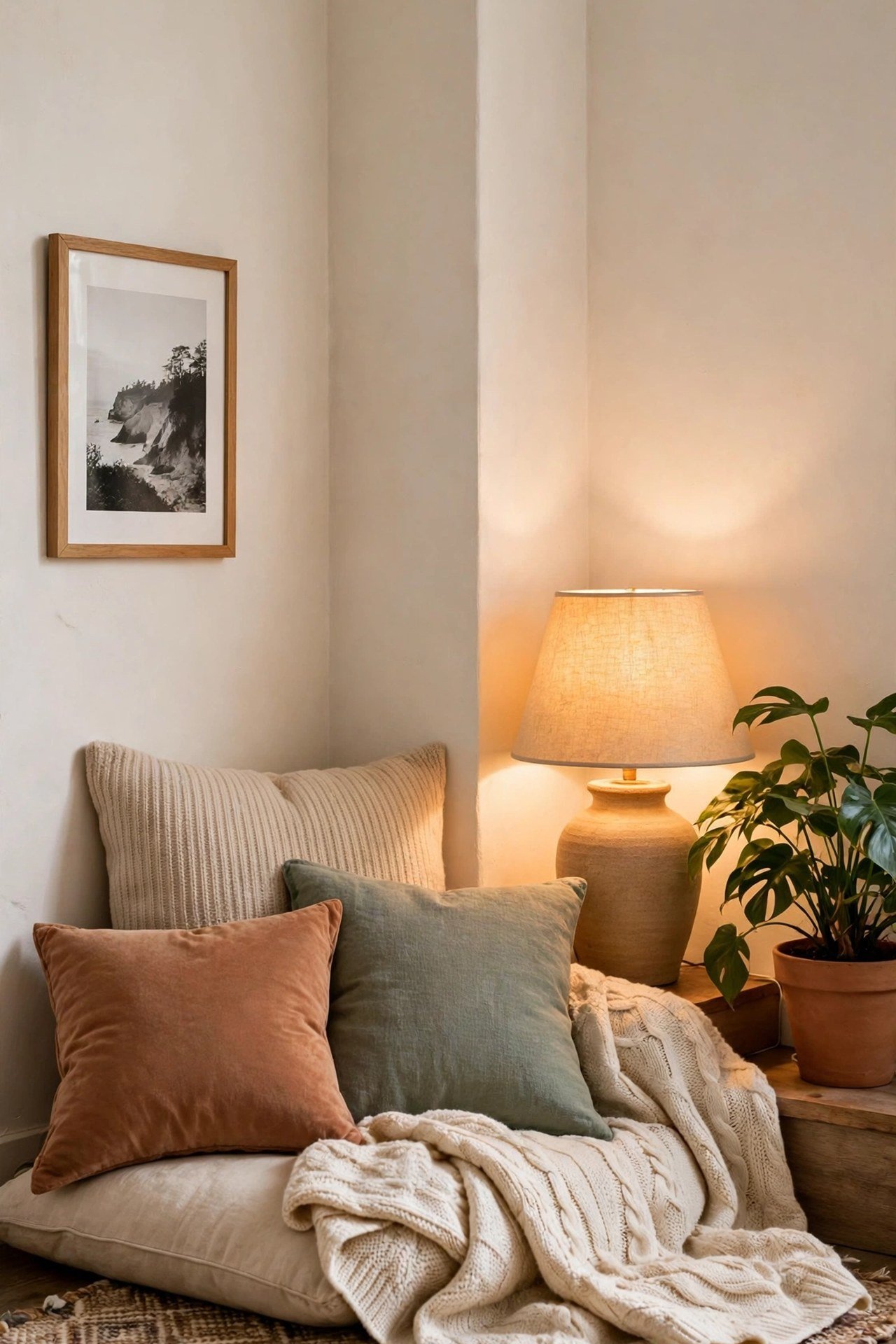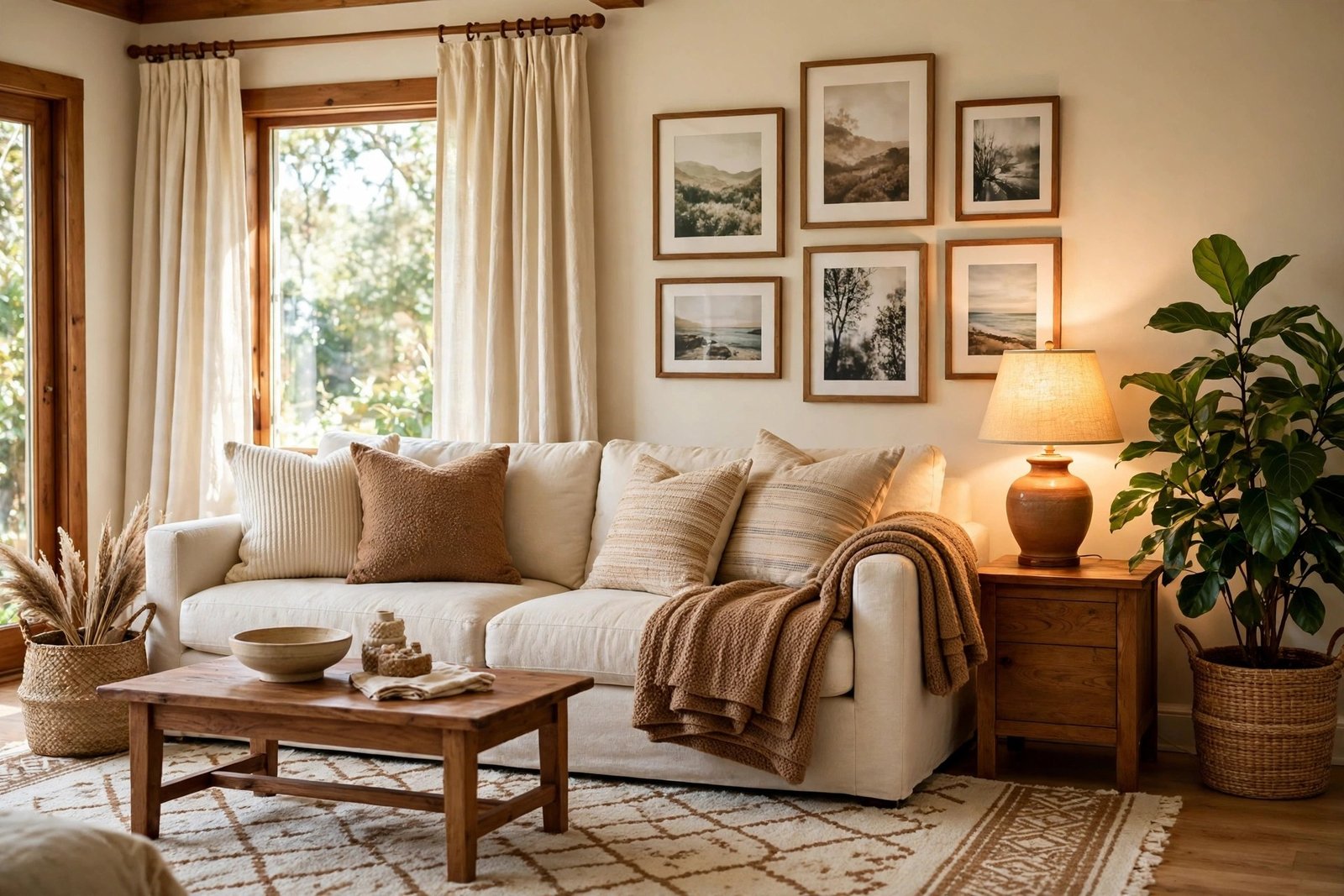
Some rooms have everything on the list: sofa, table, rug perhaps, a picture or two, a lamp. The furniture is good. Nothing clashes. And yet the room feels cold, slightly echoing, and permanently unfinished — like a showroom at closing time or a house nobody has quite moved into. If that is your room, the furniture is not the problem. The layers are missing.
A finished room is not built from furniture alone. Between the big pieces and the people who live there sits a set of soft, light and living layers that absorb sound, soften hard edges and give the eye small, warm details to rest on. Skip them, and even an expensive room feels bare. Add them in the right order, and the same furniture suddenly looks intentional. This guide audits the six layers one by one and gives you the order to add them on a budget.
Quick Answer
A room feels cold and unfinished when it is missing layers. The six layers of a complete room are: a floor layer (a rug that anchors the seating), a window layer (curtains hung long and wide), a textile layer (cushions and a throw), a light layer (lamps at more than one height), a green layer (at least one living plant), and a personal layer (books, photos, objects with a story). Audit each layer, find the ones that are absent, and add them one at a time in that order — most rooms turn warm after just two or three.
Why Bare Rooms Feel Cold: Hard Surfaces and Echo
Stand in an empty room and clap once. That slight ring or flutter is sound bouncing between hard, parallel surfaces — floor, walls, ceiling, tabletop, window glass. Everyday rooms are full of hard surfaces, and every hard surface reflects both sound and visual “temperature”: bare floors look cold, bare windows look stark, bare walls look flat.
Layers are simply soft, absorbent things placed between those surfaces. A rug interrupts the floor. Curtains cover glass and wall. Textiles break up the flat plane of a sofa. Each layer absorbs a little sound, softens a little glare, and adds a little visual warmth. That is why two rooms with identical furniture can feel completely different: one has the layers, the other is still an echoing box with furniture in it.
It is also why “buy nicer furniture” never fixes this problem. The coldness was never in the pieces. It is in the gaps between them.
The Six-Layer Audit
Walk into the room with this list and answer honestly for each layer: present, weak, or missing.
1. The floor layer: a rug that anchors
The rug should reach under the front legs of the seating so the group sits on it, not around it. Bare floor between the sofa and the chairs is the single biggest source of the cold, unfinished look. No rug at all — or one too small — counts as missing.
2. The window layer: curtains with presence
Windows are large, hard, reflective holes in the wall. Curtains hung close to the ceiling, wider than the frame and falling to the floor soften that whole wall. A bare window, a blind alone, or short thin curtains leave the layer weak.
3. The textile layer: cushions and a throw
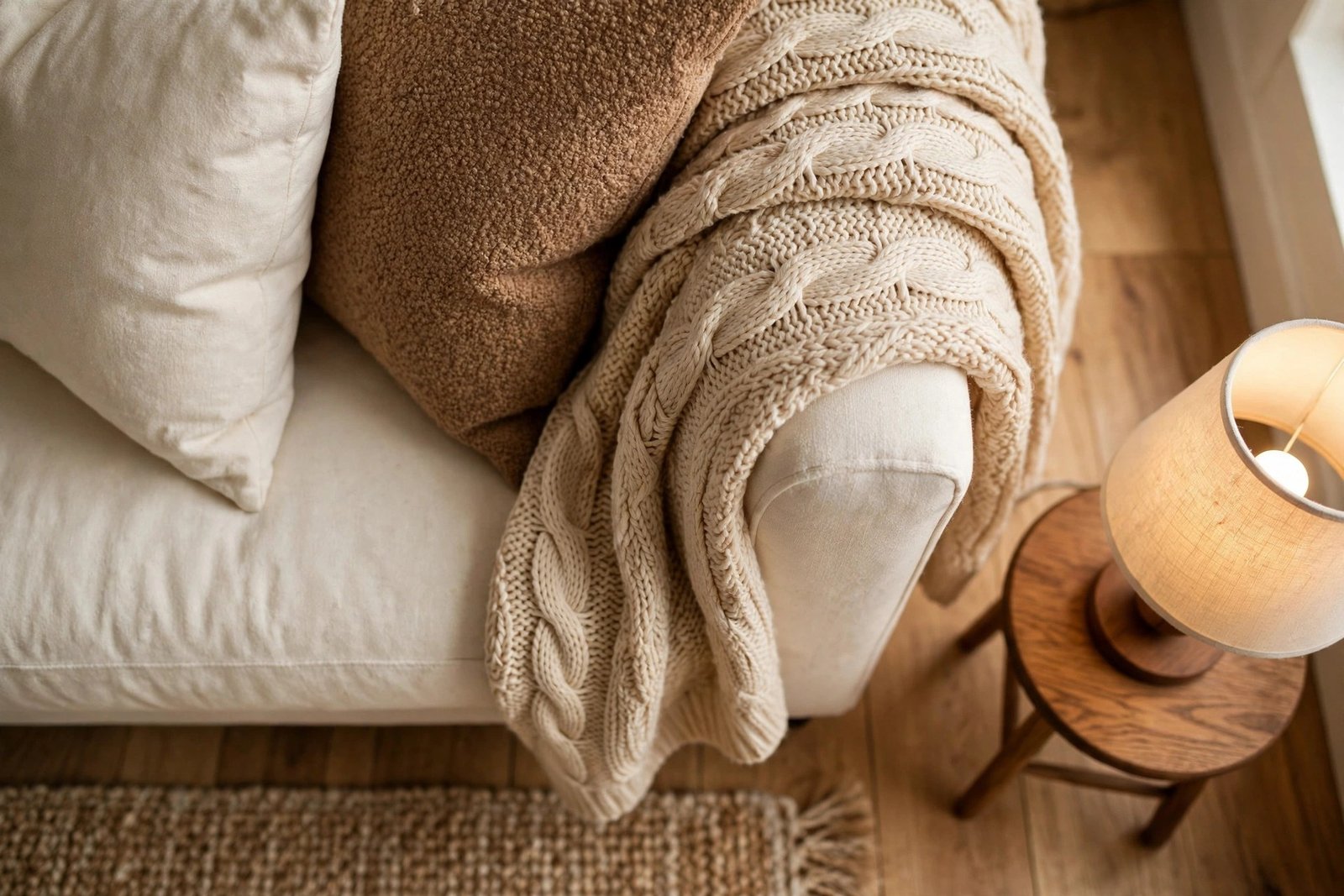
A sofa with no cushions reads as seating in a waiting area. Two or three cushions in the room’s colours plus one folded throw over an arm give the seating softness, colour repetition and the sense that someone actually sits there.
4. The light layer: lamps at heights
One ceiling light flattens everything it touches. A complete light layer has sources at different heights — a floor lamp, a table lamp, perhaps a small accent light — so the room glows in pools instead of glaring from above. If your only evening light is overhead, this layer is missing.
5. The green layer: something alive
One real plant changes the air of a room more than almost any object, because it is the only thing in it that is irregular, soft-edged and alive. A plant on the floor, a trailing plant on a shelf, herbs on a sill — one is enough to count; three, spread at different heights, is better.
6. The personal layer: your life, on purpose
Books you read, a photo that matters, an object from a trip, a handmade piece. This is the layer showrooms cannot copy, and its absence is why they feel cold. The key is placement, not quantity: a few chosen pieces, grouped and given space, not a crowd of small items spread everywhere.
Missing layers are one of the eight problems in the overview of why a finished room can still feel wrong — and often the last one solved, because each layer is small enough to overlook.
Step by Step: Adding the Layers on a Budget
- Fix the floor layer first. It has the largest surface area and the largest effect. If you own a rug that is too small, layer it over a larger plain base; if you own none, this is where the first money goes — a simple flatweave in a neutral tone beats a small beautiful rug.
- Dress the window. Raise and widen the curtain rod if you can, and let the curtains reach the floor. If new curtains are not in the budget, a longer pair moved from a less-used room counts — layers belong where you live most.
- Add textiles from what you own. Gather cushions and throws from the whole house and redistribute them. Most homes own this layer already; it is just spread across the wrong rooms.
- Build the light layer. Move lamps before buying them: one at seating height, one lower or higher for contrast, warm-white bulbs throughout. The full method is in the guide to fixing harsh lighting without an electrician.
- Add one plant, in the emptiest corner. Choose something forgiving, sized to the corner it will fill. A single healthy plant beats three struggling ones.
- Place the personal layer last, and place it — do not pile it. Choose a few pieces, group them on a tray or in one cluster per surface, and leave empty space around them. The difference between a layer and clutter is editing: the system in the guide to fixing a room cluttered with small decor items shows how to group pieces so they read as chosen, not stored.
Materials and Costs
- Large plain base rug for layering, if needed — $40–$90
- Curtain pair, linen-look, floor length — $20–$45
- Cushion covers to unify colours — $6–$15 each
- One throw — $10–$25, or moved from another room for $0
- One easy-care plant plus a simple pot — $10–$25
- Warm-white bulbs for existing lamps — $4–$8 a pack
- One tray for grouping the personal layer — $5–$12
Most rooms need only two or three lines from this list; redistribution usually covers the rest for free.
Related Mistakes to Avoid
- Adding all six layers in one shopping trip. Layers added at once look like a set, and sets look like showrooms. Add one layer, live with it, then add the next — the room should accumulate warmth, not receive it by delivery.
- Confusing layers with clutter. A layer is one soft, light or living element placed with intention. Ten small ornaments are not the textile layer. If a surface has no empty space left, you have piled, not layered.
- Matching every layer to one colour. Layers should repeat the room’s palette loosely, not form a uniform. A rug, cushions and curtains in identical fabric reads flat, however soft it is.
- Skipping the floor layer and compensating with small things. No number of cushions warms a room whose seating floats on bare boards. Big surfaces first, small touches after.
- Buying decor before checking the light. A room lit by one cold ceiling bulb will make every new layer look grey. Warm bulbs and a second lamp often “fix” layers you already owned.
Frequently Asked Questions
Which layer makes the biggest difference if I can only afford one?
The floor layer. A properly sized rug changes the sound of the room, the temperature of the floor underfoot and the way all the furniture groups together, all at once. If a rug is genuinely impossible, the window layer is next — long curtains soften the largest hard surface after the floor.
Can a room feel cold even with all six layers?
Briefly, yes — if the colours are all cool (greys, blue-whites, chrome) or the light is cold, warmth stays low. Swap bulb temperature first (2700–3000K), then warm one textile layer: cushions and a throw in a warm tone shift the whole palette for very little money.
How many layers does a small room need?
The same six, in smaller doses. A small room may take a thinner rug, one curtain pair, two cushions, two lamps, one plant and one tray of personal pieces. Small rooms actually feel unfinished faster than large ones, because every missing layer is a bigger fraction of what you see.
Is a “personal layer” just clutter with a nicer name?
No — the difference is selection and space. A personal layer is a few chosen pieces, grouped, with empty room around them, and it gets edited as your life changes. Clutter is everything you own, spread out, with nowhere chosen for any of it. If you cannot see the surface beneath the pieces, it is clutter.
Add the layers in order, one at a time, and stop after each to feel the difference. Most people find the room turns the corner at layer three or four — the point where the echo dies, the light softens, and the furniture finally looks like it belongs to someone.