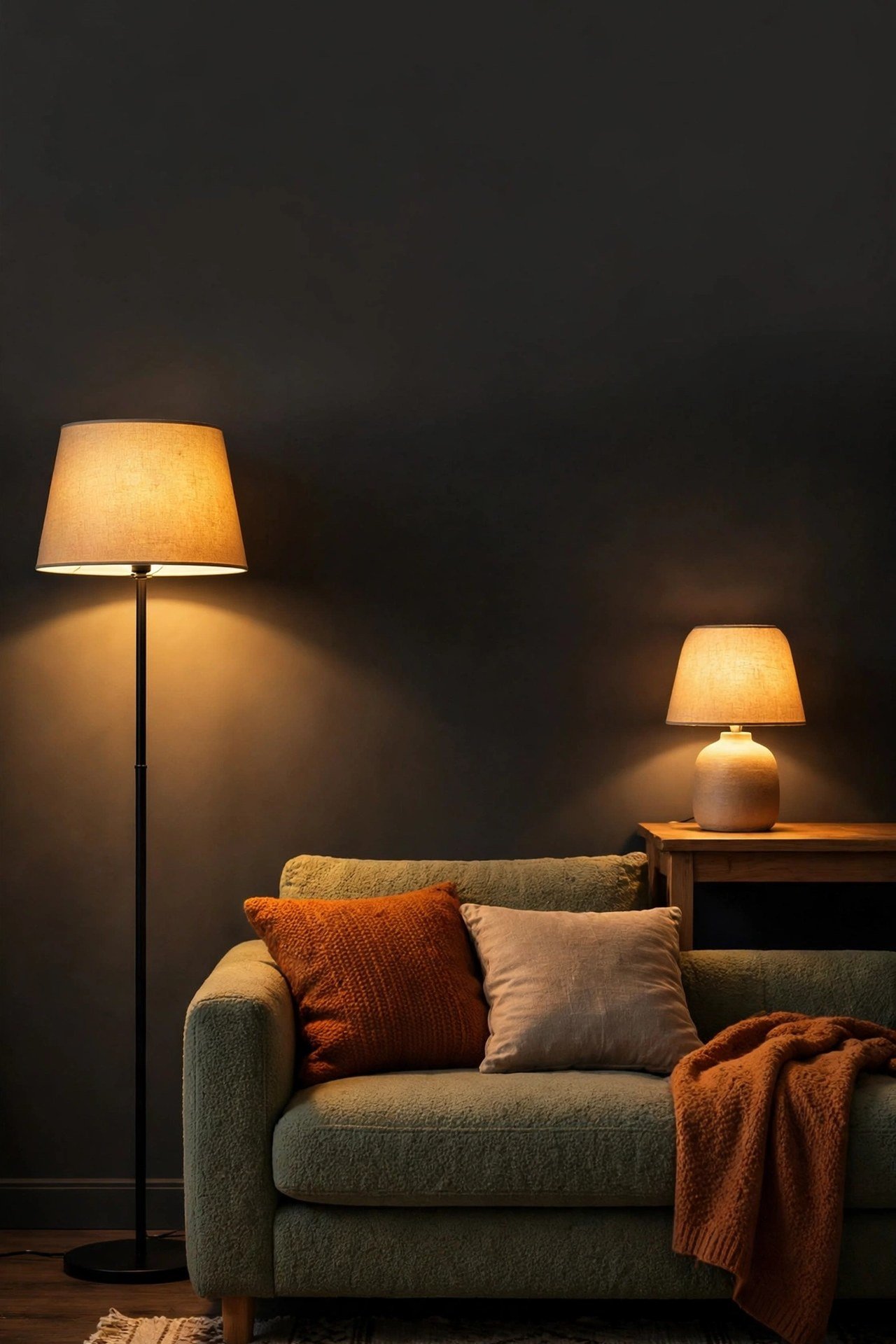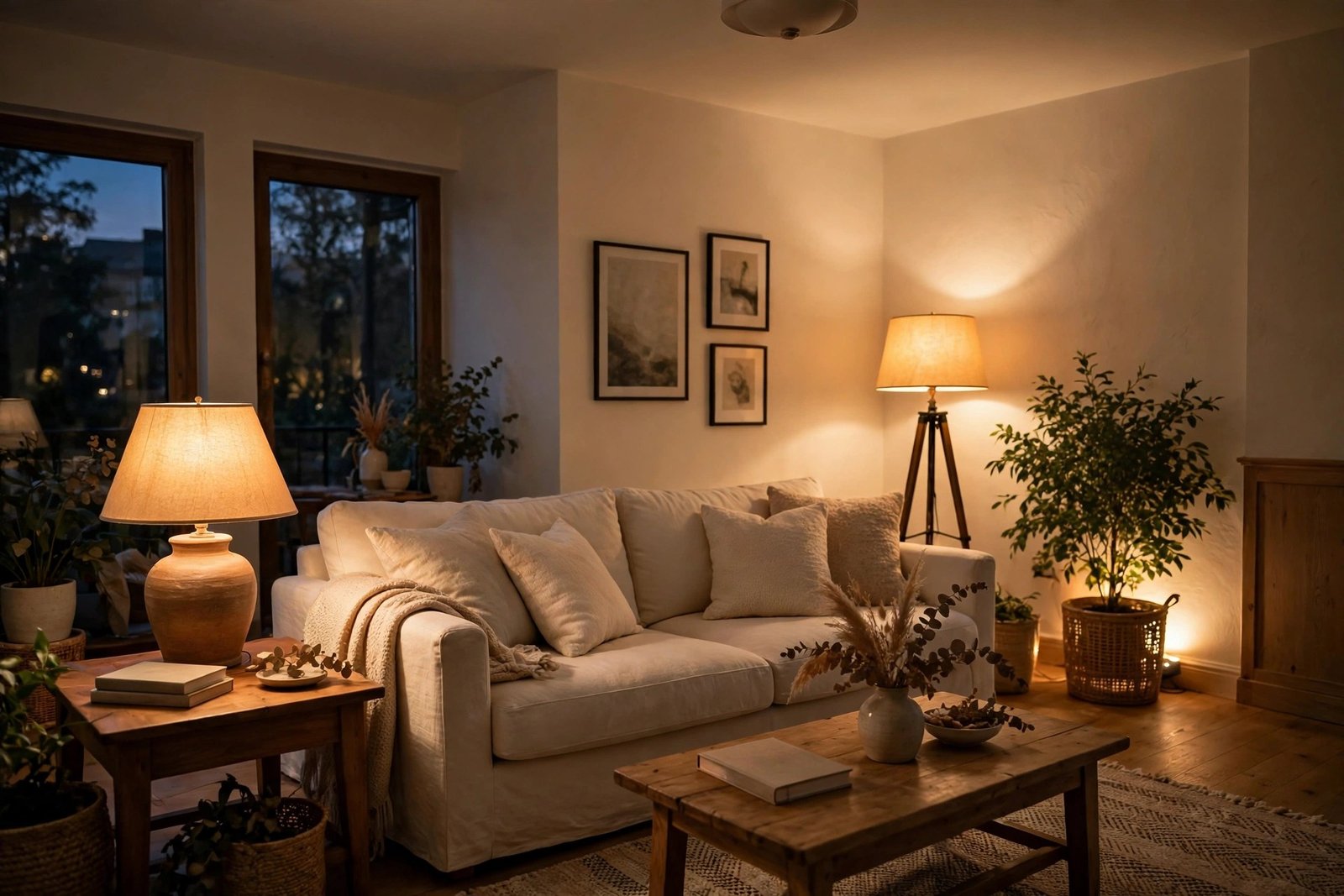
You can walk into a room in daylight and like it — then switch the light on at night and watch it turn cold, flat and faintly unfriendly. Faces look tired, colours turn grey or orange, and every corner seems to glare or sulk. Nothing about the furniture changed. The lighting did it.
Harsh light is one of the eight classic mistakes behind a room that feels wrong, and it is the one people most often assume needs an electrician to fix. It doesn’t. Almost everything that makes light feel warm and layered is decor-level work: bulbs, shades, lamps and where you put them. This guide covers the fixes in order, with one safety boundary stated up front and kept throughout.
Quick Answer
A room looks harsh when one bright ceiling light does all the work, especially with a cold “daylight” bulb. Fix it without an electrician by layering light instead: at least three light sources per room at different heights, all with warm-white bulbs (2700–3000K), shades that soften and direct the light, a plug-in dimmer or two, and one uplighter washing a dark corner. Everything in this guide is bulbs, shades and plug-in lamps only — anything that involves wiring, new sockets or the fuse box belongs to a qualified electrician.
Why One Ceiling Light Ruins a Room
Light from directly above flatters nothing
Overhead light casts shadows downward — under eyes, noses and chins — which is why everyone looks tired in a room lit only from the ceiling. It also leaves the walls, where your eyes actually rest, dimmer than the floor or the tabletop. Rooms feel kind when light comes from the sides, at face height, the way firelight and window light do.
The wrong bulb temperature reads as “office”
Bulbs labelled 4000K and above — “cool white” and “daylight” — are made for workshops and offices. At home they strip the warmth out of wood, cream paint and skin, and they make warm colours look muddy. Most “my room feels cold at night” complaints are a bulb problem that costs a few dollars to solve.
A single height flattens everything
When every lumen comes from one point at ceiling height, there are no pools of light, no glow on the wall, no difference between the reading chair and the corner nobody uses. Layered light is what tells your eyes where the room’s centres are. Without it, the room has no focus — the same complaint as a room with no focal point in daylight.
The Three Layers, in Plain Terms
Layer 1: Ambient — the soft general glow
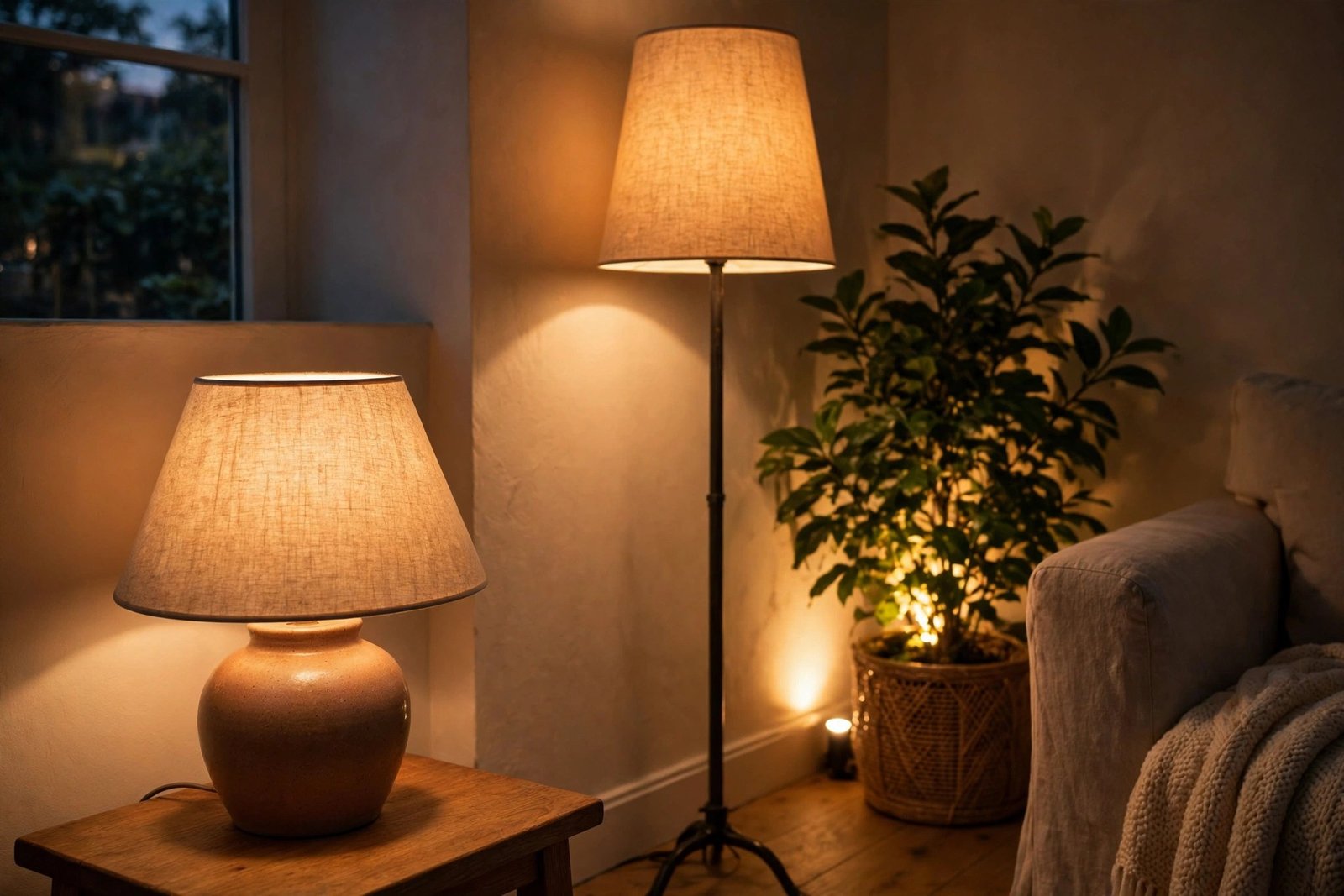
This is background light, and its job is to be gentle. The best decor-level ambient source is an uplighter: a lamp that throws light at the ceiling or high on a wall, where it bounces back soft and shadowless. A torchiere-style uplighter in a corner, or a shaded lamp behind a plant, gives the room its base glow without a single bare bulb in sight.
Layer 2: Task — light where you do things
Reading, sewing, working, chopping: each needs a focused light aimed at the job, at the right height. A reading lamp’s shade bottom should sit roughly at shoulder height when you are seated, so the bulb lights the page, not your eyes. A desk lamp angles down onto the work. Task light is where “the room is too dark” complaints usually live — and the answer is one lamp in the right chair, not a brighter ceiling.
Layer 3: Accent — the glow that makes it feel finished
Accent light has no job except atmosphere: a small lamp on a bookshelf, a picture light, a candle on the table, a soft source low in a corner. It is the layer most rooms skip entirely, and it is the cheapest one. Two or three low, warm points of light in the evening are what make a room photograph like the ones you save.
Step by Step: The Evening Light Audit
- Wait for dark, then stand in the doorway. Note every place your eye goes: it should land on pools of warm light, not on one glaring ceiling fitting or a bare bulb.
- Check every bulb’s temperature. Look for the Kelvin number on the bulb or its box. Replace anything above 3000K in living spaces with 2700–3000K warm white, and keep the temperature the same across the whole room — mixed temperatures are a top cause of “something feels off”.
- Turn the ceiling light off and build from the lamps up. Aim for at least three sources at three heights: one high (uplighter or tall floor lamp), one at table height, one low (shelf lamp, candle, small lamp near the floor).
- Fix shade direction. A shade that is open at the bottom sends light down onto a table or page (task). Open at the top, it washes the ceiling (ambient). Translucent fabric shades glow in all directions (accent). Swap or flip shades before buying new lamps — the same lamp can change jobs.
- Add one plug-in dimming option. A plug-in dimmer switch between the socket and a lamp, or dimmable smart bulbs you control from a phone, lets one lamp do evening-soft and cleaning-bright. No wiring involved — it plugs in like a charger.
- Kill the dark corners. One uplighter or a small lamp behind furniture in the darkest corner opens the whole room up; corners in shadow make rooms feel smaller and gloomier than they are — the same trick used for making a small, dark, boxy room feel lighter.
- Finish with candlelight, honestly. Real candles give the warmest flicker there is; keep them on a stable holder, away from curtains and fabrics, and never leave them burning unattended. LED candles with a warm tone give 90% of the effect with none of the worry, and can sit inside bookshelves where real flame never should.
Materials and Costs
- Warm-white LED bulbs, 2700–3000K — $4–$8 for a multi-pack
- Plug-in dimmer switch for a lamp — $10–$18
- Uplighter floor lamp for a corner — $15–$35
- Replacement fabric shades — $8–$20 each
- Small table or shelf lamp for accent light — $12–$30, or move one you own
- LED candles, set — $8–$15
Related Mistakes to Avoid
- Mixing bulb temperatures in one room. A warm lamp beside a cold ceiling bulb makes both look wrong. Change the whole room in one go.
- Asking one lamp to do every job. A single bright lamp in the corner is just the ceiling-light mistake at a lower height. Three modest sources always beat one strong one.
- Shades that are too small for the bulb. A bulb poking out below the shade creates glare exactly at eye level. The shade should hide the bulb from anyone seated nearby.
- All the light at one height. Three table lamps in a row still reads flat. Vary the heights — that variation is the layering.
- Trying to fix wiring yourself. Everything in this guide stops at the plug. Hardwired fittings, new sockets, dimmer switches on the wall and anything at the fuse box are a qualified electrician’s work — one call is cheaper than one mistake.
Harsh light is mistake six in the overview of why a finished room can still feel wrong, and it frequently travels with its neighbour on that list — seating arranged for the ceiling light’s sake rather than for people, covered in the guide to furniture pushed against every wall.
Frequently Asked Questions
What colour temperature is best for a living room?
2700–3000K, labelled “warm white”. It is the range of old incandescent bulbs and candlelit rooms, and it flatters wood, warm paint and skin. Save 4000K and above for a garage or workshop. Bedrooms often feel best at the warmer end, around 2700K.
How many lamps does a living room actually need?
At least three light sources at different heights, not counting the ceiling light — typically one ambient (uplighter or shaded floor lamp), one task lamp by the main reading seat, and one or two small accent lights. Most rooms that feel harsh have one or two; most rooms that feel calm have four or five modest ones.
Can I dim LED bulbs with a plug-in dimmer?
Only if the bulb is labelled dimmable — a non-dimmable LED on a dimmer may flicker, buzz or fail early. Check the bulb’s box first, or use dimmable smart bulbs that dim through their own control with no extra hardware. When in doubt, swap the bulb, not the plan.
My room has no spare sockets for more lamps. What can I do?
Work with what exists: put the warmest bulbs and best shades in the fittings you have, move one lamp from a less-used room, and use LED candles for accent glow where no socket exists. A single well-placed uplighter on an existing socket, with the ceiling light off, already transforms most rooms.