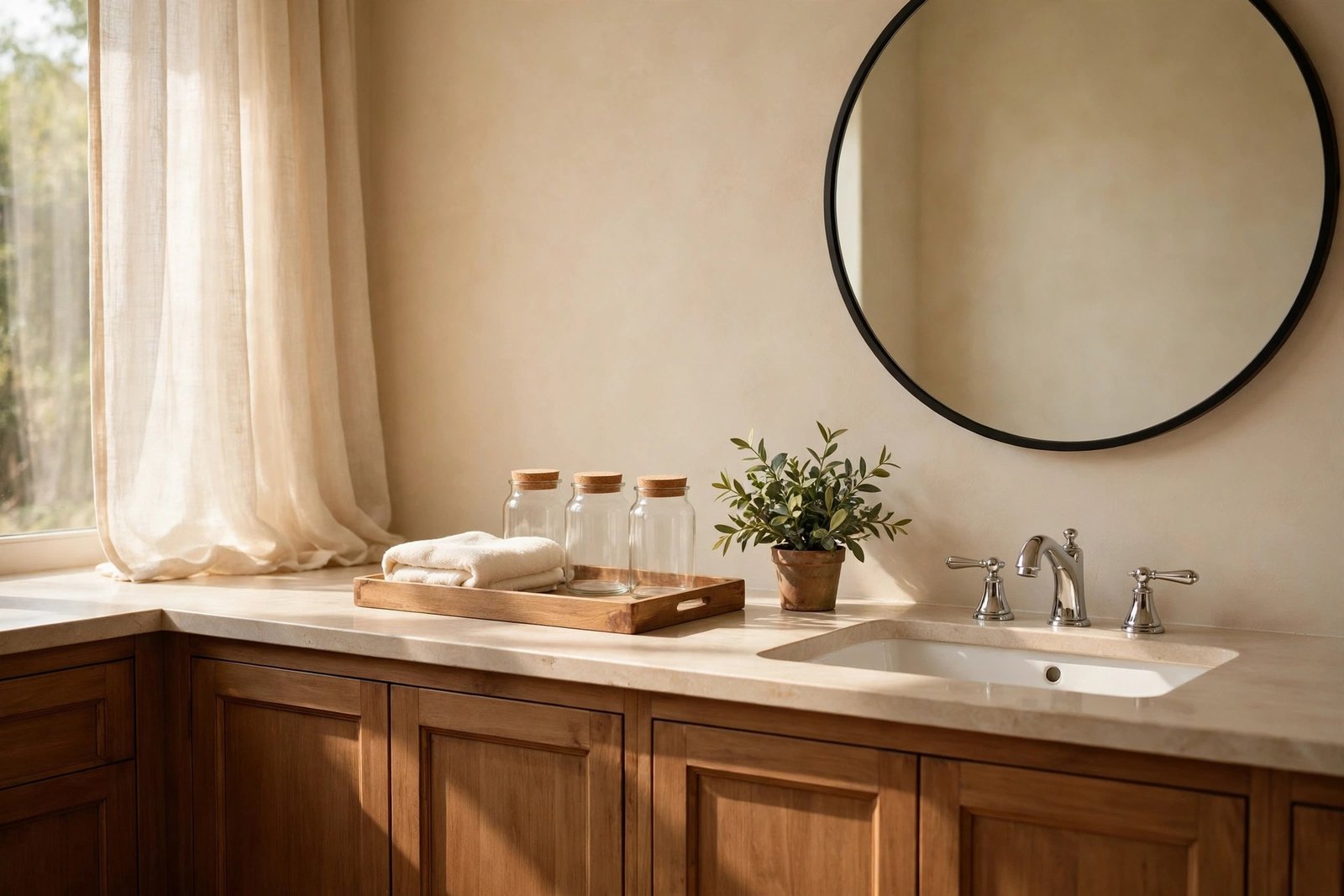
A bathroom counter is usually the smallest work surface in the home, and it is asked to hold the largest number of small things. Bottles, tubes, jars, brushes, cotton wool escaping its bag, a hair tool cooling wherever it landed — each item is small, but together they turn a few square feet into the most chaotic-looking spot in the house. Guests see it. You see it first thing every morning.
The fix is not more space, and it is definitely not hiding everything you use daily in a cupboard you will resent opening. The fix is containment with a styled finish: trays as the base unit, daily products decanted into matching jars, only one of each thing allowed out, and the backups given a closed home under the sink. Done in that order, the same products in the same bathroom look calm — and stay that way.
Quick Answer
A bathroom counter looks chaotic because dozens of different-shaped, different-labelled products stand loose on it, with backups and spares mixed in. Calm it down by giving everything a tray to live on — one tray per person or per job — decanting the daily basics (cotton pads, cotton buds, bath salts) into matching jars, keeping only one of each product out, and moving all spares and refills into closed storage under the sink or in a cupboard. Finish with one styled layer — a folded hand towel, a small plant — so the counter reads as a composed corner of the room, not a shelf of supplies.
Why Bathroom Counters Look Chaotic
Too many shapes, labels and colours
Skincare and bathroom products are designed to shout on a shop shelf: bright labels, five different bottle shapes, caps in six colours. In a shop that is marketing. On your counter it is visual noise — the eye cannot find a pattern, so the whole surface reads as mess even when every item is clean, capped and in use.
Backups are living with the dailies
The spare toothpaste, the second shampoo, the refill bottle, the nearly-empty one you are finishing — most counters hold two or three households’ worth of product because nothing has ever been assigned a different home. The daily counter should hold today’s products only; everything else is stock, and stock belongs in closed storage.
Nothing has a base, so everything spreads
Loose items drift. A bottle put down slightly differently each day ends the week spread across the whole counter, and wet rings and splashes collect around each one. Containment is not about tidiness habits — it is about giving items a physical boundary their hands can find without thinking.
Step 1: Trays Are the Base Unit
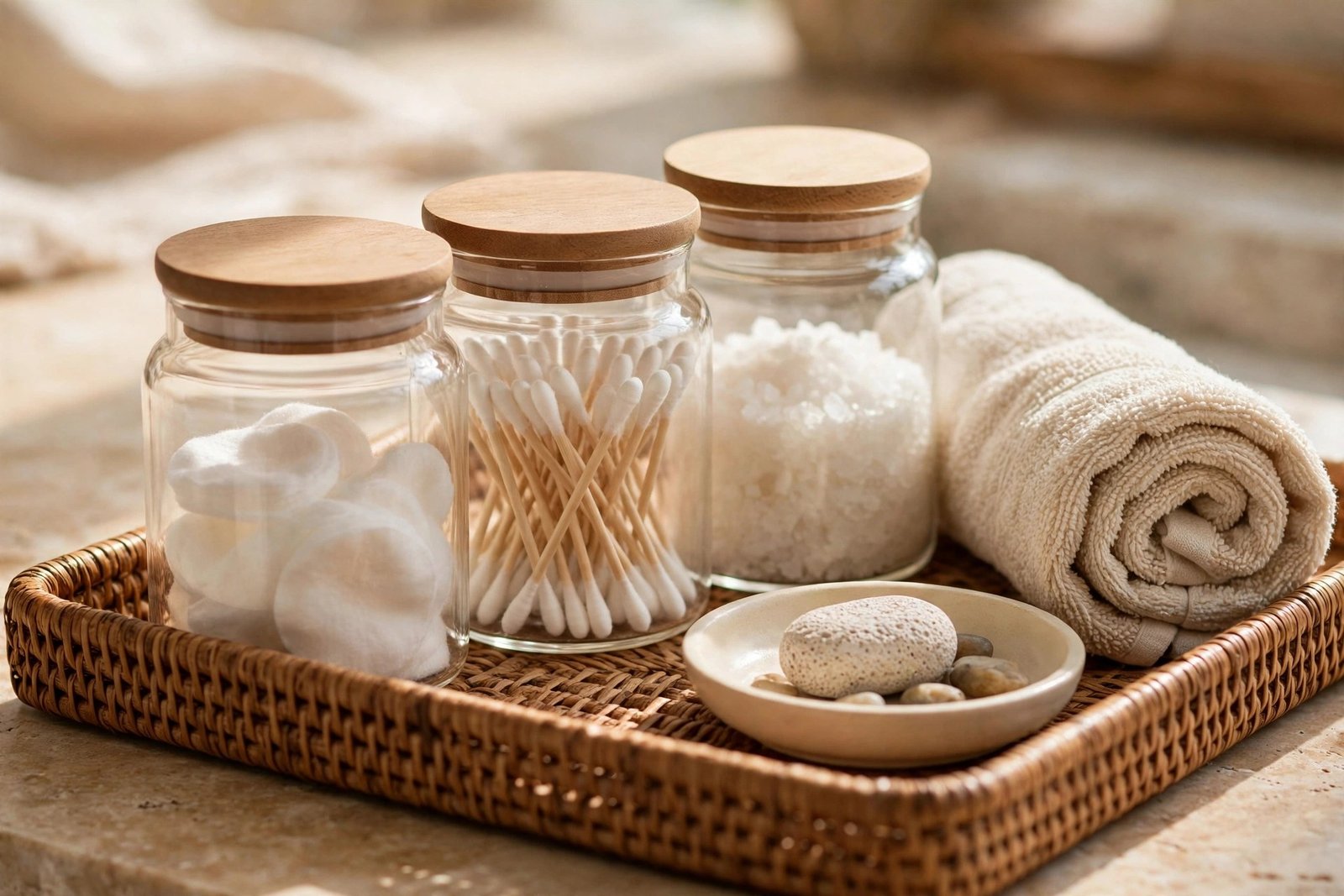
Every calm bathroom counter starts the same way: nothing stands directly on the counter. Everything stands on a tray.
- One tray per person in a shared bathroom, or one tray per job in a single one — face and teeth on one, hair on another. A tray turns six loose products into one group with an edge, and the edge is what the eye reads as “tidy.”
- The right tray matters: flat, wipeable, with a low lip, sized so products stand with a little room — a tray crammed edge to edge still looks chaotic; a tray at about two-thirds full looks styled.
- The cleaning bonus: a tray lifts off in one hand. The counter wipes clean in seconds, with no ring-by-ring excavation around twenty bottles. Systems that make cleaning easier are the systems that survive.
It is the same landing-spot logic that fixes the front door: the entryway guide on decor-friendly entryway storage gives keys one bowl and bags one hook each — one chosen home, within reach, that looks deliberate. The bathroom tray is that bowl, scaled up.
Step 2: Decant the Daily Basics Into Matching Jars
The products used in handfuls and pinches — cotton pads, cotton buds, cotton balls, bath salts, hair ties — arrive in the ugliest packaging of all: crinkly bags and shouty tubs. Decant them:
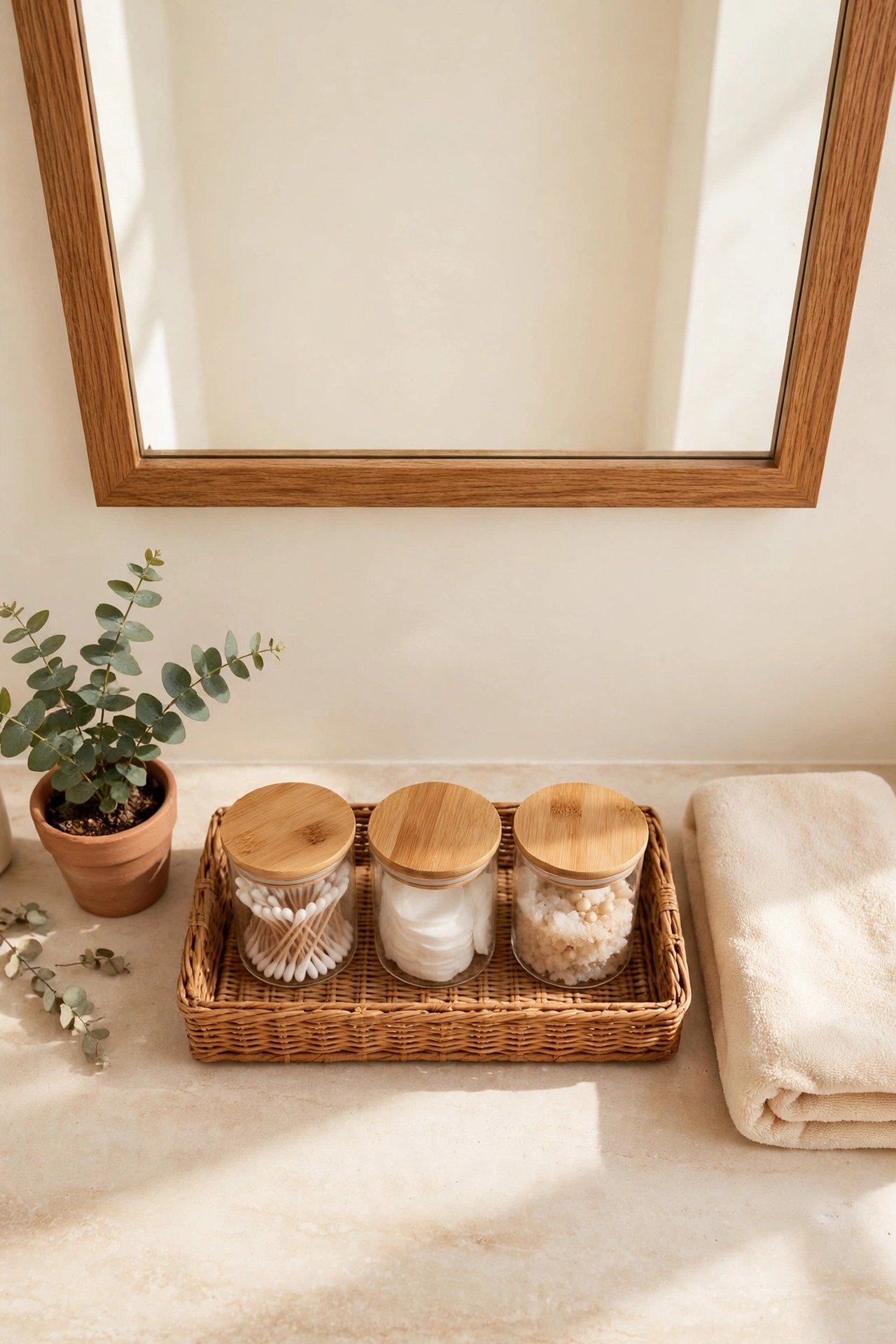
- Matching glass, ceramic or stone-look jars with lids, in one material and one size family. Three matching jars in a row read as a designed set — the single fastest visual upgrade a bathroom counter can get.
- Keep jars on the tray or grouped tightly beside it — jars dotted around the counter are just bottles with better manners.
- Decant only what you use weekly or more. Rarely used items do not earn jar space; they belong with the backups. And be sensible: keep medicines and anything children should not reach in their original, labelled, closed packaging in a cupboard — decanting is for the harmless daily basics only.
Step 3: One of Each, Out — Everything Else, Away
Walk the counter and enforce one rule: one shampoo, one toothpaste, one moisturiser — the one in use. Every spare, refill and “nearly finished” duplicate moves to the storage described below. Most chaotic counters lose a third of their items to this rule alone, and nothing about the morning routine changes. If you are also clearing the kitchen worktops, the audit habit is identical — the kitchen counter audit uses the same daily/weekly/rarely test, and the two rooms are usually worth doing in the same weekend.
Step 4: Under-Sink Storage, Closed and Sorted
The space under the sink is where backups go to be forgotten in a heap. Give it the minimum of structure:
- Two or three closed boxes or baskets — one for hair, one for refills and spares, one for cleaning. Closed, because under-sink space is dark and damp-adjacent, and closed boxes keep contents clean and the view calm when the door opens.
- A small riser or stacking shelf if the space is tall: bottles below, small boxes above, nothing balanced on anything else.
- Work around the pipes with narrow boxes rather than one wide one that fits nothing. Measure the actual gaps before buying anything.
Step 5: The Styled Finish
With the chaos contained, add the layer that makes the counter read as decor rather than as storage:
- A folded hand towel in the room’s accent colour, on a hook or folded over a small rail beside the sink — softness, colour repetition, and it is the towel you actually use.
- One small plant that tolerates humidity — a trailing pothos on a shelf edge or a small fern — placed where it will not sit in standing water.
- One calm object: a candle in a glass holder, a small framed print leaned against the wall (away from splash range), or a smooth stone dish for rings. One, not three — the finish is a whisper, not another crowd.
For more rooms given the same treatment — everyday storage dressed as decor — browse the home organisation with decor collection.
A Note on Bathroom-Safe Materials
Bathrooms are wet rooms, and some pretty materials fail in them. Untreated wood trays and boxes that sit in splashes will stay damp, swell and mark — if you love the wood look, keep it on the dry side of the counter or choose sealed, bathroom-rated pieces. Stone, ceramic, glass and metal trays shrug off water and wipe clean, which is why they anchor most calm counters. Fabric baskets belong in the dry zone or under the sink, not beside the tap. None of this needs to cost more — it just needs choosing once, with the splashes in mind.
Materials and Costs
- Counter tray, stone/ceramic/metal, one per person or zone — $8–$18 each
- Matching lidded jars, set of 3 — $10–$20
- Closed under-sink boxes or baskets, 2–3 — $6–$12 each
- Small under-sink riser/stack shelf — $8–$16
- Hand towel in the room’s accent colour — $5–$10
- Small humidity-tolerant plant and pot — $6–$14
- Glass candle holder or ring dish for the finishing layer — $4–$10
Mistakes to Avoid
- A tray so big it becomes the counter. If the tray covers the whole surface and holds twenty items, you have built a clutter tray, not a system. Trays should group one job’s worth of products, with visible counter around them.
- Decanting everything. Jars are for the handful-of-daily basics. Decanting medicines, treatments and rarely used products removes labels you need and earns nothing visually. Those stay packaged, in the cupboard.
- Pretty but water-damaged materials. An untreated wooden tray under daily splashes will look worse within a month than the bottles did. Match the material to the wet zone it will live in.
- Backups creeping back. The spare shampoo returns to the counter “just for now” and the chaos rebuilds. Refills live in the under-sink box; when one runs out, the replacement’s ceremony is walking two steps.
- Skipping the finish — or overdoing it. A counter of only trays and jars can read as a chemist’s shelf; a counter buried under plants and ornaments is chaos in a new costume. One towel, one plant, one calm object is the whole recipe.
Frequently Asked Questions
What if my bathroom has almost no counter — just a sink?
Then the tray goes vertical: a slim wall shelf above the sink holding one small tray or the jar set, or a narrow over-tap shelf that bridges the sink’s back edge. The rules do not change — one group, one of each, backups closed away — only the surface does. A mirror-front cabinet, if you have one, is the ideal home for the daily group.
We share one bathroom between several people. How do trays work then?
One slim tray per person, in the same material, lined along the counter or on a shelf — identical trays keep it looking designed rather than divided. Each person keeps only their in-use products on their tray; shared items (soap, hand towel) get one spot by the sink. It also ends the morning argument about whose bottle is whose.
Do matching jars really make that much difference?
Yes — they are usually the single biggest visual change per dollar. Three identical jars replace a crinkly bag, a bright tub and a cardboard box: three competing labels and shapes become one calm row. The contents are the same; the eye reads pattern instead of noise.
How do I stop it sliding back into chaos?
Two habits: the tray rule (if it does not fit on the tray, it does not live on the counter) and a monthly two-minute sweep when you clean the bathroom — duplicates back to the under-sink box, empties out. Because the trays lift off, the sweep happens during normal cleaning, not as a separate project.